

HACKENSACK, N.J. — The first time the jury read a not-guilty verdict, they called it a fluke.
It was February 1983, and Hudson County, N.J., Prosecutor Harold Ruvoldt was on trial for extortion and bribery. The prosecutor was a seasoned attorney and the judge had a pro-government reputation.
Due to some scheduling conflicts, the case fell into the lap of Ted Wells, a young appellate attorney who had never tried a case. Courtroom spectators fully expected a bloodbath.
Instead, the case was the first in a string of victories for Wells, who has become one of the top white-collar-criminal-defense lawyers in the nation.
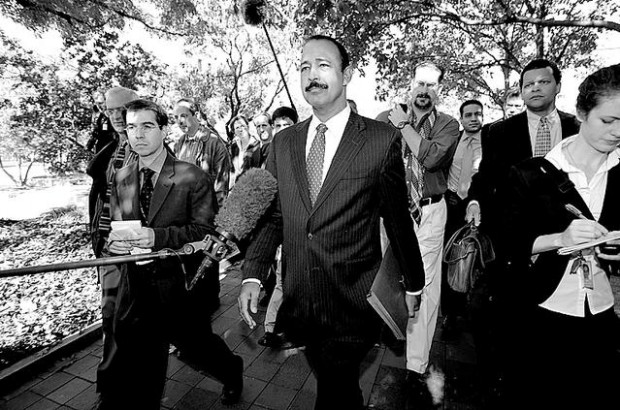
Two months ago, after decades of defending politicians, big tobacco and the oil industry, Wells, 55, took his highest-profile and most polarizing case yet: representing I. Lewis "Scooter" Libby, Vice President Dick Cheney's former chief of staff, who is charged in the Val-erie Plame CIA leak case.
People are also reading…
On its face, the decision to hire Wells might seem strange.
Wells, a black man raised in a working-class Washington, D.C., neighborhood, has deep ties to New Jersey Democrats. He campaigned tirelessly for Sen. Bill Bradley and Rep. Donald Payne, New Jersey's first black congressman. He has thrown fund-raisers at his New Jersey home and poured thousands of dollars into the war chests of local and national Democrats.
In the courtroom, his clients have skewed Democratic as well. In the late 1990s, he won an acquittal for Mike Espy, the agriculture secretary in the Clinton administration accused of corruption.
Yet those who have worked with Wells and know him best say Libby's decision to hire Wells is remarkably savvy.
"Fundamentally, I wasn't surprised because he's one of the one-tenth of 1 percent of the top lawyers in this country," said Bradley.
Theodore V. Wells Jr. was born in April 1950. His parents separated when he was young, and Wells was raised mostly by his mother, who worked in the Navy's mailroom for 35 years.
He entered College of the Holy Cross in Worcester, Mass., on a football scholarship in 1968, but quit playing after a year to concentrate on black causes and his academics. During his senior year, he married his high school sweetheart, Nina Mitchell.
Holy Cross-Harvard ties
After graduation, he headed to Harvard University and in 1976 received a joint law and business degree. He landed a job in New Jersey, a state where he had no ties, clerking for Judge John Gibbons on the 3rd U.S. Circuit Court of Appeals. Like Wells, Gibbons was a Holy Cross-Harvard alumnus.
When his clerkship ended, Wells drove across the country for a job in California. He quit after a day and called Gibbons, who persuaded him to come back to New Jersey and work with a friend at Lowenstein Sandler in Roseland.
It was the beginning of a 22-year career in New Jersey during which Wells built an impeccable reputation as a lawyer who sequestered himself in intense preparation, captivated juries and handily defeated several independent prosecutors. Wells declined through a spokesman to be interviewed for this article.
"I grew to see a good deal of intelligence, passion and commitment to hard work and thoroughness in Ted that he eventually demonstrated," said Ruvoldt, Wells' first client.
That 1983 victory shocked the more experienced lawyers on the federal bar, who never thought Wells stood a chance, said longtime friend and colleague Jack Arsenault.
"I think a lot of people were jealous because it was such an enormous win. They started to pooh-pooh his performance and said it was luck and it wasn't skill," Arsenault said.
Wells' star continued its rapid ascent, and in 1987 he took his first high-profile case, defending Raymond J. Donovan, secretary of labor under President Ronald Reagan, and others against fraud charges.
After a months-long prosecution, Wells decided not to put on any witnesses for the defense — a technique he has repeatedly used — and the jury acquitted on 137 counts. Wells wept as the foreman repeated "not guilty" more than 100 times, said Bob Krakower, who partnered with him on the case.
It's that passion that makes Wells such a convincing voice to juries, lawyers say. Wells is known for checking into a hotel during trial so he can meticulously prepare. When Wells speaks to a jury, Arsenault said, he does not use notes and has a "down-home style."
"I think I'm very lucky," Wells told The American Lawyer in June 1990. "I'm doing what I really love to do, which is solve people's problems. That's what I think I do pretty well."


