

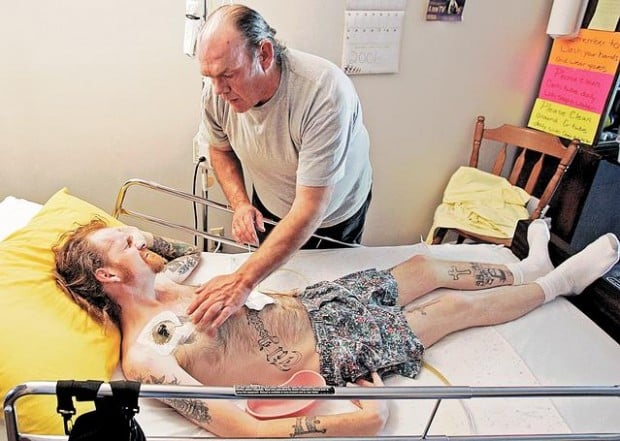
CAPE GIRARDEAU, Mo. — Wide-eyed and appearing catatonic, Shawn Bridges couldn't muster any talk from his hospital bed, his gaunt, tattooed body wracked by years of abusing the powerfully addictive witch's brew of chemicals that is methamphetamine.
The footage from the documentary the 34-year-old trucker commissioned about his slow, agonizing decline does the talking for him. And he hopes the 29-minute film, shot by a southern Illinois television videographer, speaks volumes to children and others headed down a similar path to drug addiction.
By his family's account, Bridges already died twice, his heart so ravaged by meth over the years that it stopped and had to be shocked back into beating. "The bottom half of his heart is dead," his dad laments on camera.
As the documentary "No More Sunsets" shows, Bridges' life now isn't much. Largely bedridden, his constant companions are the catheter that funnels the urine out of his body and the feeding tube sticking from his stomach.
People are also reading…
When he does speak, it's in guttural slurs. "Ahmmmmmmm collllllllllllllllllllllld," Shawn, dressed in boxer shorts and sweat socks, said recently from a hospital-style bed wedged into his father's living room. His dad hustled to blanket him.
"I'd say he's got a 34-year-old body on the outside with 70- to 80-year-old man on the inside," Jack Bridges says of his son. "You see what meth has done to my son and what my son has let it do to him.
"If the documentary helps just one person stay away from this terrible poison, it's worth it."
Bridges prays his son's story sways the young, including the 12 million people ages 12 and older the U.S. Department of Health and Human Services says reported in a 2002 national survey that they had used meth at least once in their lifetime.
According to federal estimates, roughly 28,000 people sought treatment for meth addiction across the country in 1993, accounting for nearly 2 percent of admissions for drug-abuse care. But just a decade later, the meth-related admissions numbered nearly 136,000 — more than 7 percent of the national total.
The man who shot and narrates the film calls it a cautionary tale. "He's dying because of the decisions he's made," Chip Rossetti. "Long ago, he chose to give in to temptation. Long ago, he chose a life of drugs. But he wasn't always that way."
Parents' leniency backfired
Bridges' story is one of tragedy and torment.
Family members say he forever was haunted by the dreary day in 1976 when younger brother Jason, barely a year old, died in a car wreck. Shawn was just 4 and nowhere near the wreck but inexplicably blamed himself, wanting to trade places with his dead sibling, his father says.
Bridges' parents were lenient with Shawn, convinced their "wishy-washy" disciplining would ease the grieving, his father says. It backfired.
"We didn't realize we were making a little monster of him," Jack Bridges says.
By 16, Shawn was a high school dropout, a partier with little regard for authority. He struggled accepting his parents' divorce in 1996 and drifted in and out of his own relationships. Between two failed marriages and a girlfriend, he fathered three daughters.
Jack Bridges insists he didn't suspect his son was doing drugs; if the boy was using, he artfully hid it. But Jonathan Bridges says in the documentary that he witnessed his brother's addiction and how it tormented him.
At 26, Shawn had a heart attack his father blames on meth, a concoction that can include such toxic chemicals as battery acid, drain cleaner and fertilizer. When pressed by his dad, Shawn admitted using the drug.
Several years ago, Shawn sought redemption from Buddy Walls, the former southern Illinois pastor to Shawn's grandparents. He told Walls of his struggles with drugs, talked of wanting to get clean from a drug he said made him feel bulletproof.
Congestive heart failure
Soon after that, what Shawn thought was pneumonia was diagnosed as congestive heart failure, his heart enlarged two or three times its normal size. Shawn insisted to relatives he had quit using meth, famous for fatally damaging a chronic user's heart and other internal organs because it puts the body in overdrive for long periods.
A little more than a year ago, Shawn was spitting up blood. When his heart quit, doctors brought him back. His epiphany came months later, when he told Walls he'd like to find someone to videotape him going through his "nightmare, so the kids can see the pain I'm feeling."
"'I know I'm dying,'" Walls recalls Bridges saying. "But he had a real desire to live to get his story out. "
Walls eventually contacted Rossetti, a videographer for WSIL-TV in Carterville, Ill. To Rossetti, the project wasn't "about just what drugs did to this guy. This is about what drugs did to his entire family and everyone he knows."
For now, the documentary _ available for $20 from the Web site of Rossetti's production company — closes on the note that Shawn's fate is "yet to be determined." If he dies, that signoff will be updated.
"You see what meth has done to my son and what my son has let it do to him."
Jack Bridges
Meth abuser's father


