

WASHINGTON — The nation honored Gerald R. Ford in funeral ceremonies Saturday that recalled the touchstones of his life, from combat in the Pacific to a career he cherished in Congress to a presidency he did not seek. He was remembered as the man called to heal the country from the trauma of Watergate.
Ford's decision to pardon Richard Nixon, so divisive at the time that it probably cost him the 1976 election, was dealt with squarely in his funeral services by his old chief of staff, Vice President Dick Cheney.
"No healing without pardon"
"It was this man, Gerald R. Ford, who led our republic safely though a crisis that could have turned to catastrophe," said Cheney, speaking in the Capitol Rotunda where Ford's body rested. "Gerald Ford was almost alone in understanding that there can be no healing without pardon."
People are also reading…
Hundreds of ordinary Americans lined up outside the Capitol for a chance to view the closed, flag-draped casket of the 38th president late into the night and through the weekend. The Washington portion of Ford's state funeral opened with a procession that took his casket from Maryland to Virginia and then over the Memorial Bridge — dressed in flags and funeral bunting — to the World War II memorial, past the White House without pausing and on to the U.S. Capitol for the first service and a lying in state that continues until Tuesday morning.
Although Ford's family planned the state funeral to emphasize Ford's long service in the House, Watergate quickly set the tone of the proceedings.
"In our nation's darkest hour, Gerald Ford lived his finest moment," said Republican Sen. Ted Stevens of Alaska told the Rotunda service. "He was the man the hour required."
Said House Speaker Dennis Hastert: "In 1974 America didn't need a philosopher-king or a warrior-prince. We needed a healer, we needed a rock, we needed honesty and candor and courage. We needed Gerald Ford."
The Rotunda ceremony was interrupted when William Broomfield, 84, a former Michigan congressman who served with Ford in Congress, collapsed. He was laid out on the floor of the Rotunda, and attended to by Sen. Bill Frist, a physician, before being taken out on a wheelchair. Frist later indicated Broomfield was OK.
Naval service in WWII
Lights bathed the granite arch of the memorial commemorating the Pacific theater as Ford's nighttime funeral procession, bearing his wife, Betty, and the casket of the 38th president, stopped there in tribute to his years as an ensign and gunnery officer. The other arch, representing the Atlantic theater, stood in darkness.
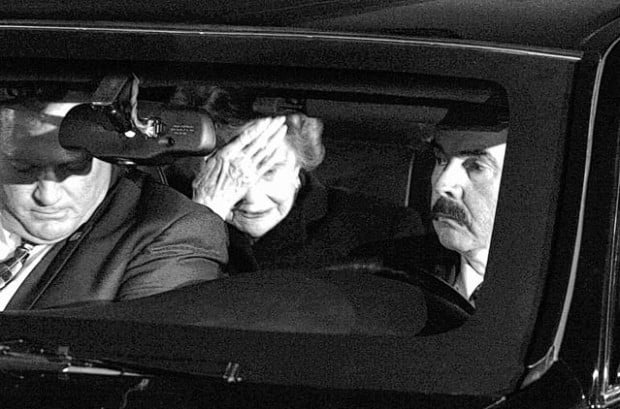
Mrs. Ford sat stoically in the line of gleaming limousines, clutching a tissue and dabbing her face on occasion, then walked slowly at the Capitol in the arm of her military escort, soon followed by the casket bearing her husband of 58 years. Another round of cannon fire rang out.
After the ceremony, Mrs. Ford walked to the casket with the aid of her son and rested her clasped hands briefly on top of it.
The pageantry was muted, as Ford wanted, but the ritual unfolded with regal touches and according to exacting traditions dating to the mid-1800s.
In one departure from tradition, pallbearers placed his casket outside the House chamber before it was taken to the Rotuna to lie in state. That honored Ford's years of service in the House as a congressman from Michigan and minority leader.
Similarly, Ford's body will rest briefly outside the Senate chamber on Tuesday, commemorating his service as vice president, which also made him Senate president.


