

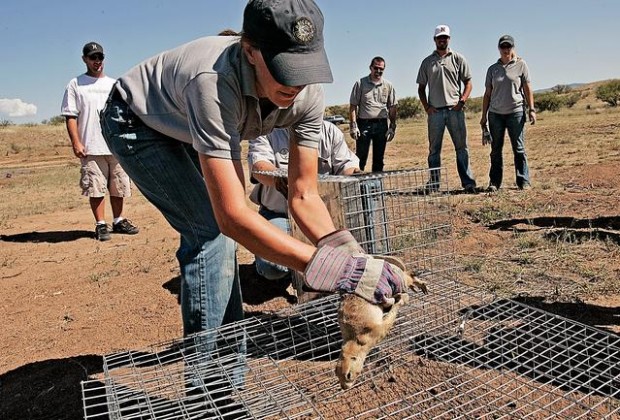
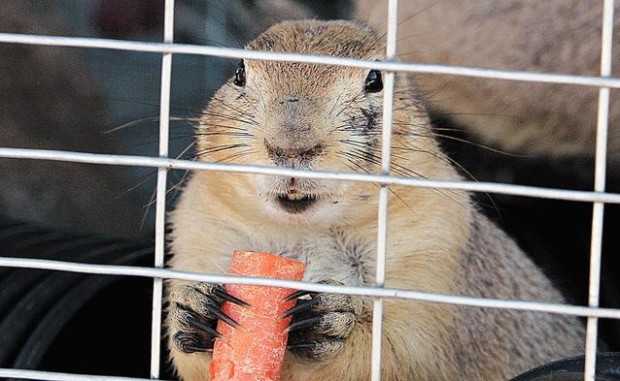
After being caged, dusted and inspected, 27 New Mexico natives were introduced Monday to new homes in Las Cienegas National Conservation Area, about 50 miles southeast of Tucson. Apart from being a little homesick, the black-tailed prairie dogs, released by the Arizona Game and Fish Department, have a bright future, Kristen Lenhardt said.
"Right now they're probably a little nervous, but this is a new area," said Lenhardt, a public affairs specialist with the federal Bureau of Land Management. "Once we put them into their holes, they're right down there, and then it's just a matter of adjusting."
This is the second of six planned prairie dog releases by Game and Fish and the BLM. The reintroduction is aimed at restoring the native species that was wiped out in Arizona by the 1960s. Last year the department released 74 prairie dogs on land adjacent to the conservation area. The reintroduction number this year was significantly less due to poor weather conditions during the trapping in New Mexico. The organizations plan to add more to the site in the next couple of weeks.
People are also reading…
Before the 1960s, ranchers poisoned the prairie dogs, regarding them as a nuisance to their cattle land and carriers of diseases such as plague, said Karen Simms, ecosystem planner with the BLM.
From a biological perspective, the prairie dogs are far from being pests; they are regarded as a "keystone" species, beneficial to maintaining the desert grassland ecosystem.
"Among the biological community, there is definitely an interest in restoring the species to the grasslands," Simms said.
The reintroduction of prairie dogs will provide prey for a variety of animals, including the goshawk, and their digging will encourage floral diversity in the area, thus attracting other animals such as the pronghorned antelope. Also, animals such as the burrowing owl will use the prairie-dog holes for protection.
These results are already visible in the area where the initial batch of 74 prairie dogs was released last year, Simms said.
While biologists are seeing a lot of positive changes happening, Simms acknowledges that there are some people who are not as excited about the return of the prairie dog.
"There is still a lot of concerns on what impacts they could have on the grasslands and on forage; there are also still concerns about diseases," Simms said.
Joe Parsons owns a ranch just north of Las Cienegas. He said he had been unaware of the reintroduction, but he has concerns.
"They make big mounds and undermine the ground, which makes it dangerous for people going out there and horses," he said.
However, rancher Ian Tomlinson, who has cattle that graze the area where the prairie dogs have already been reintroduced, said he has had no problems with the prairie dogs and fully supports their reintroduction.
"They don't harm anything we're doing, and they seem to be fairly well-contained," he said.
Containment was just one of the many precautions the BLM and Game and Fish took to ensure that the prairie dogs would not negatively affect private land and nearby ranchers.
The BLM instituted a two-mile barrier from any landowner who was opposed to the reintroduction. Also, to keep the prairie dogs from carrying diseases, Game and Fish dusts all incoming prairie dogs for disease-carrying fleas.
Game and Fish and the BLM also keep close tabs on them after they are reintroduced to ensure that they aren't acquiring diseases or spreading where they shouldn't, said Game and Fish's James Driscoll.
"If they become a pest on somebody's property who doesn't want them, we have the ability to go in and remove those," he said.
Game and Fish and the BLM plan to continue to reintroduce prairie dogs to four additional sites in the area as well as supplement the existing sites until colonies become self-sufficient. The goal is that one day the black-tailed prairie dog will again thrive in the environment that it once inhabited without the help of humans.
"What we have here in the Las Cienegas National Conservation Area is a prime habitat for this species," Lenhardt said. "I think they will do very well."


