

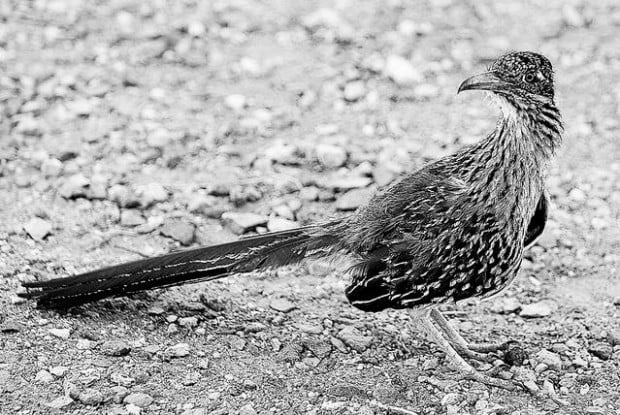
BULLHEAD CITY — Cowboys, bleached cow skulls, scorpions and roadrunners are the epitome of the desert Southwest, as illustrated in Warner Bros. cartoons.
But, the beep-beep simplicity of Wile E. Coyote's nemesis undermines the complexity of the actual critter, according to experts.
"The most famous bird in the Sonoran Desert, without a doubt the roadrunner, is also the most fictionalized in popular imagination," said Kenn Kaufman of Tucson's Arizona-Sonora Desert Museum. "Cowboys used to tell tales about how roadrunners would seek out rattlesnakes to pick fights, or would find sleeping rattlers and build fences of cactus joints around them."
Though they may not manipulate and antagonize the desert's most vicious snake, they will hunt them down and eat them, according to Arizona Game and Fish Department spokesman Zen Mocarski.
People are also reading…
Because of its lightning quickness, the roadrunner is one of the few desert dwellers that preys upon rattlesnakes. Using its wings to distract attention, the roadrunner will snatch the snake by its tail and snap its head repeatedly against the ground.
"Roadrunners may occasionally feed on fruits and seeds, but their primary diet is insects, snakes, scorpions, lizards, small rodents and small birds," Mocarski said.
Roadrunners swallow their prey whole, and are not deterred by the length of snakes. They will simply swallow a piece at time, wait for it to be digested and swallow an inch or two more.
"They can often be seen running around with snake dangling out of their mouths," retired biologist Paul Morris said. "It doesn't bother them a bit. They just go on with their lives, swallowing a bit here and there."
With their heavy black bills, long blue legs and large feet, the birds can appear clownlike when seen meandering around, but their bumbling walk is not an indication of their speed.
"Roadrunners are extremely quick," Morris said. "They can snatch a hummingbird or dragonfly out of midair."
Like the roadrunners of cartoons, they are fast on their feet.
"Roadrunners prefer running over flight and are capable of running up to 15 miles per hour," Mocarski said. "They leave a distinctive X mark on the ground because they have two toes facing forward and two toes facing back."
Rather curious animals and strangely unafraid of humans, roadrunners with their intense yellow eyes will often tilt their heads and check out the possible food suppliers, Morris said.
"If you get too close they'll flap at you and flutter their tails. They can be rather ferocious for a bird. But, if you're offering a tasty morsel they'll put up with you, to an extent," he said.
The fearless desert mascots turn a different feather when it's time to mate, however, Mocarski said.
"They have a somewhat unusual courtship ritual," he said. "The male bows, alternately lifting and dropping its wings while spreading its tail and parades in front of the female. The ritual may also include stick and food offerings."
Morris sees the display as a sort of bribery and reward for the female, he said.
"The male dances around the female as she begs for food, then gives her the morsel after breeding briefly," Morris said. "I guess you could say she's a pretty cheap date."
Tough love and survival of the fittest are the rules roadrunners live by, Morris said.
"Before you start to think about what great parents these birds are, you should know that the first to hatch usually crowd out the late bloomers, which are sometimes eaten by the parents," he said. "The young are completely independent at about a month."
Ideally suited to live in the desert, roadrunners are equipped with a variety of physiological adaptations, Morris said.
"They also reduce their activity by about 50 percent during the heat of the day," he said. "It might not seem like it, because you see them all hours of the day, but they reserve major exertions of energy for evening and early morning."


