

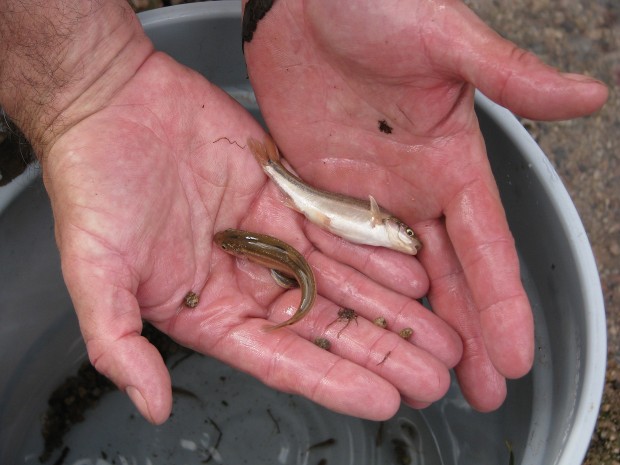
The numbers of native fish are growing rapidly in the upper Santa Cruz River as it sheds oxygen-choking nutrients and deadly ammonia, a new report says.
Because the river continues to get cleaner, the one native fish species now living there - which is not imperiled - is likely to be joined by an endangered native fish species as its population rebounds, a federal fish expert says.
Also, an eight-mile stretch of river where hundreds of native trees died five years ago could eventually be repopulated with new trees because algae blooms that choked off the trees' water supply are dissipating, a University of Arizona water expert says.
Credit for these current and predicted improvements along the river from Nogales to Amado goes to a federal $59 million upgrade of the Nogales International Wastewater Treatment Plant, said the new report from the Sonoran Institute.
People are also reading…
The Tucson-based environmental group has monitored the river's health for three years now and just released its latest "A Living River Report."
The upgrade, completed in 2009, removed much of the ammonia, phosphorous and other pollutants that used to enter the river every year from the sewage plant.
Ammonia kills fish. Even at low concentrations, it can reduce fish-hatching success. Phosphorous at elevated levels can accelerate plant growth. As plants decay in the river, the amount of dissolved oxygen decreases and fish and other aquatic life can die, the report said.
But elevated levels of E. coli, a bacterial species, and the heavy metal cadmium remain problems, although cadmium levels are decreasing, the new report said.
As recently as 10 years ago, the nonprofit group Friends of the Santa Cruz River used to see three native fish species, but by the mid-2000s, water quality had deteriorated to the point where there were almost no native fish, said Emily Brott, a Sonoran Institute project manager. But in the latest survey, covering October 2009 to September 2010, workers found 589 native longfin dace in the river from Rio Rico to Amado and more than 1,250 non-native Western mosquitofish.
"We're seeing this incredible bounce-back," Brott said. "What's exciting to us is that you had this imperiled stretch of river, and it's really coming back due to human management changes."
The endangered Gila topminnow and the non-native desert sucker were seen in this stretch of the Santa Cruz in the 1990s downstream of the wastewater plant, but later disappeared, said Doug Duncan, a U.S. Fish and Wildlife Service fish biologist. In 2006, however, surveys in the Santa Cruz River in Mexico found both fish there, and they also occur in Sonoita Creek, Duncan said. Although the river and creek have dry stretches separating the fish populations from the Santa Cruz downstream of the Nogales wastewater plant, the fish could be washed downstream by flood flows during monsoons or winter rains, he said.
"I don't know if we could give a time, but I expect it to happen," Duncan said.
The effort to monitor the river's health started after a massive die-off of cottonwoods and other native trees along the river in 2005, Brott said. No one at the time knew why that happened. But a study finished four years later led one of its researchers, Thomas Meixner, to conclude that the strongest link was the clogging of the river with nutrients from pollutants.
"We cannot prove what killed the cottonwoods, but we were able to demonstrate in the paper that nutrients clogged the streambed and disconnected the river from its underlying aquifer," said Meixner, a University of Arizona associate hydrology professor. "Over time, the algae can clog up the subsurface below the stream, slowing the rate at which water moves from the stream into the groundwater. It can become so strong that almost no water will seep through."
The total number of riparian trees such as cottonwoods, willows and mesquites hasn't changed significantly since the sewage plant was cleaned up. But Meixner said it's possible that with many of the algae-generating nutrients gone, the trees could come back.
On StarNet: Read more environment-related articles at azstarnet.com/news/science/environment
Contact reporter Tony Davis at tdavis@azstarnet.com or 806-7746.


