

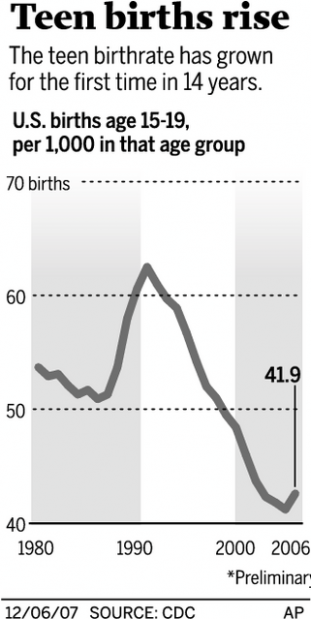
ATLANTA — In a troubling reversal, the nation's teen birthrate rose for the first time in 14 years, surprising government health officials and reviving the bitter debate about abstinence-only sex education.
The birthrate had been dropping since its peak in 1991, although the decline had slowed in recent years. On Wednesday, government statisticians said it rose 3 percent from 2005 to 2006.
The reason for the increase isn't clear, and federal health officials said it might be a one-year statistical blip, not the beginning of an upward trend.
However, some experts said they had been expecting a jump. They blamed it on increased federal funding for abstinence-only health education that doesn't teach teens how to use condoms and other contraception.
Some key sexually transmitted disease rates have been rising, including those for syphilis, gonorrhea and chlamydia. The rising teen-pregnancy rate is part of the same phenomenon, said Dr. Carol Hogue, an Emory University professor of maternal and child health.
People are also reading…
"It's not rocket science," she said.
At the same time, some research suggests teens are using condoms far more often than they did 15 years ago.
The new teen-birth numbers are based on the 15-to-19 age group, which accounted for most of the 440,000 births to teens in 2006. The rate rose to nearly 42 births per 1,000 in that group, up from 40.5 in 2005. That translates to an extra 20,000 births to teen mothers.
In 1991, the peak year for teen births, there were nearly 62 births per 1,000.
The new report is based on a review of more than 99 percent of the birth certificates from last year by the U.S. Centers for Disease Control and Prevention.
The new report offers a state-by-state breakdown of birthrates overall. Many of those with the highest birthrates teach abstinence instead of comprehensive sex education, according to the Planned Parenthood Federation of America.
local angle
A similar trend has occurred in Pima County and statewide, with teen pregnancy rates rising in 2006 after a decade of steady declines.
In Arizona, teen pregnancies dropped almost every year, from a high of 45.4 pregnancies per 1,000 females age 19 and younger in 1996 to 32.7 pregnancies in 2005, then jumped to 34.1 in 2006, the Arizona Department of Health Services reported.
In Pima County, teen pregnancies peaked at a rate of 44.3 in the mid-1990s, dropped steadily through the decade to 30.6 in 2005, but then rose to 32.9 in 2006, according to the state agency.
— Carla McClain


