

SAN JUAN, Puerto Rico — Dengue fever is spreading across Latin America and the Caribbean in one of the worst outbreaks in decades, causing agonizing joint pain for hundreds of thousands of people and killing nearly 200 this year.
The mosquitoes that carry dengue are thriving in expanded urban slums scattered with water-collecting trash and old tires. Experts say dengue is approaching record levels this year as many countries enter their wettest months.
"If we do not slow it down, it will intensify and take a greater social and economic toll on these countries," said Dr. Jose Luis San Martin, head of anti-dengue efforts for the Pan American Health Organization, a regional public-health agency.
The U.S. Centers for Disease Control and Prevention in Atlanta has posted advisories this year for people visiting Latin American and Caribbean destinations to use mosquito repellent and stay inside screened areas whenever possible.
People are also reading…
"The danger is that the doctors at home don't recognize the dengue," said Dr. Wellington Sun, chief of the CDC's dengue branch in San Juan. "The doctors need to raise their level of suspicion for any traveler who returns with a fever."
Dengue has already damaged the economies of countries across the region by driving away tourists, according to a document prepared for a Pan American Health Organization conference beginning Monday in Washington.
Some countries have focused mosquito-eradication efforts on areas popular with tourists. Mexico sent hundreds of workers to the resorts of Puerto Vallarta, Cancun and Acapulco this year to try to avert outbreaks.
Pandemic feared
Health ministers from across the region will meet at the conference, and San Martin said he will urge them to devote more resources to dengue fever.
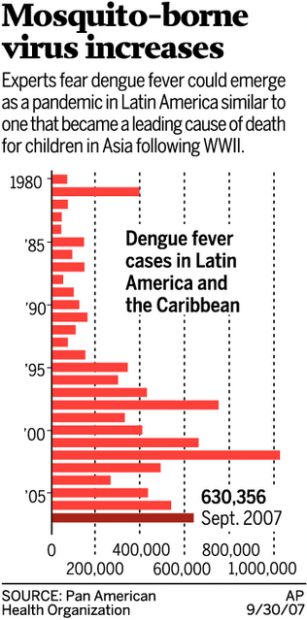
The tropical virus was once thought to have been nearly eliminated from Latin America, but it has steadily gained strength since the early 1980s. Now officials fear it could emerge as a pandemic similar to one that became a leading killer of children in Southeast Asia after World War II.
Officials say the virus is likely to grow deadlier in part because tourism and migration are circulating four strains across the region. A person exposed to one strain may develop immunity to that strain, but subsequent exposure to another strain makes it more likely the person will develop the hemorrhagic form.
"The main concern is, what's happening in the Americas will recapitulate what has happened in Southeast Asia, and we will start seeing more and more severe types of cases of dengue as time progresses," Sun said.
The disease — known as "bonebreak fever" because of the pain — can incapacitate patients for as long as a week with flulike symptoms. A deadly hemorrhagic form, which causes internal and external bleeding, accounts for less than 5 percent of cases but has shown signs of growing.
So far this year, 630,356 dengue cases have been reported in the Americas — most in Brazil, Venezuela and Colombia — with 12,147 cases of hemorrhagic fever and 183 deaths, according to the Pan American Health Organization. With the spread expected to accelerate during the upcoming rainy season in many countries, cases this year could exceed the 1,015,000 reported in 2002, according to San Martin.
In Puerto Rico, 5,592 suspected cases and three deaths have been reported.
In the Dominican Republic, which has reported 25 deaths this year, the health department announced Thursday that it would train 2.5 million students to encourage people to eliminate standing water.
Researchers have not developed a vaccine against dengue, and Sun said that for now the only way to stop the virus is to control mosquitoes.


