

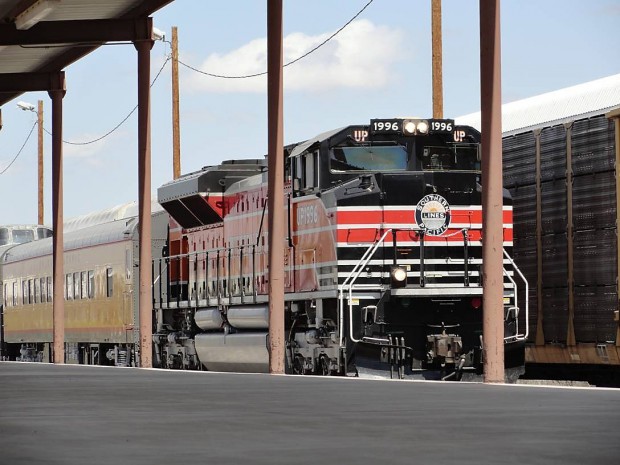
NOGALES - With an emphatic blaring of its horn, the Union Pacific passenger train pulled up alongside a loading platform in Rio Rico shortly before noon on Wednesday.
Sandwiched by two gleaming engines, the train's three bright-yellow 1950s-era coach cars, emblazoned with the names "City of Salina," "Challenger" and "Cheyenne," beckoned the approximately 75 awaiting passengers aboard.
"This is my childhood," exclaimed local historian and soon-to-be passenger Axel Holm, who dressed for the occasion in a smart gray suit, matching felt hat and aviator sunglasses.
"I wasn't allowed to get on a train without a coat and tie," Holm said later while reminiscing about a family trip in 1951 from Tucson to Los Angeles on Southern Pacific's "Sunset Limited" line.
For one day, passenger rail service returned to Santa Cruz County as part of an effort by Union Pacific Railroad to reach out to the local community. The eye-catching vintage train, used by the railroad for educational and promotional purposes, made an hour-and-a-half round trip from Rio Rico to Nogales and back, attracting the attention of waving bystanders more accustomed to the sight of freight trains rumbling along the local tracks.
People are also reading…
"There's a lot of organizations that come down to Nogales, they talk about the port infrastructure, highway infrastructure - very rarely do we have an opportunity to talk about the rail infrastructure," Union Pacific spokeswoman Zoe Richmond said.
"In Nogales, people always see the outside of the train - not from the point of view of the train. It's a different perspective."
In a domed seating section atop this Challenger car last week, much of the conversation involved that perspective - and memories of past train travel.
City Councilman Joe Diaz recalled riding a passenger train from Nogales, Sonora, to Guadalajara as a boy, and marveling at the precision of the Korean passenger rail system while he was stationed there with the military. Mayor Arturo Garino also flashed back to train trips from Nogales, Sonora, to Imuris and other Sonoran destinations. His aunts worked as teachers for the Mexican railroad company Ferromex, which meant plenty of opportunities to ride the rails.
"We used to take the train all the time," he said.
As the train chugged along, Richmond pointed out one of the difficulties UP faces in managing local rail traffic.
"Ultimately, land acquisition is the biggest challenge," she said. "Just look at where we are now: We've got the river on one side, we've got the highway on the other side."
Those constraints not only affect a railroad's ability to add additional rail lines, she said, but they also factor into the community's potential efforts to build bridges over the rails.
The fact that UP, which wants to improve its cross-border shipping through Nogales, is taking an interest in these issues is an encouraging sign to Bruce Bracker, who watches three northbound and three southbound trains bisect the downtown each day as they pass his family's clothing store.
"They understand it affects our lives," he said of the train traffic. If the city is going to eventually build a bridge over the tracks, Bracker said, "UP has to be part of the conversation."


