

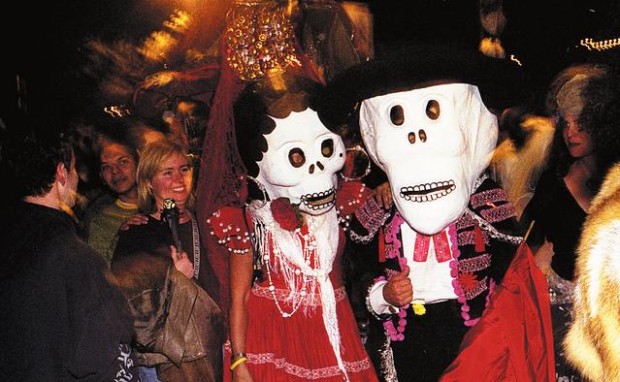
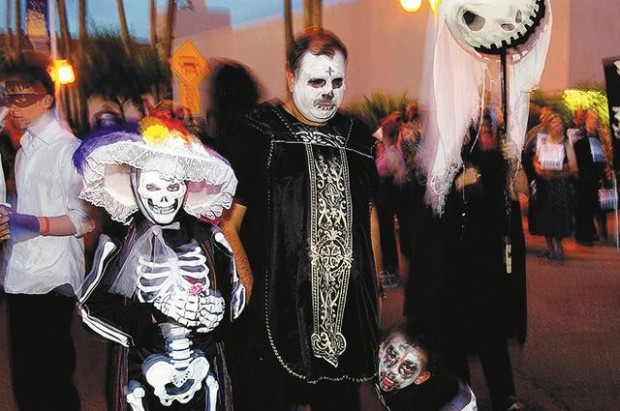
Tonight the streets of Downtown Tucson will take on an air of mystery as thousands don masks, paint their faces and gather in the annual All Souls Procession to grieve for loved ones lost.
As the parade winds from Fourth Avenue through Downtown, spectators will jump in.
Some will carry signs to honor the dead. Others will write short prayers on bits of paper and slip them into the large steel-and-papier-mâché urn that leads the throng.
The event, which organizers say 7,500 attended last year, is one of the highlights of the fall season. It began as a sort of memorial service more than 15 years ago, as local artist Susan Kay Johnson searched for a way to process her father's death.
Johnson had a troubled relationship with her dad, a World War II veteran. The artist looks like him — she has his hands, she says — but she felt cheated because of the emotional roller coaster she rode as a result of his tempestuous nature.
People are also reading…
After he died in 1990, she discovered a collection of hidden journals detailing how emotionally broken he was after his stint at Pearl Harbor, where many he served with died.
"Art is a vehicle for people to express all kinds of emotions," she says. "That's really where this parade came from."
Johnson, who has a degree in art therapy, put together a three-night performance that took place on Halloween, All Saint's Day and All Soul's Day, recruiting performers from Downtown coffee shops.
She studied the influence of ritual in the healing process, and borrowed bits from different cultures, including the Hispanic Día de los Muertos and pagan harvest celebrations.
"I always think that nature never wastes anything and that the spirit just transforms into something else," Johnson says.
The 53-year-old, who now lives in a Spanish Methodist church she converted into a home and studio, incorporated skeletons.
"When I first moved to Tucson, they were digging up lots of things Downtown, and wherever they dug there were these bones," she says. "Bones are something I've always been connected to. This idea that who we are is buried in the ground kept occurring to me."
The imagery, she felt, was more than appropriate and helped her wrap her mind around the blurry concepts of life and death. She made leather masks for the performers to wear to represent the idea of hidden secrets and the veil between the living and the dead.
The performers emerged from a cocoon to the sound of a flute and a drum. Then they danced. The evening culminated in a procession of about 35 people along the streets of Downtown.
After the processions, Johnson says, she felt transformed.
"It opened up my heart and let me connect with things that were frightening to me," she says.
Over the next few weeks, Johnson found more than 250 letters slipped under the door. Writers thanked her and asked how they could participate.
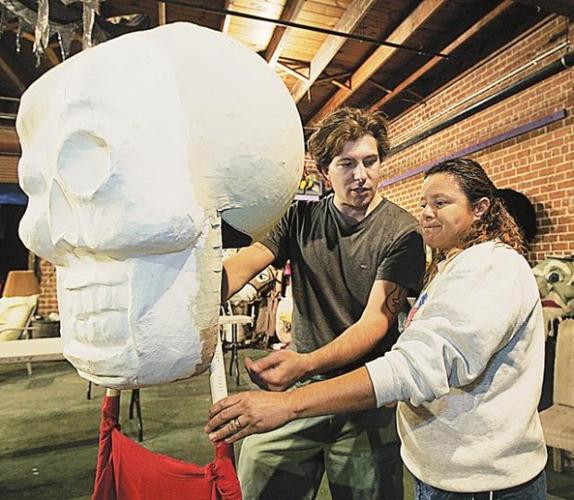
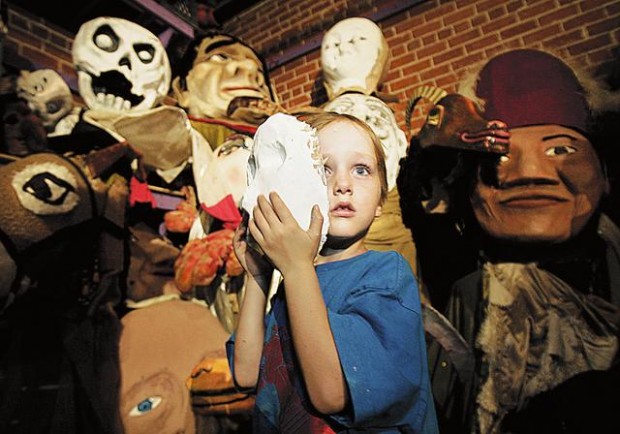
During the next few years, the traditions that carry through to today developed. Local artists started workshops on mask-making, processional lantern building, processional music and street dance. Community members spent weeks making puppets, costumes and floats for the parade. Many of the early joiners now lead other Tucsonans through the artistic lead-up to the procession.
Matt Cotten, of Tucson Puppetworks, discovered the parade in 1992 when he and a friend stumbled across it while hanging out Downtown. Cotten is still heavily involved, helping hundreds of community members create their own masks or puppets to memorialize the dead.
"I didn't realize the significance of what we were doing at the time," Cotten says. "Since then, I've had people die in my life. Since then, a larger community has come to participate. I've been a part of people's grieving, and I've been grieving myself."
For the first several years, the procession stayed small and intimate — at most a few hundred people — and was made up mostly of the Downtown art crowd. At the end, everyone would gather around a bonfire to tell stories of loved ones.
In the early years, Cotten says, the procession flew under the radar, operating without official permission.
"There was this conflict of, well, what are the police going to do? Should we stay on the sidewalk? Should we get on the road? I remember being chased under the Fourth Avenue underpass. I had this gigantic pig puppet on my back, and this policeman on a motorcycle was chasing me," Cotten says, laughing. "We have a very different relationship now."
Procession's growth
Johnson continued organizing the procession and the weeks of workshops that led up to it for about the next eight years, but the effort began to wear, she says.
By 1998, Johnson had turned the reins over to Nadia Hagen, founder of Flam Chen, a fire performance group that participates in the finale. Hagen hoped to turn the growing procession into more of a community-wide event.
"I realized if we wanted the parade to go on, I was going to have to get the proper permits and start closing the street," instead of trying to contain the march to the sidewalk, she says.
After a raucous Saturday night crowd crashed the parade, it was moved permanently to the Sunday after All Soul's Day.
"It was a decision we made to keep the intention of the parade clear, that it wasn't a party," Hagen says.
The procession continued to swell each year as more people discovered it through word of mouth and the fliers posted around Downtown.
"I was way more interested in creating a spectacle and really having this feeling of taking over the streets," Hagen says.
By 2001, the procession had developed a larger life. More than 2,000 people participated, Hagen says. The finale had outgrown the lot at the Mat Bevel Institute, predicating a move to the Franklin Street docks the next year.
It continued to expand so quickly that Hagen established a formal nonprofit, Many Mouths One Stomach, to help finance and organize the event.
Paul Weir, technical adviser to Flam Chen and a parade organizer, says he thinks people have latched on because we have so few opportunities to mourn in America.
"There's not a lot of room in Western culture for grieving in an exalted way to express your emotions and your grief," he says.
As the procession's size increased, Johnson, Hagen and other organizers say, so did tension between the desire to cling to the event's intentions and the need to make it accessible to the increasing number of people who wanted to participate but weren't as invested as those who latched on early.
"I like that it's growing, but what matters to me is the sincerity of the small acts that happen at the workshops and during the parade," Cotten says.
The organizers acknowledge the inherent challenges of getting bigger and say they're committed to keeping the sacred nature of the event from devolving into pure spectacle. Hagen, for example, says the procession will never take on corporate sponsorship. And Weir, who runs the finale at the Franklin Street docks, says he consistently retools Flam Chen's role to create not just a performance, but a ritual that helps Tucsonans gather meaning from the event.
"It serves the role of festal culture," Weir says. "Festal is this very archaic word that references to core human need for celebration."
To try to help participants create a more interactive experience, Weir placed two small papier-mâché urns at the front of the procession two years ago. As the parade snaked along, people dropped in their prayers and mementos.
"We really wanted to find a way for people to feel like they owned the parade and they were really involved in it," Hagen says.
Weir lifted the urns into the air with a crane and ceremonially burned them, hoping to create a ritual spectators could identify with.
"The urns were full to the brim, and we started almost basically crying at that point. I thought, 'This crane and these lights, this is all illusory.' I was pointing to the two urns saying, 'This is the real McCoy,' " he says. "That urn has become the symbol of our intention."
● What: All Souls Procession. Some will dress up in honor of loved ones lost. Others craft puppets or carry totems to celebrate family and friends who died during the year.
A large urn leads the parade; participants can drop in prayers or objects to memorialize others. During the finale, Molehill Orkestrah and Flam Chen will perform and the urn will be set on fire to symbolize release and transformation.
● When: Tonight. People will start lining up outside Epic Café, 745 N. Fourth Ave., at 5 p.m. Others line up along the route and jump in. The parade will begin at 6 p.m.
● What you should know: This is a celebration, but it's not a party. Don't come inebriated or bring intoxicating substances.
Feel free to participate by joining the parade or rattling a noisemaker or even singing, but respect others.
"It's never going to be a rock show. It's never going to be Mardi Gras. It's a spiritual march of death," says organizer Nadia Hagen.
● How you can prepare: Matt Cotten, who has been involved in the procession for a decade and teaches workshops on mask- and puppet-making during the weeks leading up to it, suggests writing the name of a loved one a card to be passed into the urn or bringing a small memento.
● Planning for next year: In the weeks leading up the parade, various artists lead workshops on puppet-making, mask-making, altar-making and more. Log on to www.allsoulsprocession.org for information.


