
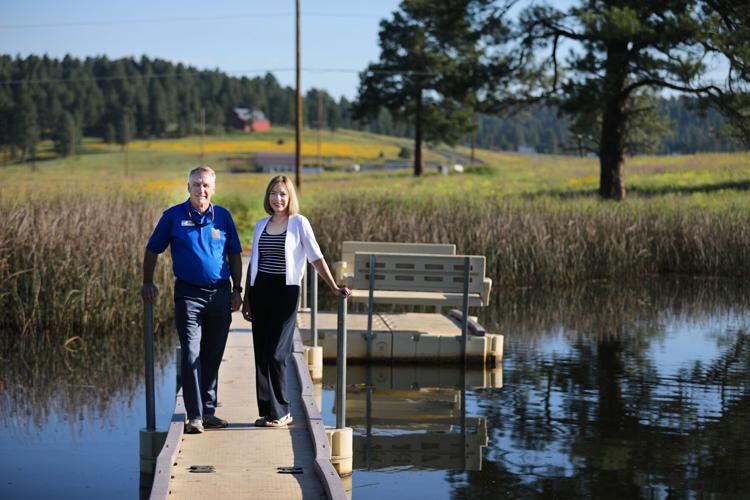
FLAGSTAFF — The Pumphouse County Natural Area, one of northern Arizona’s few preserved wetlands, has expanded its borders.
Coconino County Parks and Recreation recently announced it acquired an important 6-acre parcel in Kachina Village that will be restored and incorporated into the preserved natural area.
Located immediately adjacent to an Interstate 17 frontage road, the parcel would have been an attractive site for future development in the Kachina Village area, but with this recent acquisition, it will become a protected piece of the wetland landscape.
The 129-acre Pumphouse area was buzzing with life early Wednesday last week. Red-wing blackbirds flitted among the reeds of a pond where a duck sought shade from the rising sun. Wildflowers splashed over the low meadow through which a man and a dog ambled. The ponderosa forests stood tall on the hills surrounding the basin, but not as tall as the San Francisco Peaks, which rose purple and proud above the vibrant wetland.
People are also reading…
“If you drive down this highway, everybody really appreciates this,” said Matt Ryan, county supervisor, as he looked over the scene. “It’s a gateway into Flagstaff, into northern Arizona.”
The view shed is just one of the reasons the county has worked to preserve the Pumphouse wetlands, Ryan said.
The area also constitutes the headwaters of Oak Creek Canyon, a federally recognized “unique waterway.”
Multiple freshwater springs make the Pumphouse area “unusual” on the Colorado Plateau, said Hannah Griscom, habitat evaluation and lands program manager for the Arizona Game and Fish Department.
The “fractured” nature of the area’s regional geology usually sees water seep into lower water tables before appearing on the surface, but in Pumphouse wash, perennial springs “feed the meadow” and support a variety of species in the area, Griscom said.
“More than 80% of (wildlife species in Arizona) rely on some sort of riparian or wetland habitat at some point in their life,” Griscom said. “That’s an indication of how important these wetlands can be.”
A county news release said wetlands “provide numerous benefits for people and wildlife, which include protecting and improving water quality, providing wildlife habitats, storing floodwaters and maintaining surface water flow during dry periods.”
And in Arizona, wetlands are extremely rare. A 2012 report form the Arizona Department of Environmental Quality estimated that 0.88% of Arizona’s land was wetland. That percentage has also decreased over the years.
“Depending on the source, estimates range anywhere from 65% to 90% loss of wetlands and riparian areas in Arizona,” Ryan said. “That definitely is a reduction for the opportunity of biodiversity.”
These factors are part of the driving force behind the preservation of the Pumphouse County Natural Area, said Cynthia Nemeth, Coconino County Parks and Recreation director.
The county has assembled the lands piece-by-piece through “donation, purchase and grant funds.” Nemeth said the recently acquired parcel had previously been identified as a “priority” due to its general zoning and potential for commercial and residential development.
“That type of encroachment could be really detrimental to the ecology here,” Nemeth said. “Definitely not conducive to our plan of trying to manage this very important natural resource.”
Acquiring the 6-acre parcel at market value cost the county just over $300,000, Nemeth said. The funds came from the sale of “conservation easements” in the Rogers Lake area. It is an agreement through which the U.S. Department of Defense buys the development rights in order to protect land around its installations — in this case the U.S. Naval Observatory and Camp Navajo.
The county “remains vigilant,” Nemeth said, in its watch for more opportunities to acquire and preserve similar areas.
The immediate plan for the new parcel is to restore it to a functioning natural habitat.
In the long term, Nemeth hopes the new parcel can hold a small recreational site, a place for “quiet enjoyment,” such as a wildlife viewing area similar to what has been maintained elsewhere in the Pumphouse area. Such a site could tie into some of the existing trails as well as future “dream” projects such as a boardwalk that would consolidate foot traffic.
For residents John and Amy Deangio, who have lived on the western edge of the Pumphouse County Natural Area since the 1990s, the county’s protection of the wetlands against development has been unequivocally good.
“When we first moved here, they originally thought about a golf course,” Amy recalled. “I said, ‘I hope they never do that.’”
Fortunately for Amy, she instead enjoys watching wildlife throughout the wetlands.
“We see eagles, we see blue herons, we see mule deer,” she said. “I love the quiet, the nature.”
Wildlife aside, the Pumphouse County Natural Area is evidence of good governance, John said.
“I’m glad to see a positive result from taxpayer dollars.”
Though relatively small, the new 6-acre acquisition is an example of “incrementalism,” Ryan said, “continually building upon what our local residents want and value. It’s about stewardship of the land.”
For Nemeth, it’s “a pleasure” to be a part of acquisitions that “protect an area not only for its ecological value, but for its scenic value, for the sense of arrival to our mountain town. We’re just immensely proud and honored to be able to fulfill that goal. That vision is not just ours, but our community’s.”