PHOENIX — State lawmakers are moving to wrest control of transportation planning from local officials to instead represent their own political philosophies.
And now the question is whose vision among all those lawmakers should take effect.
Strictly speaking, debate on Senate Bill 1122 deals with whether Maricopa County voters will get a chance to extend a half-cent sales tax for transportation projects for another 20 years.
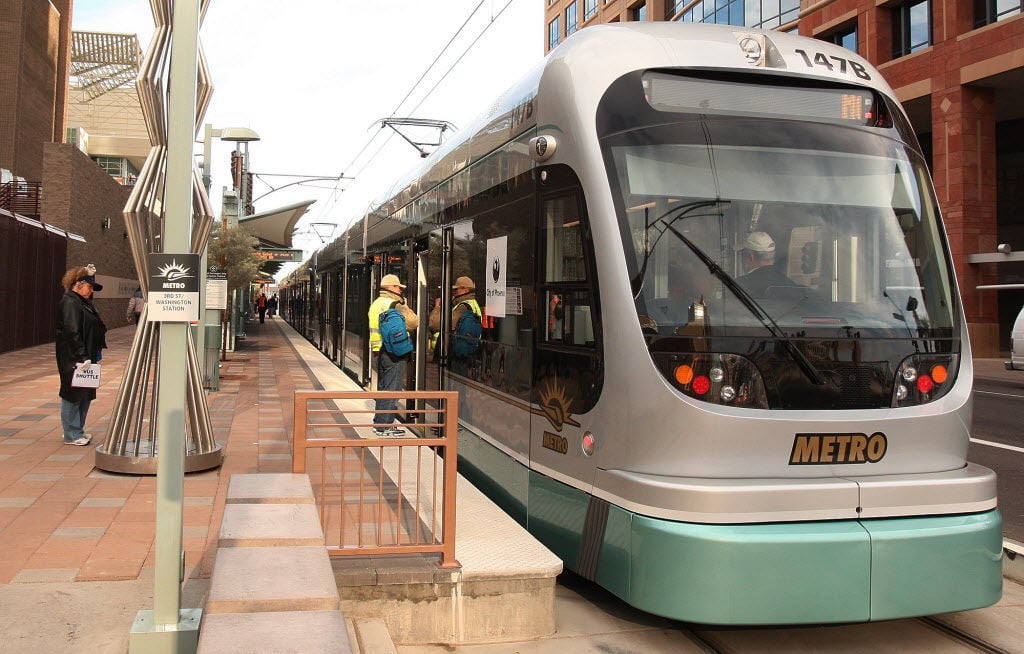
That can happen only with permission of the Republican-controlled Legislature. Several GOP lawmakers said they will give the go-ahead only if the amount set aside for mass transit is reduced from current levels — and if absolutely none of that goes to pay for light rail.
For the moment, a 4-3 vote Monday to kill SB1122 by the Senate Committee on Transportation and Technology quashes any future election. The Maricopa levy is set to expire in 2025 unless lawmakers give the go-ahead for an election.
People are also reading…
But the broader point is this: Monday’s debate and vote shows that any county that wants to fund transit projects will get the necessary legislative OK to ask their own voters for approval only if the plan complies with how state lawmakers want the money spent.
Roads vs. transit debated
A specific legislative bias favors more roads at the expense of mass transit and light rail in particular.
Bucking that philosophy, Sen. Frank Carroll, R-Sun City, has backed a broader approach with continued funding for alternatives to freeway construction. That’s the plan prepared by and backed by the Maricopa Association of Governments, made up of elected officials of all area cities, tribes and urban areas of Maricopa and Pinal counties.
Carroll said rising gasoline prices will boost the need for alternatives to driving by car.
But Sen. Jake Hoffman, R-Queen Creek, rejected that as being driven by “nudge theory.”
“It’s a tactic the left likes to use called ‘choice architecture,’” he said, saying it essentially forces people to accept the policies desired by those setting the rules. Hoffman said that’s what’s happening under President Joe Biden by shutting down the Keystone Pipeline, shutting areas off from offshore drilling and refusing to renew some lease permits for drilling in Alaska.
“The left is making a concerted effort to drive up the cost of gas,” to advance its agenda of reducing driving and emissions, Hoffman argued.
But Carroll, who supports more money for mass transit — and sponsored a bill continuing funding for light rail — said while that may be true, it’s also irrelevant. He said the gas prices are a reality for taxpayers.
“They’ve still got to get to work, they’ve still got to get to places,” Carroll said. That makes it logical to assume that ridership on mass transit will increase along with gas prices, he said.
Overriding local control?
The more over-arching question is whether lawmakers, being pushed by groups like the Home Builders Association of Central Arizona whose members are developing housing projects further from the county’s urban core, know better than local elected officials what their constituents want.
Avondale Mayor Kenn Weise, who chairs the Maricopa Association of Governments, acknowledged that not every community benefits from each part of the regionally developed plan. For example, he said, his residents would not be aided by light rail, which doesn’t extend into his community.
But he said the plan was unanimously adopted after “extensive public input” as being the best for all concerned.
In fact, state lawmakers agreed last year to put it on the ballot. But that was quashed when Republican then-Gov. Doug Ducey vetoed even letting the issue go to voters.
That resulted in this year’s new — and sharply modified — plan, with more of the funding going to pavement.
What the Legislature wants to do, Weise said, is override the locally adopted plan, substituting its own priorities and those of “special interests,” meaning groups that would benefit financially by financing more road construction rather than transit.
MAG wants lawmakers to simply give voters a chance to approve the plan it created, the voters who adopted the tax and the first 20-year plan in 1985 and its renewal in 2005, he said.
Weise rejected Hoffman’s suggestion of holding two separate votes: One on road construction and the other on mass transit. He said that would destroy the idea of having a plan where everyone recognizes the needs of the larger community.
He said the needs of the larger community enabled the MAG plan to include money for extension of State Route 24 in Hoffman’s district — far from Avondale — even though Avondale’s residents might otherwise have wanted money for a new State Route 30 to funnel traffic into their area of the county.
Hoffman and some other lawmakers also want to insert other political elements before giving local voters permission to vote on transit funding.
For example, he wants to say that projects cannot be developed to fit “demand management” policies to reduce vehicle miles traveled. He said he is not bothered if that means giving up federal dollars, a large share of transit funding that the state and counties receive.
Monday’s vote leaves in limbo the question of whether Maricopa County voters — and voters elsewhere — will get a chance to enact or extend existing taxes for their transportation plans if they do not meet with approval of a majority of state legislators.
Tucson's Department of Transportation and Mobility shared an aerial view of the latest progress in phase three of the Downtown Links project on Jan. 6. The new roadway and multi-use path are part of the lengthy city project that will connect Barraza-Aviation Parkway and Interstate 10. Video courtesy of Tucson Department of Transportation & Mobility.
Howard Fischer is a veteran journalist who has been reporting since 1970 and covering state politics and the Legislature since 1982. Follow him on Twitter at @azcapmedia or email azcapmedia@gmail.com.

 Hate all those campaign signs on streets? This proposal's for you