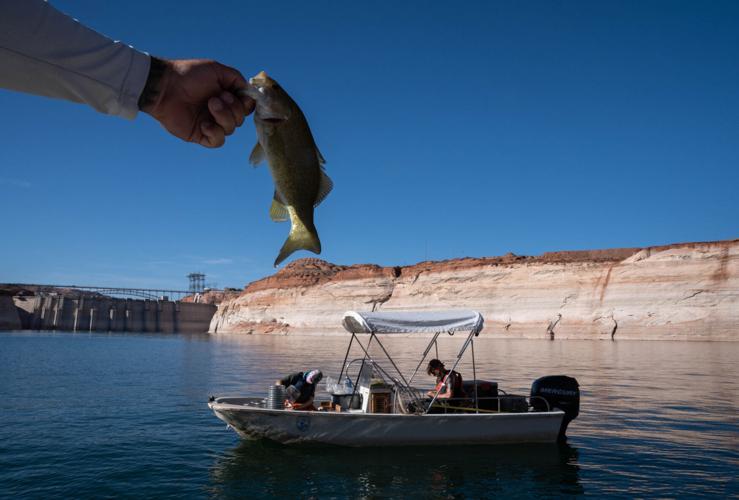
The U.S. Bureau of Reclamation is abandoning an effort to fight a non-native bass invasion in the Grand Canyon by releasing cool water from Lake Powell this summer, blaming the reservoir’s record-low water levels.
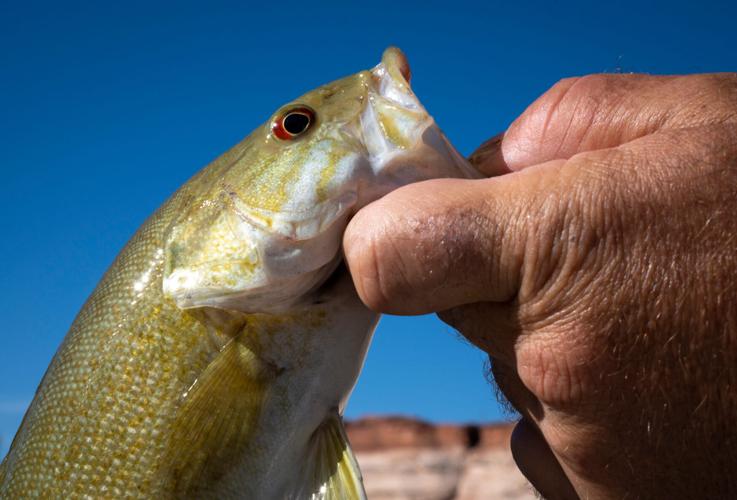
Smallmouth bass that experts think survived a plunge through Glen Canyon Dam’s hydropower turbines began spawning in the Colorado River above Lees Ferry in 2022, prompting emergency removal efforts to protect Grand Canyon’s native humpback chubs from the predators. In 2024, Reclamation instituted a program called “cool mix” that bypassed the dam’s power plant to cool the river during warmer months when the bass spawn.
By all accounts, it worked to suppress bass reproduction during the last two summers and falls, though adult bass remained in the river. It also cost millions of dollars in lost electricity generation, and now the government intends to skip a third year of cool mix to protect Lake Powell and its generating capacity.
People are also reading…

An effort to fight a non-native bass invasion in the Grand Canyon by releasing cool water from Lake Powell this summer is being abandoned by the U.S. Bureau of Reclamation.
Reclamation’s Upper Colorado Basin regional director, Wayne Pullan, broke the news in an Aug. 6 email to members of the Glen Canyon Adaptive Management Work Group, which advises the agency on programs to minimize the dam’s environmental impacts. Some work group members already had said they suspected there would be no cool mix this year, as summer heat had warmed the river past the point that biologists say triggers bass reproduction: 15.5 degrees Celsius, about 60 degrees Fahrenheit.
“I am writing to inform you that Cool Mix flows will not be implemented this year to control nonnative fish,” Pullan said in his email. “Careful consideration of management alternatives was taken across all authorized purposes and impacts were evaluated. Due to significant hydropower generation concerns under already strained system conditions, other alternatives were reviewed and ultimately chosen to be implemented this year.”
The strained conditions he referenced include water storage behind the dam that has dropped to all-time lows and was projected to dip below the line where all power production would cease this year. To avoid or at least stall that outcome, the government is releasing water from upstream at the Green River’s smaller Flaming Gorge Reservoir to prop up Powell this summer.
Record-low Rocky Mountain snowpack last winter worsened the outlook at Lake Powell, now holding less than a quarter of its capacity and pushing the federal government to impose deeper shortages on the states that count on it. Reclamation has released a range of reductions that it could impose on the downstream states over the next decade, and Arizona officials have said the worst of them would devastate their state's economy.
How Glen canyon Dam has distorted Grand Canyon ecosystem
In 2024 and 2025, cool mix worked by augmenting the water that routinely gushes from the dam’s turbines with more from bypass tunnels that draw from colder depths in the reservoir. The Western Area Power Administration said it had cost more than $20 million to do so as it had to find more expensive replacement power on the grid. WAPA had estimated that continuing the program this year, when the water level is lower, could cost as much as $40 million.
Scientists with the Glen Canyon Adaptive Management Program have warned that skipping cool mix in a summer when water levels are so low could raise the river temperatures into the upper 70s — a potential bass-breeding bonanza. Bass have devastated humpback chubs and other native species upstream of Lake Powell, but the species' recovery within Grand Canyon in recent years prompted the U.S. Fish and Wildlife Service to change its status from endangered to threatened in 2021.
The need for cooling is just one example of how the dam built in the 1960s distorted Grand Canyon’s Colorado River ecosystem. Before the dam, the river warmed as spring snowmelt ended and summer flows subsided, a transition that native fish had evolved to handle in the absence of bass. The dam created a colder river when Lake Powell was full and pushing relatively deep water through the dam turbines.
But as the region has warmed and dried, the reservoir's warm surface has sunk nearly to the level of the power intakes. That means warmer water courses through the turbines, and the river is once again a warm one in summer — now in the presence of bass that can eat young chubs. Colder dam releases, unnatural as they may be, now protect native fish from the invaders.
Conservationists who advocate for the river in Grand Canyon were disappointed at the news, but not necessarily surprised given the acute water shortage and threats to hydropower production. Still, some who participate in Reclamation's adaptive management program said cool mix's success at preventing bass breeding should make it a model for managing environmental resources through crisis.
"We can't ignore these values that are important to everybody," said Matt Rice, Southwest senior director for American Rivers. He said he'll push to reinstate the flows next year as a means of complying with the Grand Canyon Protection Act, a 1992 law intended to minimize the dam's harm to the national park.
"Hopefully we can hold the line and we can get a little more water and continue to make the case that innovative approaches like cool mix flows are important as we manage a river for 40 million people."

Smallmouth bass that experts think survived a plunge through Glen Canyon Dam’s hydropower turbines began spawning in the Colorado River above Lees Ferry in 2022, prompting emergency removal efforts to protect Grand Canyon’s native humpback chubs from the predators.
'It's going to crush the fishery'
Ending cool mix threatens both native fish and the popular rainbow trout fishery around Lees Ferry, said Jim Strogen, an angler who represents Trout Unlimited and recreational interests on Reclamation’s work group. He said he and allies from sporting groups had submitted letters asking for the program’s continuation, and an online petition had received 1,700 endorsements.
“It’s very disappointing obviously,” Strogen said, “and I just know that it’s going to crush the fishery.”
Rainbows also are a nonnative species in Lees Ferry and Grand Canyon, but one that sporting groups say poses little threat to native fish. They eat more insects, whereas bass are bigger fish eaters.
The trout had struggled to reproduce as summer water temperatures warmed into the 60s before the cool mix experiment, Strogen said. Temperatures in the mid- to upper 70s would kill trout, and maybe the entire fishery that generations of Arizonans have enjoyed, he said.
“It’s going to kill all or most of the trout,” Strogen said. “So there won’t be trout for anglers to go up and try to catch if conditions are going to be as bad as it looks like they’re going to be.”
But advocates for electric utilities that distribute the dam’s power to millions of customers around the West argued that bypassing Glen Canyon’s power plant unfairly put all the cost of native fish protection on them. The Colorado River Energy Distributors Association wrote to Reclamation’s boss, U.S. Interior Secretary Doug Burgum, in May asking him to reject cool mix or any other bypass releases this year.
In that letter, CREDA Executive Director Leslie James disputed claims that cool mix is cost-effective because it prevents the need to spend on other methods of keeping bass from overwhelming a humpback chub population that, though downlisted to threatened, still enjoys the protections of the Endangered Species Act.
“We keep hearing comments that we must continue Cool Mix because the cost of not doing it will be even greater,” James wrote. “We would like to understand what remediation would consistently cost more than $20 to $30M per year.”
Agencies try other ways of slowing bass invasion
In announcing the decision, Pullan said Reclamation and partner agencies would continue to fight the bass invasion with other methods including “expanded rapid response removal actions.” In recent years biologists have captured and removed bass, electrofishing the river, for instance, to stun and net them.
Last year, the government paid a contractor to dig a channel across a sandbar downstream from the dam to get water flowing through a backwater slough that had served as a protected spawning bed for bass and other invasive species.
Reclamation and its Glen Canyon work group have also debated the wisdom and cost-effectiveness of creating a permanent barrier like an anchored net to impede the movement of more bass or walleyes through the dam. State biologists stocked the sportfish in the reservoir decades ago.
“We recognize the implications this decision may have for several critical resources,” Pullan wrote, “but we are also aware of other options that can be effective.”
Pullan had advocated for cool mix as the most effective and immediate method of bass control, and as recently as February had said he thought it likely that Reclamation would need to continue it this year.
“We cannot move ahead with hope as our strategy that, well, maybe we can take a year off of cool mix and we’ll see what happens, because we haven’t studied that,” Pullan said at a committee meeting of the adaptive management program at the time. “I don’t think that’s in the offing.”
By the time he addressed a gathering of the Grand Canyon River Guides in late March, though, he was cautioning that cool mix might not happen. He noted that President Donald Trump had signed an executive order titled “People Over Fish” in response to environmental programs in California, and he said Lake Powell was in danger of dropping below the point where it can make power, known as minimum power pool.
“There's always the possibility that we may go below minimum power pool and that we may for a period of time not be able to generate power,” he told the guides. “If that happens, and it happens in the same year that we have bypassed power for cool mix flows, it won't look good.”
At that time, Pullan said skipping cool mix flows this summer could make them all the more important to restart next summer and beyond, “to knock back those young (bass) that may show up.”