It was like a bomb went off.
Diana Glazer remembers screaming.
There was glass everywhere. She couldn’t get out. She saw smoke. She was being pulled from the car.
“Where is she, where is she?” Glazer remembered saying. “Why is that (tarp) on him? And I was screaming.”
Later, she learned that her husband, Michael, and 6-year-old daughter, Sydney, died in a fiery, violent crash in 2007 that sheared the driver’s side of the car off. A car heading eastbound on Interstate 10 crossed the 80-foot dirt median and collided nearly head-on with the Glazers.
Nine months later, on May 14, 2008, Mike Humphrey lost his wife, Pam, and sister, Ann Quinn, at the same milepost on I-10 between Phoenix and Tucson in a cross-median crash.
Their bodies were so mangled, authorities didn’t want to let him see them. He said he saw their feet.
People are also reading…
“There was no saying goodbye, no last words,” Humphrey said the day before the 18th anniversary of their deaths. “It's just one moment they're there, and two hours later, they're gone, and there's not a damn thing you can do about it.”
Highway crossover crashes rare, but deadly
Crashes in which one car crosses a median are rare, but cross-median or crossover crashes are known by transportation experts to be violent, often fatal events because they typically involve vehicles traveling at high speeds in opposite directions.
The Arizona Department of Transportion has been sued at least a dozen times in the past 20 years over the lack of median barriers on freeways across the state and spent millions of dollars fighting and settling litigation. In each case reviewed by The Arizona Republic, ADOT maintained that the agency was not at fault for the crashes and that it has complied with national standards.
Federal crash data showed that over 15 years, there were 34 fatal cross-median crashes statewide.

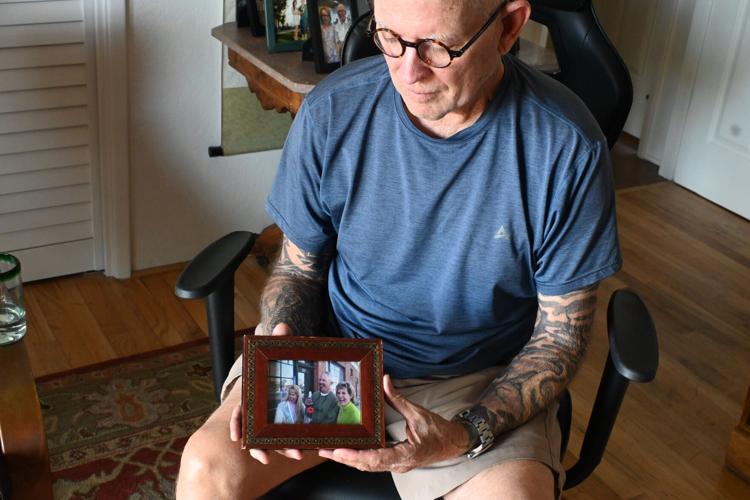
Mike Humphrey holds a photo of his late wife, Pam Humphrey, and sister, Ann Quinn in this May 2026 photo. They died May 14, 2008, in a cross-median crash on Interstate 10.
ADOT declined two interview requests and did not reply to emailed questions. Instead, an ADOT spokesperson provided an emailed statement and a link to the agency’s Roadway Design Guide.
“ADOT builds and maintains highways that meet state and federal guidelines. When the guidelines call for them, median barriers are installed,” the unnamed spokesperson wrote.
Humphrey has, for more than a decade, battled ADOT to put cable or concrete barriers along I-10 between Phoenix and Tucson.
“Once I could start thinking clearly again, I was thinking I need to make something positive out of what happened to them because that kind of death seemed like it could have been prevented,” he said.
Now, the section of I-10 where Glazer and Humphrey lost their families is under construction — and a barrier is being built.
The 26-mile Wild Horse Pass project includes widening the freeway to three lanes in each direction and installing a barrier in the narrowed median.
“Despite ADOT’s inaction, it’s going to get done,” Humphrey said.
A deadly I-10 crash in a blink of an eye
The crash happened in the blink of an eye.
It was a bright, sunny Thursday afternoon in August 2007. It was hot ― about 110 degrees, Diana Glazer remembered. She, with her husband and young daughter in tow, had just dropped off her older daughter at the University of Arizona for her freshman year.
“That was going to be the sad thing in our life,” Diana said. “We had just had a party, a goodbye party for her, and I said, ‘Oh, I’m going to walk by your room and be sad.’
“Little did I know that was the least of it.”

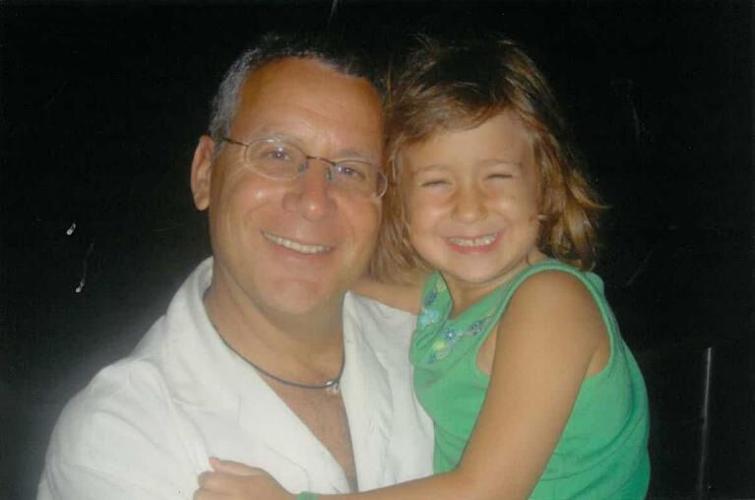
Michael Glazer and Sydney Glazer died in 2007 in a violent, fiery cross-median car crash on Interstate 10. Diana Glazer survived.
The California native was heading to Phoenix to meet someone. She and Michael stopped at the Rooster Cogburn Ostrich Ranch for 6-year-old Sydney, then stopped at a gas station and McDonald’s.
They had just gotten back on the road when it happened.
A car swerved across the wide median to avoid a semitruck encroaching into the left-hand eastbound lane and hit the Glazer car nearly head-on, each car going at least 75 miles an hour.
Diana Glazer closed her eyes and felt the “boom” wrack her body.
Her seatbelt and car door became stuck. She tried to crawl out the sunroof before a man opened her car door and took her out.
“He takes me out, and I'm screaming, ‘Where are they? Where are they?’” Diana Glazer said. “He just starts hugging me and holding me ... and he goes, ‘With God, honey.’ I don’t even know what I did, other than probably screaming.”
That man testified in court that the scene looked like a war zone, according to Diana Glazer’s attorney, John Leader, a Tucson-based attorney who has spent the past 20 years litigating similar cases.
She and Michael had been married for 20 years, more than half of Diana’s life.
“He doesn’t get to be here, and I know he would have wanted that so much,” Diana said.
Nine months later, it happened again
Nine months later, a second crash occurred at milepost 171, again killing two: Pam Humphrey and Ann Quinn. Milepost 171 is between Riggs Road and Casa Blanca Road.
Pam Humphrey was driving in the left-hand lane going westbound when she swerved to miss something on the road. Her vehicle careened into the median and rolled into eastbound traffic before hitting a semitruck.
The driver of the semitruck suffered injuries to his neck so severe that he needed a neck brace. The semitruck's hood was almost completely ripped off, and the front was crushed, according to Arizona Department of Public Safety reports.
The crash sheared Pam’s car — and her body — in half.
“Eighteen years ago, 20 years ago ... (ADOT) knew that there were problems, and they chose to ignore them,” Mike Humphrey said.
Median barriers relatively new on Arizona highways
When that Arizona stretch of I-10 was built in the 1960s, it did not include either concrete or cable median barriers, consistent with design standards at the time.
Since then, the use of the freeway has changed ― traffic demand has risen exponentially, trucking needs have transformed, speeds have been increased, and part of I-10 has been widened.
The first record of ADOT taking a serious look at median barriers was in 1999 at the direction of then-Gov. Jane Hull. In that report, ADOT engineers recommended protected medians along metro Phoenix freeways, including the still unbuilt Santan Freeway and Red Mountain Freeway, which was under construction, in the East Valley.
The study team recommended a three-strand cable median barrier along urban freeways in metro Phoenix, including State Route 51, Loop 101 in the East Valley and I-10 in the West Valley. The team specifically noted that "all urban freeways in Tucson, Flagstaff and Yuma provide median protection or have medians of sufficient width at this time."

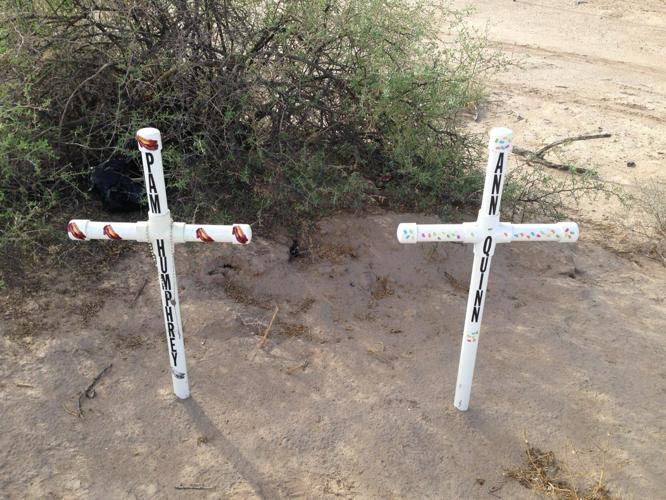
A roadside memorial near milepost 171 for Pam Humphrey and Ann Quinn are pictured in an undated photo. They died in a cross-median car crash 18 years ago at milepost 171 on Interstate 10.
Many Phoenix freeways now have a concrete barrier, not a cable one.
But many freeways outside of the Phoenix area still have no barriers dividing the two directions of travel, despite a 2013 ADOT report that recommended a cable barrier be added to sections of interstates 8, 10, 17, 19 and 40 to decrease what the report called "roadway departure fatalities."
Nearly 100 cross-median crashes occurred on I-10 since 2000
Tracking the number of cross-median crashes is difficult. ADOT began tracking them in 2015 but could not provide a list to The Republic.
A review of all accidents dating back to 2000 showed many different causes for collisions known to include a car crossing a median. The Humphrey crash was listed as a rollover crash, not a cross-median one.
But according to data provided by the National Highway Traffic Safety Administration, between 2010 and 2024, there have been 34 fatal collisions statewide where the cause of the crash was a car crossing the median.
I-10 between Phoenix and Tucson isn’t the only hot spot for cross-median crashes. According to the NHTSA data, Interstate 40 and State Route 95 saw the highest frequency of fatal crossover crashes with three each.
Data for 2025 is not yet available. NHTSA only provided information on fatal crashes.
In dozens of court filings, The Republic found 92 cross-median crashes solely on I-10 between Phoenix and Tucson. Those crashes resulted in 89 injuries and 44 deaths.
One crash at milepost 213 on I-10 alone killed five people and injured three others.
The data is incomplete, however, since each case focused on a 10-mile radius of each accident. Most crashes that resulted in lawsuits happened between mileposts 160 and 180 and mileposts 200 and 240, surrounding Picacho Peak.
Leader, the attorney for Glazer and Humphrey, said Arizona has a "much more significant problem than other states" with cross-median crashes, in part because of ADOT's rules about when a barrier needs to be installed.
ADOT’s guidelines dictate that a median barrier “shall be installed” on highways with medians 50 feet or less or with medians 75 feet or less when there are three or more lanes in each direction. Those guidelines are consistent with current national requirements.
Much of I-10 includes medians around 80 feet wide, and at milepost 171, the median width was 81 feet in 2008.
But the American Association of State Highway and Transportation Officials, which sets national guidelines for transportation planning, engineering and maintenance, includes a carveout for particularly dangerous roadways. The association's policies are only a blueprint to inform states' decisions, not a requirement.
“For locations with median widths equal or greater than 15.2 m (50 feet), a barrier is not normally considered except in special circumstances, such as a location with a significant history of cross-median crashes,” the association's 2011 Roadside Design Guide reads.
The carveout is called a crash warrant, which refers to the frequency and severity of crashes at a specific site to inform traffic engineering and design decisions.
ADOT acknowledged in court that the agency did not include such a carveout in its guidelines.
“In finalizing its recommendation, the team did not include a crash warrant as part of Arizona’s median barrier guideline,” the attorney for the state wrote in a 2020 filing in Naranjo v. State, another case litigated by Leader centering around the lack of median barriers on I-10 between Tucson and Phoenix.
Despite the association's 2011 Roadside Design Guide only being a guideline, ADOT employees testified that if ADOT’s design guides do not address a specific issue, then engineers default to the association's recommendations.
In its 2025 Roadway Design Guide, ADOT noted that crash history “may also be considered” along with engineering judgment, but that crash history would not be the determining factor for installing barriers.
It’s unclear when this consideration was added.
Despite the series of violent, fatal crashes on I-10 over the last 25 years, ADOT never considered putting median barriers along particularly dangerous stretches, such as between mileposts 165 and 175, according to court filings.
ADOT has repeatedly and publicly defended its practices.
“The Arizona Department of Transportation takes seriously all collisions on state highways, including cross-median crashes, which are a small percentage of serious crashes on the Interstate 10 corridor between Phoenix and Tucson,” a news release from 2014 read. “ADOT’s median-barrier standards are consistent with or exceed the standards used by most states to determine when a median barrier should be constructed.”
Do median barriers cause more harm than good?
Barriers in the median are designed to redirect errant vehicles striking either side, according to the Federal Highway Administration. Across the country, median barriers resulted in a 97% reduction in crossover crashes on four-lane rural highways, the agency reported.
But in court records, experts were conflicted on whether barriers would have prevented each crash.
Christine Carrigan, who has a PhD in civil engineering and worked in highway safety and design for more than 25 years, opined multiple times over the last 20 years on behalf of the state.
During Naranjo v. State, she said in 2020 that a three-strand steel cable barrier would not have prevented that crossover crash, which involved a tractor-trailer. The barrier would have, instead, exposed “more people to a hazardous situation than a wide median with no barrier,” she wrote.
“When a median barrier is installed, there is an increased risk of occupant injury due to impacts with the barrier, and there remains a risk of cross median crashes when errant vehicles breach ... the barrier,” Carrigan wrote.
Leader contended cable medians would have prevented Humphrey’s, Glazer’s and nearly a dozen other crashes. In court filings, he argued ADOT failed to address a clear history of hazardous conditions, alleging ADOT was negligent in the deaths associated with cross-median crashes statewide.
Other state departments of transportation touted the effectiveness of cable median barriers.
The Minnesota Department of Transportation reported cable barriers have “proven to be 95% effective at reducing” cross-median crashes and estimated the barriers have saved over 100 lives.
The North Dakota Department of Transportation called median barriers an “effective method to prevent these often tragic crashes.”
Keeping a promise
After suing the state, Humphrey said he would have settled his case if ADOT erected 1 mile of barriers at the crash site.
“(ADOT) didn’t even want to talk about it,” he said.
At the time, that would have cost between $150,000 and $500,000, depending on the type of barrier.
Instead, at a jury trial, Humphrey and his family won a $47 million payout in 2015.

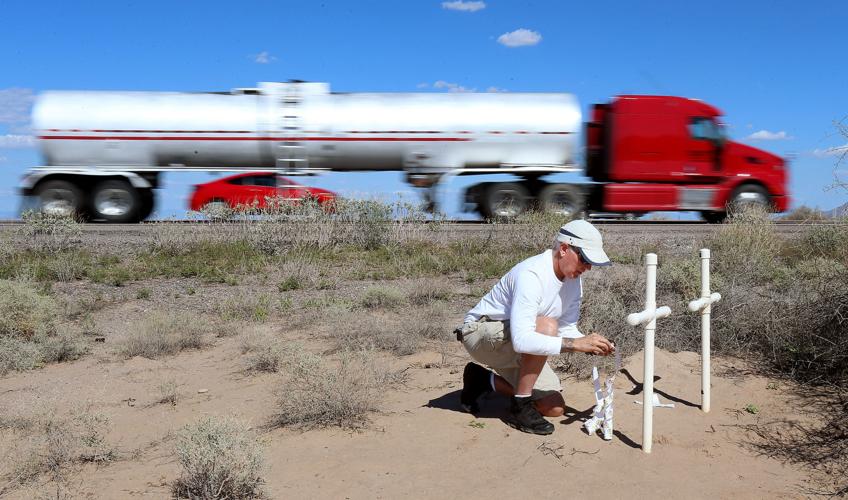
In this 2018 file photo, Mike Humphrey places stickers on a plastic cross at a roadside memorial along Interstate 10 near where his wife and sister were killed.
His ruling was overturned by the Court of Appeals because of an issue with the initial notice of claim.
Glazer and her family won $7.8 million at a jury trial in 2016.
Combined, the families won more than $50 million from ADOT.
In 2007, it would have cost about $43 million to install cable median barriers along I-10 for the 200 miles between Phoenix and Tucson, according to data from the American Association of State Highway and Transportation Officials. That figure does not include maintenance costs.
Humphrey made it his life mission to bring awareness to the lack of median barriers statewide. He has dogged ADOT, the Governor’s Office and local officials to install median barriers for more than a decade.
Humphrey said most agencies, including ADOT, ignored him.
“They would never admit that there was a problem with that median until they were forced to,” he said.
ADOT has been widening I-10 from Phoenix to Tucson for 20 years. In 2016, the agency installed yellow, diamond-shaped signs along I-10 that read, “No Median Barrier.” The signs’ efficacy has been questioned in court.
The section of the freeway from Loop 202 in south Phoenix to State Route 387 near Casa Grande is currently under construction. That stretch includes I-10 at milepost 171, where Humphrey and Glazer both lost their families.
The Wild Horse Pass project will be widened to three lanes, along with other upgrades.
Once completed in 2029 or 2030, the entire corridor between Tucson and Phoenix will be three lanes.
To do so, crews are encroaching on the median, meaning the area will meet ADOT’s requirements for a median barrier: The median will be less than 75 feet, and there will be three lanes in each direction.
The project’s website touts safety improvements such as overhead message boards, sensors and cameras. It did not highlight median barriers.
In an email on July 6, ADOT spokesperson Marcy McMacken said concrete barriers will be installed along the entire 26-mile stretch.
Humphrey made it his life's mission to see barriers where Pam and Ann died. It's been an 18-year-long journey.
“I’m glad I’ve stayed alive long enough to see this through,” Humphrey said. “I made a promise ― I kept my promise.”