PHOENIX — A Benson Republican lawmaker says Arizona lawmakers need to heed the lessons of a fairy tale when considering whether to preserve Mexican gray wolves.
"Little Red Riding Hood understood that this is a predator that we're dealing with,'' said Rep. Lupe Diaz.
He told colleagues Arizona needs a law to ensure the state doesn't cooperate with certain federal efforts to restore the gray wolves' population.
"The whole story of Little Red Riding Hood is that this predator's going to get you,'' he said as the Republican-controlled state House gave preliminary approval to Senate Bill 1280 this week.
That measure, which already cleared the Republican-led Senate, would bar the Arizona Game and Fish Department from transporting gray wolf puppies into the state. It would also keep the Arizona Game and Fish Commission from using any of its own resources to accomplish that purpose.
People are also reading…

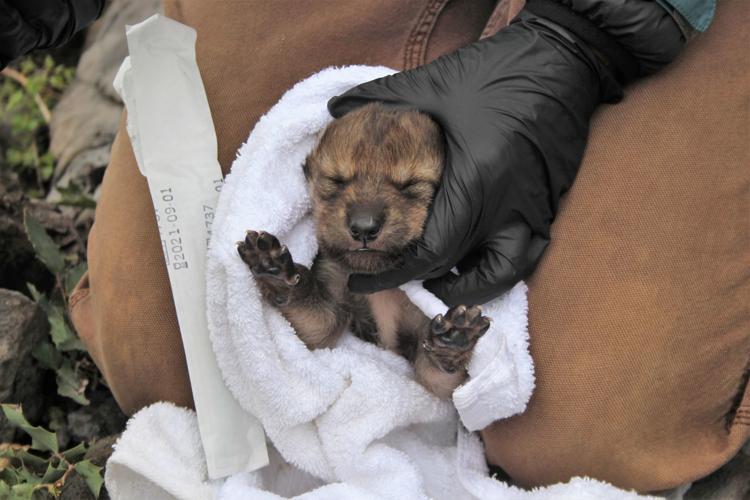
A captive-born Mexican gray wolf puppy in the U.S. Fish and Wildlife Service’s Species Survival Program.
The vote for the measure came over objections from several Democrats who pointed out that the wolf has been on the endangered species list since 1976.
Tucson Democratic Rep. Nancy Gutierrez said it is only by bringing in more pups raised in captivity that there is a chance to obtain the genetic diversity in the wild necessary to remove the wolf from federal protections.
But supporters of the legislation contend there already are enough wolves in Arizona.

Rep. Lupe Diaz
Diaz told colleagues that in northeast Arizona and northwest Mexico, communities have built "cages'' to protect children against wolf attacks.
That assertion drew a skeptical response from Democratic Rep. Mae Peshlakai, who said she has lived in the Grand Canyon area all her life and picks pinon nuts in season.
"And I have never been attacked by anything out there,'' she said. "They're well-behaved animals. They're scared of human beings. And they will not attack anything that doesn't attack them.''
he 2024 Mexican wolf census documented a minimum of 286 wolves living in recovery areas Arizona and New Mexico. The Mexican wolf population has grown for a record nine consecutive years! See how biologists capture and collar wolves to manage the growing population. Video courtesy of Arizona Game and Fish Department.
Sandy Bahr of the Sierra Club said she has never heard of a wolf attack on a human, though she acknowledged that wolves will attack cattle. The Arizona Livestock Board has a program to provide compensation for confirmed wolf kills, as well as grants for ranchers to install non-lethal methods of preventing attacks.
Republican Rep. Gail Griffin of Hereford countered: "In Southern Arizona, there is no prey bait except for cattle, kids and animals."

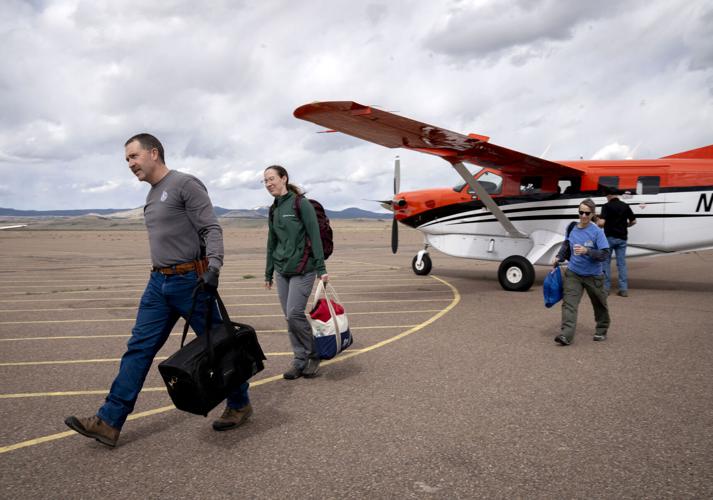
Paul Greer (left, Arizona Game and Fish operations lead) carries a pet travel carrier containing five Mexican gray wolf puppies into the terminal at Springerville Municipal Airport in April 2024. The 7-day old captive-born puppies were flown in to be fostered into two Arizona wild wolf dens.
Strictly speaking, nothing in SB 1280 would bar Game and Fish from working with federal agencies to try to restore a sustainable population of wolves in Arizona.
"Population goals are on track to be met,'' said Game and Fish Department lobbyist Ed Sanchez. He said there are 124 Mexican gray wolves in Arizona and 162 in New Mexico, with the goal of hitting 320.
But genetic diversity is another matter, he said.
Rosalind Switzer, a volunteer for Great Old Broads for Wilderness, told lawmakers that, due to capture, poaching and removal, all of the wolves now in Arizona can trace their lineage back to just seven pairs.
"Wolves in the wild are related like siblings,'' she said. "Avoiding health and reproductive issues that arise from inbreeding is of the utmost importance.''
That's where the pups raised in captivity elsewhere come in, being placed in dens with wild wolves.
Sanchez said that, except on rare occasions, his department isn't directly involved with transportation.
"Once genetic diversity and population goals are met, the Mexican wolf will be delisted, and the Mexican wolf will be managed by the Arizona Game and Fish Department," he said. "Why wouldn't we want to maintain the current flexibility to occasionally deploy resources to ensure population and genetic diversity goals to ensure that delisting will occur sooner rather than later?''
Diaz, however, said he thinks the current 268 wolves are sufficient and there's no basis for claims their numbers need to reach 320 to be self-sustaining.
"We don't have to expand the program anymore,'' he said.
Much of the debate, however, turned on the question of whether the wolves are dangerous to humans or could be a benefit to the state.

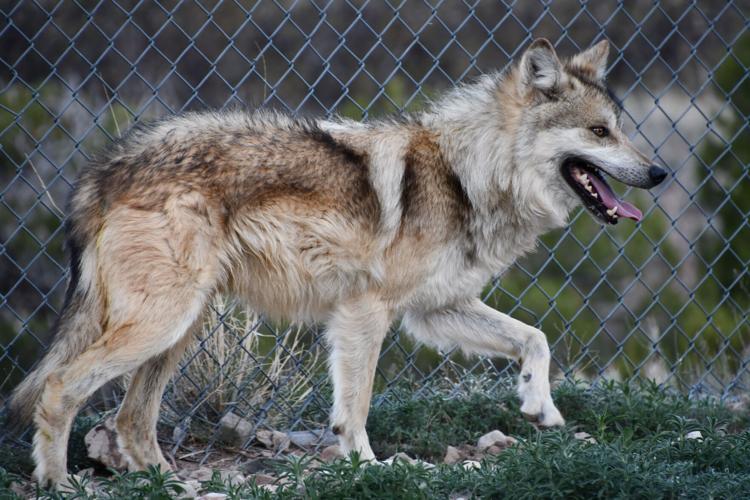
A male Mexican gray wolf photographed in captivity prior to his 2024 release into the Peloncillo Mountains in southeastern Arizona.
At one point, there was even a suggestion that having wolves in the wild could become a tourist attraction. That idea didn't impress Diaz.
"You wouldn't want to have tourism around these mature animals,'' he said. "They can be dangerous.''
The debate about what should be Arizona's role in preserving the Mexican gray wolf comes against the backdrop of a proposal by Arizona Republican Congressman Paul Gosar to delist the wolf, prohibit the federal government from releasing wolves from captive breeding programs into the wild, and eliminate federal prohibitions against killing wolves.
"Lawsuits filed by extremist environmental groups have prevented the Mexican wolf from being delisted nationally, even though the Mexican wolf was released into Arizona and New Mexico as part of an experimental program,'' he said in a written statement when introducing his HR 4255 last year. It cleared the House Natural Resources Committee in January.
Gosar, like Diaz, noted that the original target was to have 100 wild wolves in the area.
"Now a stable population, the wolf is no longer in danger of extinction and should be delisted,'' Gosar said.
Sanchez said that if Gosar's measure becomes law, it will then be up to the state to decide what to do with the Mexican gray wolf and whether to maintain Arizona's own programs to have a stable population.
"It could be where, like other wildlife, the Game and Fish Department would take responsibility of those wolves going forward,'' he said.
Howard Fischer is a veteran journalist who has been reporting since 1970 and covering state politics and the Legislature since 1982. Follow him on X, Bluesky and Threads at @azcapmedia or email azcapmedia@gmail.com.