

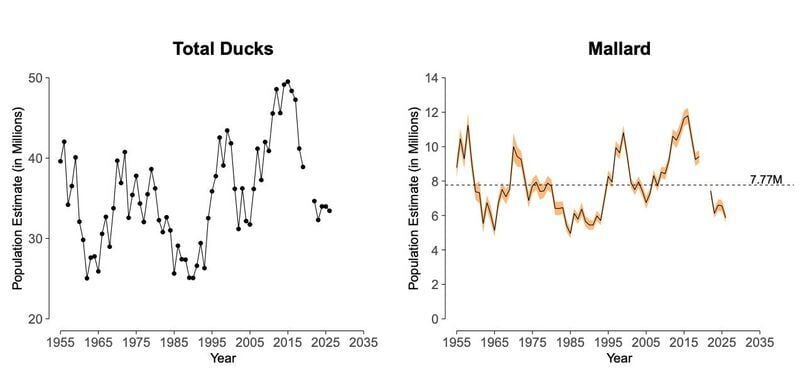
The waterfowl population in the U.S. and Canada declined slightly from last year, including the lowest numbers of the two most abundant duck species since 1993, according to an annual report of the U.S. Fish and Wildlife Service.
The 2026 Waterfowl Status Report found 33.4 million birds, a 2% decline from last year and 6% below the long-term average (since 1955).
Estimates of mallard and blue-winged teal, the most and second-most abundant ducks in North America, respectively, both fell 11% year-over-year.
Among good news, pond counts increased this year across southern Canada, an important waterfowl breeding ground.
The waterfowl estimates and wetland data are part of the Waterfowl Breeding Population and Habitat Survey conducted by the U.S. Fish and Wildlife Service; Canadian Wildlife Service; and the Atlantic, Mississippi, Central, and Pacific Flyway Councils.
People are also reading…
The work has been conducted annually (except 2020 and 2021 due to the COVID-19 pandemic) since 1955 to help track duck and goose numbers across the continent and inform decisions on hunting regulations.
It is based on waterfowl counts conducted by air and on ground by the USFWS, the Canadian Wildlife Service and various state and provincial conservation agencies, including the Wisconsin Department of Natural Resources. The data was collected in spring.
Among species, North America's most abundant duck, the mallard, was estimated at 5.86 million, an 11% decrease from 2025 and 26% below the long-term average. The mallard breeding population estimate is the lowest since 1993.
Blue-winged teal, the second-most abundant duck on the continent, was estimated at 3.96 million, a year-over-year decline of 11% and 22% below the long-term mean. As with mallards, the 2026 estimate put bluewings at the lowest breeding population in 33 years.
Among the seven species of puddle ducks listed in the traditional survey area results, only northern shovelers increased, up 19% to 3.29 million.
Gadwall, at 2.35 million, decreased 3% from 2025. Wigeon (2.94 million) and green-winged teal (2.33 million) each declined 8%, while pintails (1.99 million) were down 11%.
Even with the decreases, gadwalls, wigeon, and green-winged teal remain above their long-term averages.
The population of giant Canada geese in the Mississippi Flyway was up 1% year-over-year.
The 2026 May pond estimate was 4.8 million, a 14% increase from the 2025 estimate of 4.2 million but 9% below the long-term average.
“These results are largely consistent with our expectations, as last year saw the lowest recorded May pond count since 2004," said Steve Adair, Ducks Unlimited chief scientist, in a statement. "Those dry conditions almost certainly resulted in low production in 2025 and slight to moderate declines in returning breeding populations this year. Mallards are now at their lowest level in over 30 years. This provides a stark reminder that our conservation work is far from done and underscores the need for sustained investments in science-based population monitoring and management.”
The waterfowl news was slightly better in Wisconsin, where the 2026 survey produced an estimate of 571,460 ducks, a 1% increase from 2025 and 28% above the long-term (53-year) average.
The 2026 mallard breeding population estimate was 162,894 birds in the Badger State, 5% higher than 2025 but 8% lower than the long-term average.
Among other priority species in the state, the wood duck population estimate of 95,313 was up 6% from 2025 and 12% above the long-term average, while the blue-winged teal estimate of 111,917 was up 19% and 7%, respectively.
Waterfowl hunting regulations have already been set for this fall's seasons in Wisconsin. As defined by the USFWS and guided by waterfowl population estimates, states are offered either a restrictive, moderate or liberal season framework.
Continuing a long run of similar regulations, waterfowl hunters in 2026 in Wisconsin will have a liberal season including six duck daily bag limits and 60-day-long duck hunting seasons.
The 2026 Wisconsin waterfowl hunting seasons opened Sept. 1 statewide with the early Canada goose and teal hunts. A youth waterfowl hunt will be held Sept. 19-20, while the normal duck seasons open Sept. 26 in the north zone, Oct. 3 in the south zone and Oct. 17 in the open water zone.


