

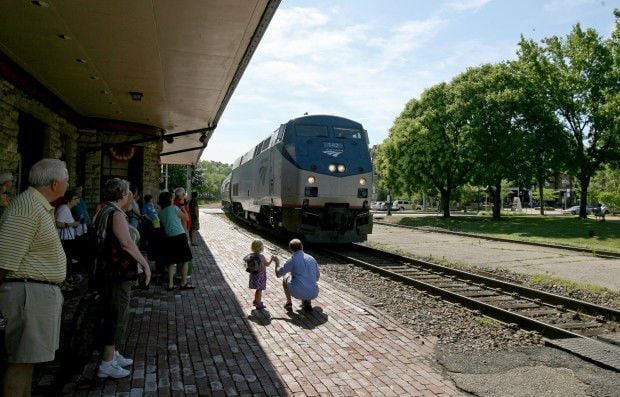
Americans are increasingly turning to Amtrak for trips less than 400 miles, like those served by the Missouri River Runner between St. Louis and Kansas City, and the Lincoln Service between St. Louis and Chicago, according to a new study.
The Brookings Institution Metropolitan Policy Program study found that an overwhelming share of Amtrak’s ridership since 1997 — about 83 percent — has been on these runs that many travelers may consider too long to drive and too short to fly.
“Amtrak is too often considered a big, bloated bureaucracy that depends heavily on federal subsidies and is no longer relevant to the technologically oriented metropolitan economies of today,” stated Robert Puentes, a Brookings senior fellow who co-authored the report. “But the fact is that Amtrak is reinventing itself through its short haul routes and with the support of states, which are helping upgrade tracks, operate routes, and redevelop stations.”
People are also reading…
The study reviewed Amtrak ridership for the 100 largest metropolitan areas and analyzed operating costs for the routes between 1997 and 2012. Amtrak carried a record 31.2 million riders a year and its ridership is growing at a faster clip than other modes of transportation, the study found.
The five Amtrak stations in the St. Louis area saw ridership levels surge 111.5 percent from 1997 to 2012. Last year’s ridership was just under a half million, the study found.
Puentes explained that the distances less than 400 miles lend themselves to this kind of ridership growth, especially when cities on both ends are economic engines of their respective regions. He said state support also is a factor. Illinois and Missouri voluntarily subsidize passenger train service within their borders.
What’s more, Missouri has made some significant investments to make Amtrak service more reliable by improving on-time performance. Moves have included new side tracks to allow slower-moving freight trains sharing tracks with Amtrak to pull over and let the passenger trains pass.
The study also found:
- Ten major metropolitan areas were responsible for nearly two-thirds of Amtrak’s ridership in 2012. Those areas are: New York; Washington, D.C.; Philadelphia; Chicago; Los Angeles; Boston; San Francisco; Baltimore; Sacramento, Calif.; and San Diego.
- The 100 largest metropolitan areas in the U.S. accounted for 88 percent of Amtrak’s ridership.
- When taken together, Amtrak’s shorter routes of under 400 miles generated a positive operating balance in 2011. This can be traced to the higher ridership on those routes.
Amtrak officials welcomed the findings. “The Brookings report shows that Amtrak ridership has been growing faster than any other domestic mode of transportation, faster than GDP, and faster than population growth,” Amtrak spokesman Marc Magliari said in an email.
RELIEF FROM SOARING GAS PRICES?
After seeing local gasoline prices jump to $3.68 a gallon in recent weeks, local drivers started to catch a slight break last week, according to AAA Missouri spokesman Mike Right. In the Missouri half of the St. Louis region, the average cost of a gallon of regular unleaded gasoline was $3.53, Right said. Nationally, the average price for a gallon of regular unleaded gasoline was $3.77 on Friday. ”I think we’re over the hump at least for the initial wave associated with the refinery maintenance shutdown,” he said. The cost of crude oil also has come down a bit. That means it may cost a few bucks less for youngsters on spring break from college to drive home. Spring break itself is not a heavy driving period, Right said. Any price relief at the pump may be short-lived, he said. That’s because refineries convert from winter to summer fuel in the latter part of March or April.
FROM THE RIDE BLOG
A St. Louis state representative has introduced a bill to name the Missouri half of the Poplar Street Bridge for former Congressman William L. Clay. State Rep. Penny Hubbard, D-St. Louis, introduced HB 591, which is being co-sponsored by Republican House Speaker Tim Jones of Eureka.
It isn’t the first time that someone suggested naming a Mississippi River bridge after Clay. There was a push to name the new Interstate 70 bridge being built north of the Edward Jones Dome after Clay and former U.S. Rep. Jerry Costello, D-Belleville.
That proposal never garnered much support. More recently, support has been building to name the future I-70 span after the late Cardinals great Stan Musial, who died on Jan. 19 at age 92.
Under Hubbard’s proposal, the costs to designate the “Congressman William L. Clay Bridge” would be paid through private donations.
The measure was scheduled for its first hearing last week in the House special standing committee on urban affairs, which Hubbard chairs.
St. Louis city officials originally named the bridge for former Mayor Bernard F. Dickmann, but it has always been known as the Poplar Street Bridge.
Ken Leiser is the transportation writer at the Post-Dispatch. Read his Along for the Ride column online and every Sunday in the newspaper.


