

the Associated Press
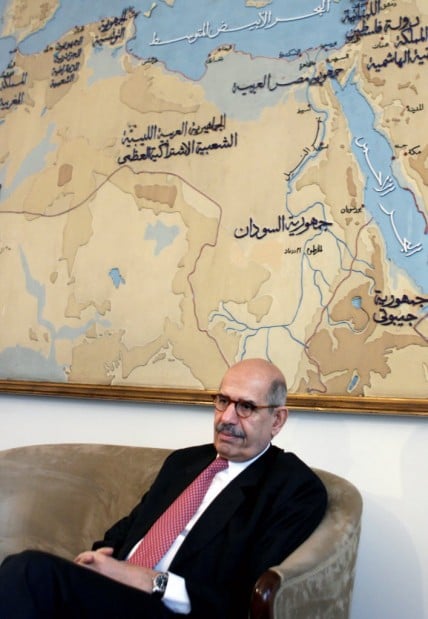
CAIRO - The former head of the U.N. nuclear watchdog agency who has emerged as an opposition leader in Egypt appealed to the government Saturday to heed calls for change before frustration over a stale political system ruled by one man for nearly 30 years spirals out of control.
Mohamed ElBaradei, a Nobel laureate who has seen a wave of support from young people and reformists who see him as a potential challenger to President Hosni Mubarak, told The Associated Press that getting the general public on board with a peaceful movement is his biggest challenge.
The 67-year-old career diplomat - who gained international respect while leading the International Atomic Energy Agency - remained mum about any presidential aspirations, saying a mass reform movement must first take hold.
"You have seen how much support I got even before I set foot in Egypt," ElBaradei said during an interview in the garden of his house on the outskirts of Cairo. "It shows that people are ready, I would say even hungry for change. But this is still something that has to take roots and has to spread to different parts of the country."
People are also reading…
widely respected
As IAEA chief, ElBaradei infuriated Washington by challenging claims Saddam Hussein had a secret nuclear program ahead of the 2003 U.S.-led invasion of Iraq and grappling with Iranian and Korean nuclear programs.
The Bush administration tried to have him removed from office. But the U.S. and its Western allies publicly lined up to praise him in the months before he left the post in late November after 12 years as the public face of world diplomacy on keeping nuclear weapons out of the hands of rogue states.
Respected worldwide and untouched by the corruption tainting much of Egypt's current regime, ElBaradei has turned his focus to promoting electoral reforms and constitutional amendments that would allow a credible rival candidate to run in next year's presidential election.
He has been meeting with various groups at his house since returning to Cairo a week ago after nearly three decades abroad, including women and youth representatives who initiated a petition calling on him to run for presidency. More than 100,000 people have joined a Facebook group supporting his candidacy.
opposition faces barriers
Existing restrictions make it practically impossible for independents or candidates from new parties to run, meaning that ElBaradei's chances would be dim without long-sought constitutional amendments.
Supporters hope his international stature will help protect him from government harassment that has been one of the key factors in preventing past opposition movements from taking hold.
"I hope the government will understand that you don't want for people to reach a point of desperation and then you get into yet another revolution," he added.
The government hasn't publicly commented on ElBaradei's campaign. But he has been criticized by pro-government writers, some accusing him of seeking a constitutional "coup" and others blasting him as arrogant or lacking knowledge of the country because of his long period abroad. One commentator said ElBaradei wants to open the door for more international interference.
corruption, cronyism
Critics accuse the Egyptian government of mismanagement, cronyism and corruption, and violent riots have broken out over the cost of food, with several people dying in 2008 in fights that broke out in lines to buy subsidized bread.
ElBaradei said the majority of Egyptians need to be educated about basic rights and freedom, and he hopes to persuade them to join his movement as a way out of increasing poverty and political stagnation.
"People need to understand the linkage between the bread they eat and democracy. That is not easy. They are not used to that," he said.
The father of two said previous efforts to push for change fizzled because they couldn't muster mass appeal in the nation of 80 million people.
While his meetings this week involved fellow reformists, he said he plans to meet with the general public after returning to Egypt after spending a few weeks abroad for previous commitments.
He is a declared independent and has refused to consider joining an existing political party because of the regime's control over the political system.


