

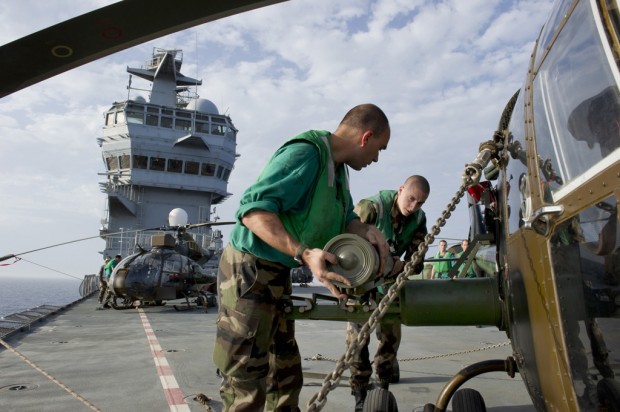
BENGHAZI, Libya - British and French attack helicopters struck for the first time inside Libya, giving the NATO campaign more muscle against Moammar Gadhafi's forces. Hours later, Tripoli was hit by another round of airstrikes and at least eight explosions sounded in the capital.
The use of helicopters significantly ramped up NATO's operations and was a major boost to Libyan rebels, just a day after the fighters forced government troops from three western towns and broke the siege of a fourth.
It was yet another erosion of Gadhafi's power since the eruption in mid-February of the uprising to end his 42-year rule.
NATO said the helicopters struck troops trying to hide in populated areas, military vehicles and equipment. Lt. Gen. Charles Bouchard, commander of the Libya operation, said the engagement "demonstrates the unique capabilities brought to bear by attack helicopters."
People are also reading…
Until now, NATO has relied on attack jets, generally flying above 15,000 feet - nearly three miles high. The jets primarily strike government targets, but there have been cases in which they missed and hit rebels instead.
The helicopters give the alliance a key advantage in close-up combat, flying at much lower altitudes.
The British Apaches hit two targets near the eastern oil town of Brega, according British Maj. Gen. Nick Pope, and separate Royal Air Force aircraft destroyed another military installation near Brega and two ammunition bunkers at the large Waddan depot in central Libya.
Brega is of strategic importance to Libya's oil industry and lies on the coastal road along the Mediterranean that leads to the capital, Tripoli.
Syria
Syrian tanks rolled toward a tense central city mourning the deaths of dozens of protesters, reaching the outskirts late Saturday hours after a funeral procession through streets lined with shuttered shops and uniformed security forces, witnesses said.
The government lifted its stranglehold on the Internet, which has been key to motivating people to join the 11-week uprising, but the crackdown that has left over 1,200 dead since March did not relent: Troops killed at least six protesters in the northern town of Jisr al-Shughour, according to the Local Coordination Committees, which helps organize and document the protests calling for an end to the regime of President Bashar Assad.
More than 70 protesters were killed across Syria on Friday, in what appeared to be among the largest demonstrations yet in the country. At least 65 of those were in Hama, the Syrian Observatory for Human Rights said.
Tunisia
Clashes between tribal factions killed five people and injured 90 others in a depressed southwestern region, Tunisia's official TAP news agency said.
The report said the clashes erupted in the mining town of Metlaoui overnight Friday after rumors surfaced about a change in the recruitment policies of the region's main employer.
Residents opened fire with hunting rifles and lobbed firebombs. The report said barricades prevented law-enforcement officials from immediately entering the town. A curfew has been declared.
Egypt
Angry protesters pelted a police station in Cairo and torched an armored vehicle overnight following the death of a bus driver who fought a police officer. Security officials said Saturday they were investigating the case, which reignited long-simmering anger toward Egypt's security forces.
Details of Mohammed Nasr's death were murky. Protesters attacked the east Cairo police station where he had been taken Thursday after a confrontation with a police officer in a busy square. Some witnesses told a lawyer investigating the case that Nasr had been beaten at the station.
Widespread police abuse was one of the driving forces behind the mass protests that erupted in January and forced out President Hosni Mubarak. Security forces were accused of using excessive force during the uprising, in which at least 846 people were killed.
Unrest in the Mideast


