

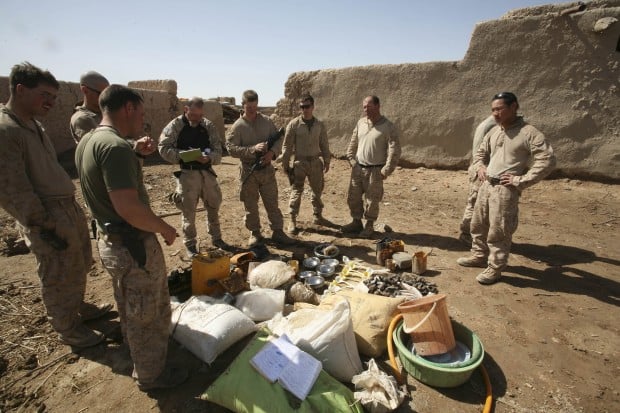
MARJAH, Afghanistan - Even by Afghan standards, it was a startling find: an opium-packaging workshop, buried under donkey dung and old hay in a stable that U.S. Marines turned into a patrol base in southern Afghanistan.
Two U.S. Drug Enforcement Administration employees nosing around the base found about 4 1/2 pounds of opium, five large bags of poppy seeds, 50 or so sickles, jugs and a large scale for measuring opium.
When the Marines leave the compound this week, though, they won't detain the old, bearded Afghan man suspected of owning the hidden cache. Instead, they'll hand him $600 in rent for using his place as a base.
It's a story that illustrates the shift in strategy to stall the Taliban's momentum in Afghanistan. The more than 2-week-old military offensive on the town of Marjah - NATO's largest ever combined Afghan offensive - is a war on the Taliban, not drugs.
People are also reading…
The opium workshop, on a compound near the entrance to the former Taliban-controlled town of Marjah, was found mostly out of luck and idleness.
"I just decided to start poking around," said Joe, who like his colleague, Jack, only went by his first name because they work for a DEA special-intervention unit stationed in Afghanistan. "I've had plenty of time on my hands."
The two DEA agents, both bearded and wearing military fatigues, had been stuck on the compound in Helmand province for the past several days because every Marine convoy heading in and out of the area had struck a roadside bomb, knocking out armored vehicles and considerably delaying travel plans.
Their find went far beyond the staple signs of Marjah's booming opium business. In nearly every farmer's compound, Marines and the DEA have seen piles of dried poppy haystacks, small doses of opium for local consumption and spent syringes.
For years, the Afghan government and its U.S. backer tried to eradicate crops, only to swell insurgent ranks across Afghanistan with impoverished and infuriated poppy farmers.
Now, farmers are left alone, even though Afghanistan produces 90 percent of the heroin worldwide, with Helmand province alone responsible for nearly half of this.
"There sure is a lot of it," Jack said last week, somewhat dismayed as he and the Marines plodded four days in a row through field after field of poppies. The official U.S. policy is now to go after the traffickers and the heroin labs, not producers.
US Toll in Afghanistan
• Deaths: 925
• Wounded: 5,130
Latest identifications
• Lance Cpl. Carlos A. Aragon, 19, of Orem, Utah; assigned to 4th Light Armored Reconnaissance Battalion, 4th Marine Division, Marine Forces Reserve, based out of Camp Pendleton, Calif.
• Spc. Josiah D. Crumpler, 27, of Hillsborough, N.C.; assigned to the 1st Battalion, 508th Parachute Infantry Regiment, 4th Brigade Combat Team, 82nd Airborne Division, Fort Bragg, N.C.
• Spc. Matthew D. Huston, 24, of Athens, Ga.; assigned to the 1st Battalion, 508th Parachute Infantry Regiment, 4th Brigade Combat Team, 82nd Airborne Division, Fort Bragg, N.C.
SOURCE: Department of Defense


