

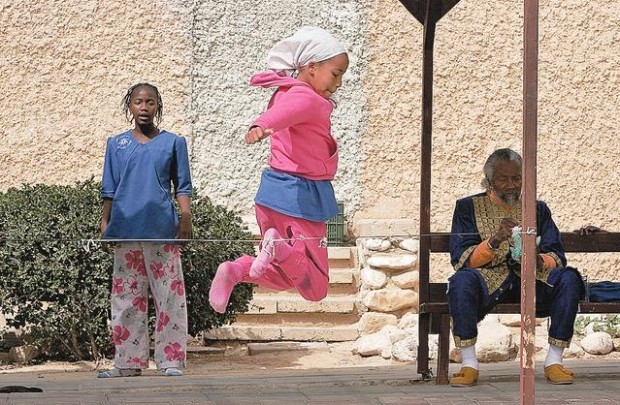
DIMONA, Israel — Israel has denied him citizenship since birth, dismissing his group as a bizarre cult, but all the same, Eddie Butler will represent the Jewish state this year in Europe's biggest song contest.
Butler belongs to the Black Hebrews, a community of polygamous vegans originally from Chicago, who believe they are a lost tribe of Israel.
"I love the state of Israel," Butler said, "and I want to show every black and white person, here and abroad, what we can do."
For that he'll have an international TV audience when he sings "Ze Hazman" — This is the Time — Israel's entry in the Eurovision Song Contest, a 37-nation pop jamboree being held in Athens May 18-20.
The Black Hebrews began arriving in Israel in 1969, following Ben Carter, a Chicago steelworker who renamed himself Ben Ammi Ben Israel and claimed to be God's representative on earth. The government, unsure where they fit into Israel's Law of Return that grants every Jew automatic citizenship, moved them into remote desert towns and left them on temporary visas without permission to work.
People are also reading…
Now, after being marginalized for nearly four decades, things are finally changing for the community, thanks in large part to the music of people like Butler.
Butler was born in a taxi that broke down on the road to a hospital in the Negev Desert 34 years ago. His parents had immigrated here three years earlier to help found the Kingdom of Yah. The African Hebrew Israelites of Jerusalem, as they call themselves, believe they are the lost tribe of Judah, exiled from the Holy Land by the Romans nearly 2,000 years ago.
No scholar gives the idea any credence, "but to any group that does not have a history, this is a very attractive claim," says Rivka Gonen, former senior curator of ethnography at the Israel Museum in Jerusalem.
The first 39 arrivals were followed by nearly 600 more in the next two decades. Arriving on tourist visas, "the Black Hebrews had a very bumpy arrival here," said Yossi Klein Halevi, an Israeli who has written extensively on the group.
They refused to convert to Judaism, even though it would have entitled them to citizenship and the right to work. They considered themselves the true Jews of ancient Israel, and they followed a lifestyle they said was based on the Torah and Ben Israel's teachings, but without traditional Judaism's rabbinical interpretations.
Now a community of 2,500 people in Dimona and two other Negev towns, the Black Hebrews live a communal life, dress African-style and refuse birth control.


