

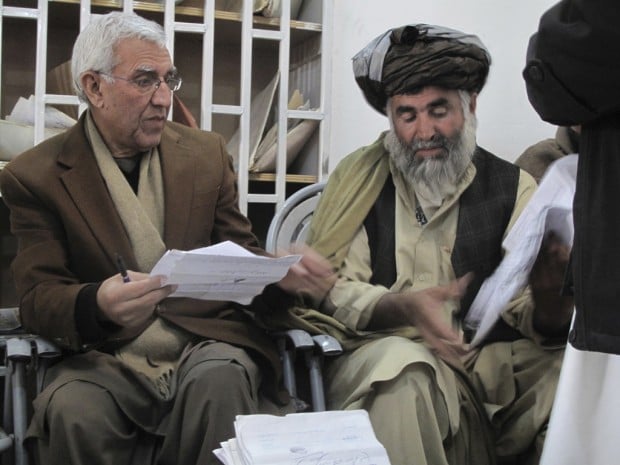
WASHINGTON - As she stood over her father's corpse laid out by the veranda of her home in Kandahar, Rangina Hamidi initially felt grateful. She was relieved the suicide bomber's explosion did not shatter his handsome, angular face, only his back and neck. Then she turned to his feet, still chilly from the hospital morgue. She kissed them.
Now she felt guilty. Several years ago, she was the one who lobbied her father, Ghulam Haider Hamidi, to quit his routine accountant's job at an Alexandria, Va., travel company and move home to Kandahar, Afghan-istan, where he served as mayor until his assassination last week.
"I apologized and said, 'I am sorry for bringing you here,'" Rangina, 33, a consultant to a U.S. Agency for International Development contractor in Kandahar, recalled in a telephone conversation.
In the days since Hamidi's death - for which the Taliban asserted responsibility - a deep grief has spread from Afghanistan to his relatives and friends in northern Virginia.
People are also reading…
His killing also illustrates the risks Afghans and other exiles can face when they ponder a return to their homelands: prestige, power and money may await, but also war and danger.
Three decades ago, Ghulam Hamidi had fled Afghanistan after the communist takeover and the Soviet invasion. In 2007, he returned to his homeland, leaving rural Aldie, Va., his long accountant's career and a large family. Four of his children live in northern Virginia. (His wife, Spoozmi, followed him later.)
Rangina said she sensed that her father, who had worked at TransAm Travel in Alexandria for 18 years, was bored.
"It was the usual nine-to-five job with two or three weeks of vacation. He worked all his life, and I could see the mundane work he was doing in America," she said. "All my sisters and brothers were against it, but I was the one who said, 'Let him experience something new.'"
For Hamidi, who had studied finance at Kabul University, that meant accepting an appointment by President Hamid Karzai to run the nation's second-largest city, once a Taliban hub.
In Virginia, the family treated Hamidi, 65, with the respect afforded a patriarch. He was treated with similar respect at TransAm Travel.
In Kandahar, Hamidi helped to build schools, pave roads and plant trees, but at a cost that also earned him enemies. He ordered the bulldozing of unregistered shops, banned illegal sidewalk vendors and evicted squatters.
As for finding the plotters behind their father's death, Rangina and her brother Ahmad expressed ambivalence.
Said Ahmad: "Half of me wants to have my vengeance, but the other half tells me to forgive my enemies - that's what my father taught me."
A1 DECK 14 gets one line before story like this
U.S. Toll in Afghanistan
1,576
Deaths
13,011
Wounded
Latest identifications
• Sgt. William B. GrossPaniagua, 28, of Daly City, Calif.; assigned to the 3rd Brigade Special Troops Battalion, 3rd Brigade Combat Team, 25th Infantry Division, Schofield Barracks, Hawaii.
• Staff Sgt. Leon H. Lucas Jr., 32, of Wilson, N.C., died Aug. 1 in combat operations in Helmand province; assigned to 3rd Battalion, 4th Marine Regiment, 1st Marine Division, I Marine Expeditionary Force, Twentynine Palms, Calif.
• Pfc. Brice M. Scott, 22, of Columbus, Ga.; assigned to 4th Squadron, 4th Cavalry Regiment, 1st Heavy Brigade Combat Team, 1st Infantry Division, Fort Riley, Kan.
• Staff Sgt. Patrick R. Dolphin, 29, of Moscow, Pa.
• Sgt. Dennis E. Kancler, 26, of Brecksville, Ohio.
• Sgt. Christopher M. Wrinkle, 29, of Dallastown, Pa.
All assigned to 2nd Marine Special Operations Battalion, Marine Special Operations Regiment, U.S. Marine Corps Forces Special Operations Command, Camp Lejeune, N.C.
SOURCE: Department of Defense


