

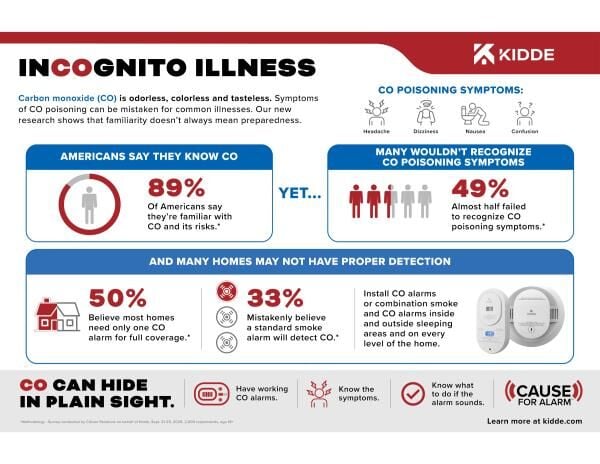
(StatePoint) Americans know carbon monoxide (CO) is dangerous. Yet new research suggests many underestimate how easily exposure can be missed, misunderstood, or mistaken for something else.
According to a survey of 2,000 American adults, 89% say they are familiar with CO and its risks, yet 43% acknowledge knowing only the basics about its sources and how to protect themselves. When presented with common symptoms such as headache, dizziness, nausea and confusion, nearly half (49%) failed to identify CO as a potential cause, revealing a disconnect between awareness of the threat and the knowledge needed to recognize potential exposure.
To help close this potentially life-threatening knowledge gap, Kidde, an authority in home and life safety for over 100 years, has launched “InCOgnito Illness,” a new educational video as part of its annual Cause for Alarm campaign. The video challenges everyday Americans, including parents, pet owners, seniors, healthcare providers and travelers, to recognize how CO poisoning symptoms can resemble common illnesses, including the flu and food poisoning.
People are also reading…
Symptoms Can Hide in Plain Sight. CO is an odorless, colorless and tasteless gas that can be produced by fuel-burning appliances and equipment, including gas furnaces, fireplaces, generators and vehicles, making exposure difficult to recognize without reliable detection. Charon McNabb, president and founder of the National Carbon Monoxide Awareness Association (NCOAA), says too often families don’t realize they’ve been exposed to this invisible threat until it’s too late. “CO poisoning symptoms are easily mistaken for the flu, a cold or just feeling run down, which is why a working CO alarm is so important,” McNabb said. “Through our partnership with Kidde, NCOAA is helping families take simple steps to prevent CO poisoning: Install alarms in the right places, have fuel-burning appliances inspected every year, and know exactly what to do when an alarm sounds. These small actions help save lives.”
CO Can Strike Without Warning. Exposure can happen when you least expect it, as Crystal Evers, Mrs. Illinois USA 2026 and a CO poisoning survivor, knows firsthand. After a hidden leak from a pool heater filled her parents’ new home with deadly gas, Evers lost her mother within hours. She now shares her story to help prevent similar tragedies.
“My parents had just moved into their new home, and their CO alarms had not yet been installed. We lost my mother in just hours. Making sure your CO alarms are installed and working from day one is critical to helping protect your family,” said Evers.
Vulnerable Populations May Face Greater Risk. Children, older adults, pets and others may be especially vulnerable to the effects of CO exposure, making it important for caregivers to recognize potential warning signs. In fact, lower levels of CO may affect these individuals before symptoms are even recognized. That’s why early detection technology is especially important for families and pet owners.
Know the Signs. Take Action. CO poisoning symptoms can include headache, dizziness, nausea, weakness and confusion and may be mistaken for other illnesses. Because CO cannot be seen, smelled or tasted, working CO alarms are an important part of helping detect its presence.
Detection is Critical. Consumers should look for alarms that are independently tested and listed by a Nationally Recognized Testing Laboratory, such as those carrying an ETL Listed or UL Listed Mark. Kidde’s latest generation of CO alarms includes enhanced detection technology, with low-level CO alerts available on select devices.
Safety Doesn’t Stop At Home. Risks don’t disappear when you travel. Hotels, vacation rentals, cabins and other temporary accommodations may have unfamiliar heating systems or completely lack CO devices. According to the National Conference of State Legislatures, only 14 states require CO alarms in hotels and motels. This makes preparedness an essential part of everyone’s travel planning.
After Chuck and Jill Heathco’s son, John, passed away in 2023 from CO poisoning while staying in a Cabo San Lucas hotel, the family founded the John Wesley Heathco Legacy Foundation to honor their son and raise awareness about CO poisoning, especially while traveling. Chuck Heathco reminds everyone, “After losing Johnny, we want other families to understand that CO safety doesn’t stop at home and taking steps to help protect yourself while traveling can make all the difference. We hope Johnny’s story encourages families to make CO safety part of every trip.”
Travelers should consider bringing a Kidde AA-battery-operated CO alarm to add a layer of on-the-go CO detection. These devices are not approved for RV or boat use and are for use in conditioned spaces only. Pack the device carefully to avoid damage, remove batteries prior to travel, reinsert upon arrival and test device before use to ensure it’s working properly.
Watch the “InCOgnito Illness” video on Kidde's YouTube channel and visit Kidde.com to learn more about recognizing the symptoms of CO poisoning, preventing potential exposure and helping protect what matters.
*****


