The following is the opinion and analysis of the writer:

Richard Boren
"The very fact that the jaguar can become extinct while the Pekingese survives indicates to me that someone hasn't thought this thing through." — A. Whitney Brown
In 1981 I got beamed up by Scotty from Boone, N.C., and dropped into the Amazon Basin of Ecuador for a three-year stint as a Peace Corps volunteer, where I made many month-long forays into jaguar habitat, but of course never saw one.
My job as a land surveyor with the Shuar Indigenous Federation demarcation project took me deep into the jungle, flying in four-seater Cessnas with bush pilots who could land on a dime. The Shuar see the jaguar as a bridge to the spirit world with great warrior discipline, and the Shuar themselves continue their warrior path peacefully resisting oil and mineral extraction on their lands. After my time living on the equator, I eventually landed in Southern Arizona, where jaguars had become extinct in the 1960s due to a federal eradication program.
People are also reading…
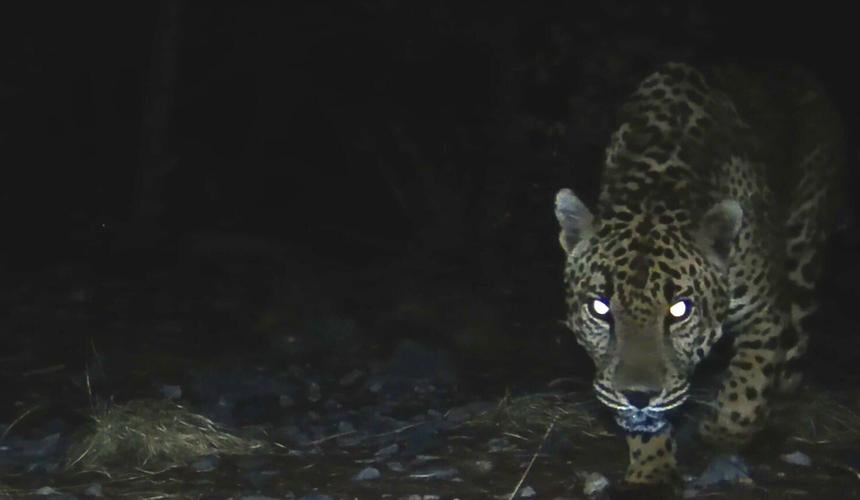
Starting in 2009, I began following articles in the Arizona Daily Star that reported the occasional lone male jaguar caught on wildlife cameras in Southern Arizona (so far, no females). Last Aug. 14, an article in the Star caught my attention: "Jaguar filmed in Southern Arizona as advancing border wall threatens his return route to Mexico". It stated that a jaguar was filmed in an undisclosed area just north of the San Rafael Valley, where construction of the double 30-foot-tall border wall is tearing a huge scar through the desert and where a tree-sit protest in Lochiel is ongoing.
Then a subsequent headline article on Aug. 30, "Female jaguar confirmed near (AZ) border", raised the tantalizing prospect of a breeding population of jaguars naturally reestablishing in AZ, if the wall doesn't slam the door shut first.

The University of Arizona Wild Cat Research & Conservation Center tracked this southern Arizona jaguar around the Coronado National Forest in 2023 and 2025. He was seen at six different camera trap locations.
Resistance to the border wall is entwined with protection of fauna and flora, and the Aug. 14 article stated that folks "have been taking turns camping in the branches of a giant Fremont cottonwood to stop a border-wall construction crew from knocking the tree down". Participants in the tree-sit have pointed out how the San Rafael Valley is one of the last major jaguar corridors into the U.S., and remaining jaguar habitat in the U.S. could become logged and mined if the Trump administration is successful at repealing the "Roadless Rule" in national forests.
The Tohono O'odham Nation, which shares a 62-mile-long border with Mexico, also considers the jaguar sacred. Austin Nunez, chairman of the San Xavier District of the Tohono O'odham, stated in 2024, “As O’odham we view jaguars as protectors of our people and the environment.” The O'odham's long struggle to prevent a border wall from desecrating their lands has come to a boiling point as armed federal agents are accompanying border wall construction crews who have ignored posted signs.
In August, I got to hear directly from someone on the front lines of jaguar conservation in Sonora when the Border Community Alliance sponsored a talk by Allison Kreis of La Tierra del Jaguar, an organization based in Sahuaripa, Sonora, in the Sierra Madre Occidental. Sahuaripa is the site of a 56,000-acre jaguar reserve managed by the allied Northern Jaguar Project. Kreis, who studied animal sciences at the University of Arizona, previously worked for the Reid Park Zoo and Arizona-Sonora Desert Museum. Kreis's inspiring talk covered their work to protect wild jaguars in Sonora, where 80% of the state is used for cattle ranching. Jaguars are considered critically endangered in Sonora, with an estimated population of 150 jaguars.
La Tierra del Jaguar prioritizes working with ranchers and local communities through environmental education, regenerative farming practices, and projects to address the economic needs of the area while protecting wildlife corridors. Kreis also paints murals, and she recounted how previously the image of a jaguar used to cause a strong negative reaction among many in this ranching community, while now the community has embraced jaguar conservation to the point where the municipality of Sahuaripa uses the jaguar as an official symbol. ¡¡¡Que viva el jaguar!!!
Follow these steps to easily submit a letter to the editor or guest opinion to the Arizona Daily Star.
Richard Boren is a retired educator/environmental consultant who lived and worked over 20 years in Latin America, and embraces the fronterizo label.