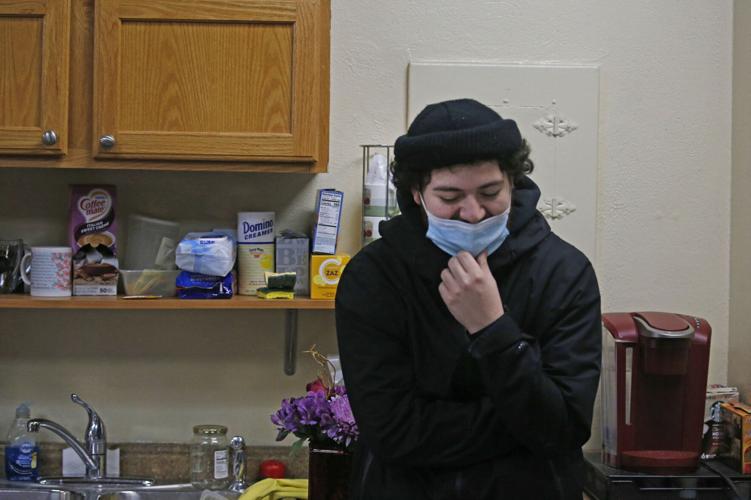
Marcos Vazquez stopped by St. Luke’s Mission of Mercy Thursday morning, just before he left for work. Some trusted mentors had told him an unnamed donor would provide a bit of help in paying for his car, and Vazquez felt a little overwhelmed at the attention even before he set foot in the main office.
“I’m not the only one,” he said, conscious of the pandemic struggles confronted by people all around him.
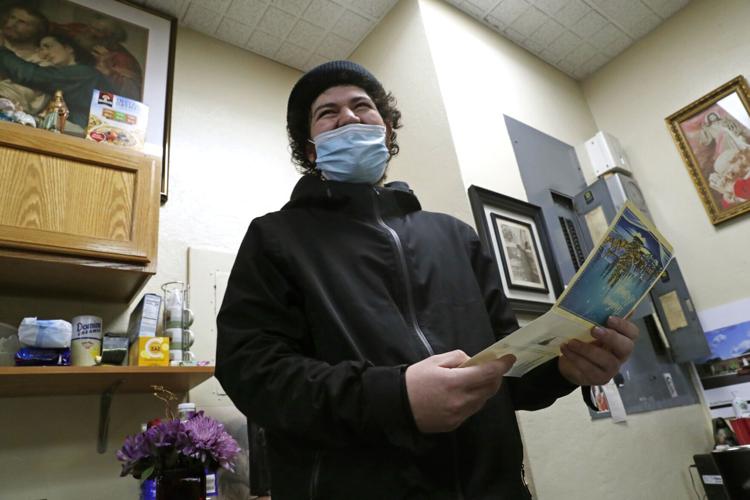
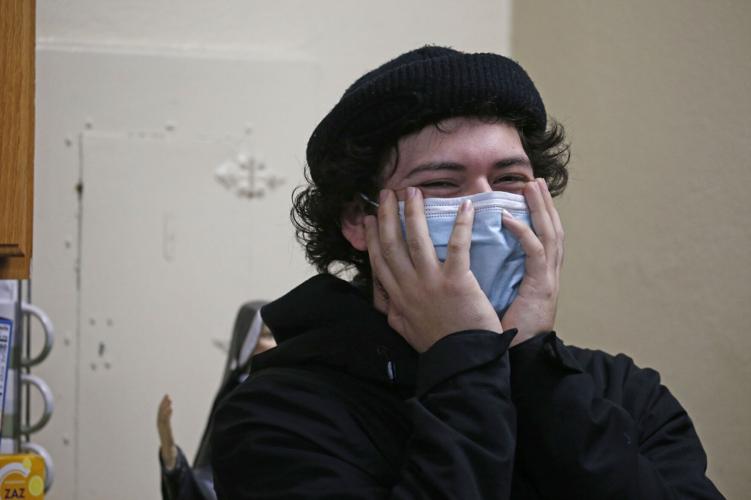
That feeling was only amplified when Amy Betros, co-founder of St. Luke's, reached up from her desk to show him the contents of what appeared to be a typical Christmas card. Vazquez marveled at the heft of it, then reeled back in joyful disbelief, emotion so evident the entire room joined him in astounded laughter.
Even in a place built on a foundation of selfless acts, mission finance director Sandy Bernstein said the delivery of this particular gift was not quite like anything they had seen before.
People are also reading…
Before we get to the contents of the envelope, a little background: Vazquez, who just turned 21, was at the heart of a Buffalo News column I wrote a few days before Thanksgiving. For about a decade, he has lived in a house on the mission campus with his sister Jessica and his mother, Sonia, a St. Luke’s volunteer.
Restless and eager to get to work, he left high school early to find a job. To Mike Taheri, a Buffalo defense lawyer and longtime St. Luke's director of education, the young man quickly emerged last year as a living symbol of the monumental obstacles faced by thousands in greater Buffalo since the arrival of Covid-19.

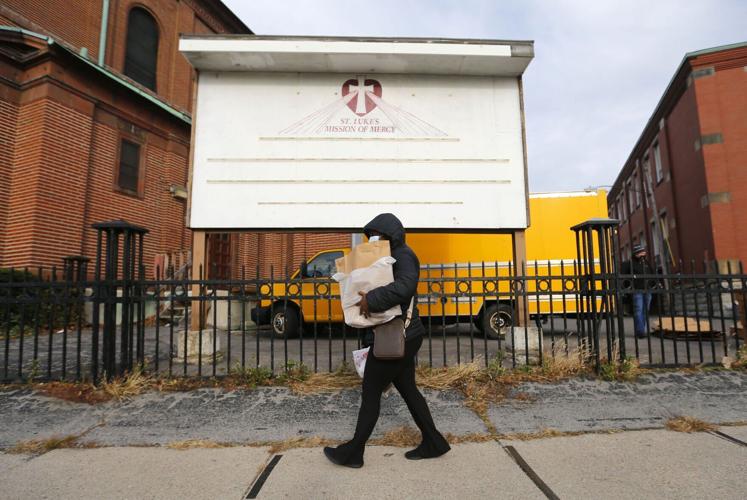
Administrators at St. Luke's Mission of Mercy estimate the need for food for struggling families has tripled during the pandemic.
On the urging of Taheri, a trusted mentor, Vazquez earned his high school equivalency certificate. He also held a job at a chain hardware store, a job that required riding the bus to work until Vazquez saved up about $1,000 and bought a 2006 Jeep Cherokee that made his life significantly easier.
The engine blew up on a summer day on the I-190. Not long afterward, Vazquez was laid off from his job as a result of pandemic cutbacks.
That meant his only way of looking for work was by using his phone. He barely had the money for bus fare, much less Uber, and he quickly discovered that arriving by bus at suburban job interviews was difficult at best, and often impossible.
“My mom knows a thing or two,” Vazquez said, referring with admiration to the way his mother – who has navigated many difficulties in her own life – kept promising things would somehow turn around. Even so, he reached a point last autumn when he had no prospects for a job and he had fallen behind on payments for his phone. Faced with the restrictions of Covid-19, he could not even find the typical release of standing around, shoulder-to-shoulder, to vent with his friends.
“I know this sounds a little dramatic, but I felt as if my life was over,” Vazquez said. “I was angry and upset and sad and miserable.”

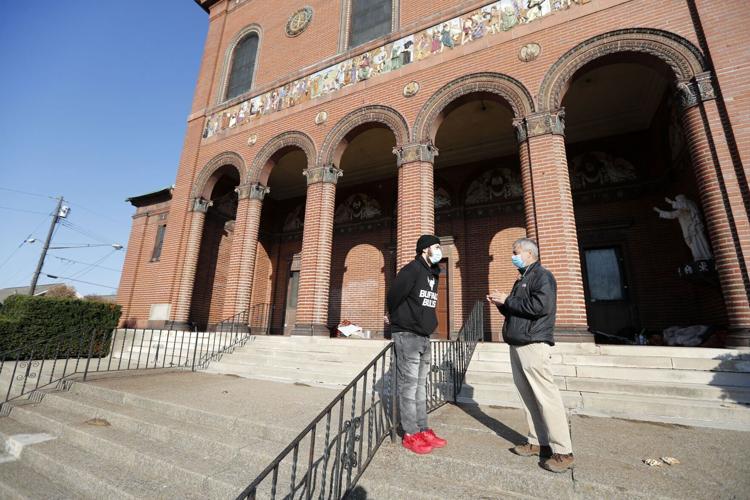
Marcos Vazquez with a mentor, Mike Taheri, in November at St. Luke's Mission of Mercy in Buffalo.
It was at this point that Taheri told me the story out of concern for Vazquez, a guy whose persistence he admires. Considering the realities of Covid-19, Taheri said Vazquez was trying to find a way through the kind of relentless difficulties endured by a legion of families throughout greater Buffalo.
The evidence, Betros says, is at the front door of the mission, where the staff is providing two to three times the number of daily meals as compared to a year ago, when the pre-pandemic need was heartbreaking enough. Each morning, Betros said, she wakes up to turn mission business into what she describes as a kind of high-stakes chess game.
“Covid makes a move,” she said, “and then I make another move.”
As we neared Thanksgiving, I wrote a piece that focused on Vazquez. In a sense, it was also about all the Western New Yorkers who are either working at jobs that barely pay the bills or cannot find any work at all in the pandemic. The column appeared as we moved into the Yuletide, a time of traditional selflessness and empathy, which led Taheri to speak with worry of a hard new year ahead.
“Christmas starts Jan. 1,” he said, offering a wish for long-term compassion.
For Vazquez, in totally unexpected fashion, it came true.

Throughout Western New York, the pandemic only intensifies the crisis for those who have the least. But St. Luke's Mission of Mercy remains a beacon in the community for those in need.
Shortly after the piece appeared, Vazquez - with Taheri's guidance - landed a job with a detailing company at the West Herr Auto Group in Hamburg. Once there, aware of the situation, dealership president Scott Bieler covered a down payment for Vazquez on a used Nissan Altima, which gave Vazquez a way to travel from the city to his work and left him with a car payment he could handle, thanks to a steady paycheck.
All of it leads into one more recent twist: In the same way as so many others in this community, I find myself doing much of my work from home, which means I had not been to our newsroom in many weeks when I stopped by not long ago to catch up on my mail, on a quiet evening.
The stack in my mailbox included what appeared to be an unusually heavy Christmas card. When I opened it, in an honest-to-God moment that reminded me of a cartoon, a little cloud of crisp $100 bills went fluttering into the air.
While I have worked as a journalist since the 1970s, I had never seen anything like this. Stunned, with money scattered at my feet, I pulled out an unsigned note.
“I want to ask you to take care of something for me,” wrote the unnamed correspondent, adding that “it hurt me to see the struggles of Marcos and his difficulties with his car.” The anonymous note mentioned there was money enclosed to “help him get another car and hopefully be able to find a job.”
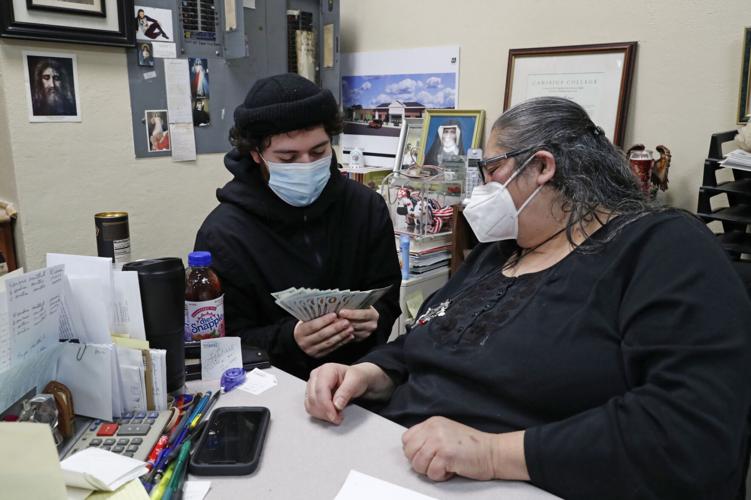
Inside the envelope: $4,000 in $100 bills, which is why Vazquez offered a kind of jubilant gasp when Betros handed him the card Thursday, at the mission.

Marcos Vazquez, 21, reacts after being informed that an anonymous donor gave him $4,000 to help him secure a car for work. He is with Amy Betros, right, president and director of St. Luke's Mission of Mercy.
Vazquez wants the donor to know how grateful he is. "It's not just me," he said, reflecting on what that envelope means to his family. Plenty of people in Buffalo are in an even harder spot, he said, noting the money is now part of this plan: St. Luke's is turning the cash into a check that will be used in its entirety, as requested, to knock off a major piece of what Vazquez owes on his car – meaning that before long the vehicle will be his, free and clear, due to the gift.
He has spent the past few days contemplating the best means of expressing thanks. The idea of a stranger believing in him to such a degree is staggering, he said, and he made a promise that Betros, Taheri and Bernstein have no doubt he will keep:

Marcos Vazquez, 21, reacts after being informed that an anonymous donor gave him $4,000 in a Christmas card to help him secure a car for work. He opened it in the office of Amy Betros, president and director of St. Luke's Mission of Mercy in Buffalo.
“No one had to do that specifically for me,” Vazquez said, “and it makes me want to do the same thing for someone else in the same position.”
He realizes the barriers he encountered are hardly unique. Countless others – including many of those who routinely show up for a meal at St. Luke’s – are one illness, lost job or unexpected bill away from economic catastrophe in this pandemic.
With that in mind, as Vazquez prepared to leave for work, I asked about his major goal in life.
“My dream is just to be stable and not to just get by, and not to live day by day and paycheck to paycheck,” Vazquez said.
In all ways, more than ever, he knows he is not alone.