At this point last summer, Larry and Cindy Wood had just left Colorado to settle near their daughter's family in Genesee County. Larry was retired from the Army, and the couple had spent much of their adult lives moving around. Still, Tiffany Gould knew how to make her parents feel at home.
A year ago this month, the Batavia Muckdogs provided a three-for-one welcome of fireworks, baseball and family just before the Fourth of July.
The game was on the eve of the holiday, a celebratory time at Batavia's 2,600-seat Dwyer Stadium. Tiffany talked it over with her husband, Joe, and their kids, Michael and Emily, and decided to treat her parents to a night at the ballpark. The Woods, who used to be season ticket holders for the big-league Texas Rangers, quickly embraced the club, the last charter city in the New York-Penn League — a circuit formed in 1939, thanks in part to a pivotal meeting in Batavia.
People are also reading…
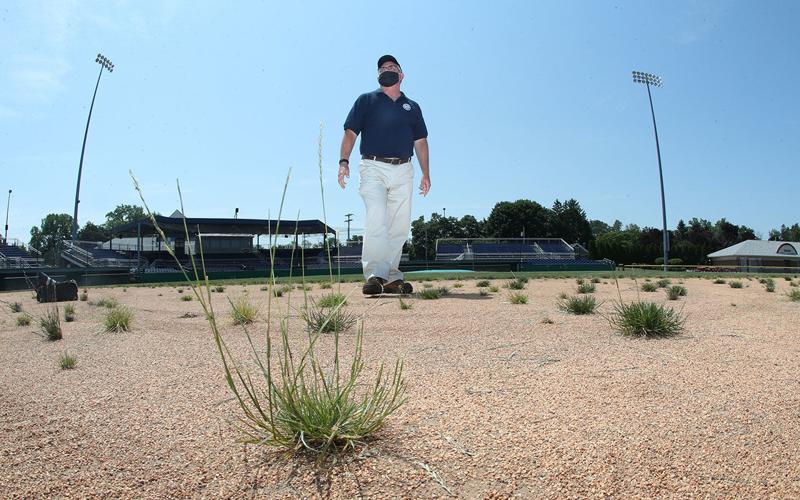
“It’s pure baseball,” Larry said Thursday of the Class A Muckdogs, still refusing to speak in the past tense. A few days ago, he and his family stopped by Dwyer to walk across a diamond unused for so long that dozens of weeds are pushing through the base paths. Minor League Baseball announced last week that it is officially canceling the 2020 season due to the pandemic, a shutdown coupled with a more distressing prospect for Batavia, population just a little north of 14,000:
The Muckdogs might not return at all.
“My fear is that we’ll never see professional baseball here again,” said Matt Worth, Batavia’s director of public works, who unlocked a door and allowed a few visitors to take a reverent walk around the silent field.

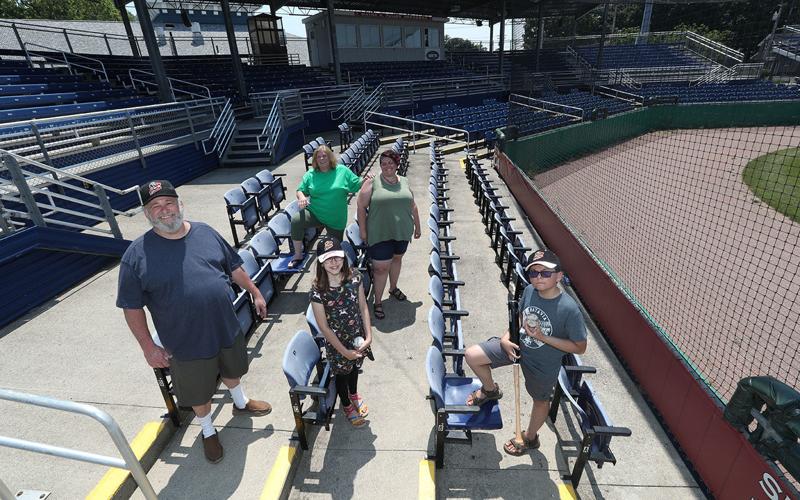
A family missing the Muckdogs: From left at an empty Dwyer Stadium, Larry and Cindy Wood and daughter Tiffany Gould; in foreground, 10-year-old Emily and 12-year-old Michael Gould.
Worth, who went to many games as a child, remembers when home runs would bounce toward swimmers in an old community pool beyond the right-field fence. He pointed out an ancient Batavia Youth Football League scoreboard, a reminder of when that league played on the outfield grass. Yet Major League Baseball, in renegotiating its Professional Baseball Agreement, reportedly wants to cut off 42 minor league teams — including Batavia, Auburn and most of the New York-Penn League.
“They’re in a really tough spot,” said Jeff Lantz, a spokesman for Minor League Baseball. His organization, he said, is “still fighting” to save those clubs. Even so, if the 42 teams end up being lost, he doubts a lingering dream for the league will come to be.
There would not be one final summer in 2021 for such clubs as the Muckdogs, Lantz said — meaning Batavia would get no real chance to say goodbye.
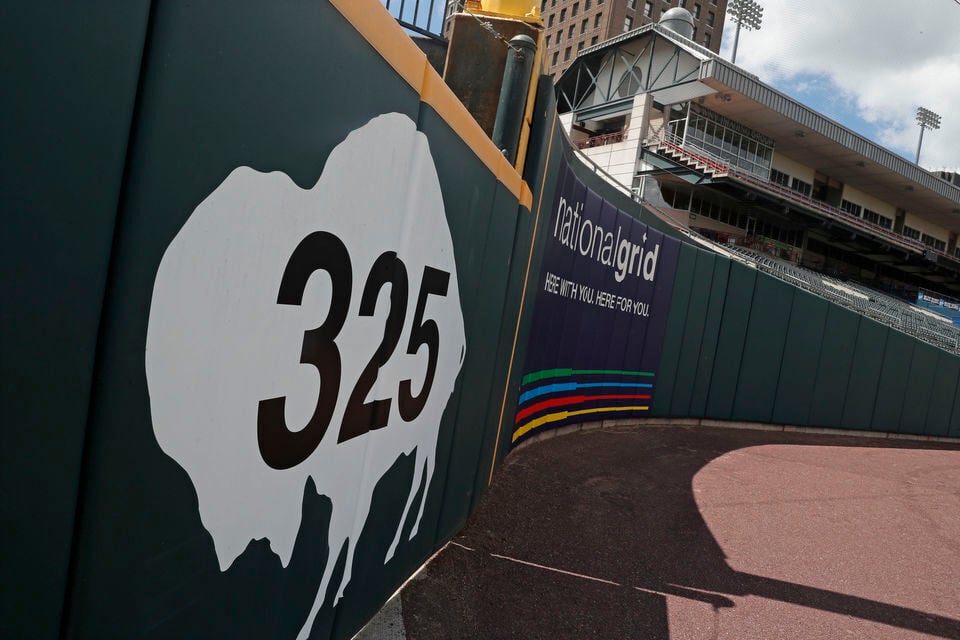
Dire straits.
Two words that describe the situation for Minor League Baseball. The Bisons and roughly 160 other teams are on pause until April 2021. We have no idea what things will look like when they come back. And for many teams, if they come back.
“We feel like we were robbed by Covid-19," said Russ Salway, speaking of a season that never was. Salway, who works for O-AT-KA Milk Products — the company whose name adorns the Dwyer scoreboard — has been involved for decades in Muckdogs baseball. He lives within walking distance from the ballpark, serves on the executive board of the Genesee County Baseball Club and was one of the locals who routinely offered lodging for young ballplayers.
Despite that passion, fear of losing the team is such an annual concern that his "Let's Keep the Muckdogs in Batavia!" Facebook page is more than a decade old.
Salway remembers the civic worry a few years ago when the league assumed control of the team. It was no death knell: Under general manager Brendan Kelly, the Muckdogs — affiliated with the Miami Marlins — drew more than 43,000 fans in 2019, their best turnout in years. They captured their division and won their only home playoff game, a 4-1 victory over Lowell that ended — as verified by official scorekeeper and public address man Paul Spiotta — when Muckdogs pitcher Evan Brabrand coaxed a grounder out of Lowell's Gilberto Jimenez, which might turn out to be the last New York-Penn League at-bat, as in ever, at Dwyer Stadium.
That kind of tale is the province of Bill Kauffman, an author and journalist who made a fateful decision in the late 1980s, based on his philosophy on what matters in life: He left Washington D.C. with his wife, Lucine, a California native, and returned to his hometown. He eventually became a board member of the community group that ran the team and, most important, a keeper of its lore — a passion made clear in his 2004 reflection on his hometown, "Dispatches from the Muckdog Gazette."
Kauffman will tell you that it was WBFO "Morning Edition" host Jay Moran and his wife, Sandy Konfederath, who came up with the well-loved team nickname. They submitted their idea in a community contest to name the club in time for the 1998 season — not long after the ballpark was rebuilt to appease the majors — leaving Moran to recall how he and Konfederath both wanted to honor the famous muck farms of nearby Elba.
“And why not a dog?” Moran asked, knowing a canine mascot could be, well, the closer.
As for Kauffman, he prefers to focus on what comes next for baseball in Batavia, rather than dwelling on what he anticipates will be a classically self-destructive choice by Major League Baseball.
“If they had one ounce or even a smidgen of sentiment, they wouldn’t do it,” he said.
Dwyer Stadium, he said, is the kind of haven that builds generational loyalty to baseball itself. "When I go there," Kauffman said, "I feel the presence of the people who were there when I was a kid, all those who came before and I've always thought it would be there for all those who would come after."
He pointed out a plaque for the late Phil Zipkin, owner of a Batavia scrapyard and “kind of a reverse scalper” who would set up near the main gate and hand out free tickets to grateful fans.

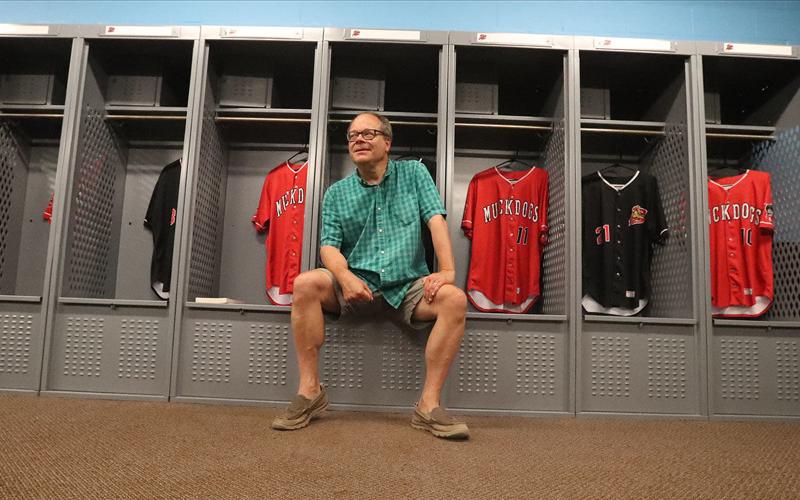
Bill Kauffman, a writer, informal historian and longtime champion of Muckdog baseball, in a Dwyer Stadium lockerroom prepared for players who are not coming.
Kauffman was there when a young Ryan Howard, later a star with the Phillies, hit what spectators instantly knew might be the longest home run in ballpark history — a shot that electrified an otherwise forgettable night and ended up rolling into the distant Batavia High School parking lot.
He recalls the late Edward Dwyer, a shoe store owner who served as team president for 40 years and lived to see the ballpark named in his honor. Dwyer was the kind of citizen who was gracious to everyone — except at home games when he would settle into his seat “and absolutely lacerate the umpires,” said an awed Kauffman, who describes Batavia as an enduring example of how the entire New York-Penn League has powerful Western New York roots.
At different points, it included such communities as Lockport, Olean, Jamestown and Niagara Falls — places where a minor league team offered a larger statement.
“The ballpark gave you a sense of belonging, of community, without social distinctions,” Kauffman said.
He likes to think, even if the Muckdogs are no more, that a wooden bat league could offer some reflection of that warmth. Tiffany Gould shares in that hope, though she will need a little time to grieve for her favorite team.
Last Christmas, she and her husband bought season tickets as a gift for Tiffany's parents, expecting to spend much of this summer at the ballpark. To understand such loyalty, she said, consider this: Her son Michael, then 11, used to watch with awe as older boys successfully chased down foul balls, even as he routinely came up empty-handed.
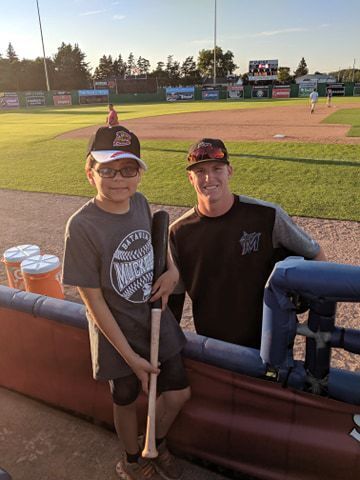
Michael Gould at a Muckdogs game last summer, after first baseman Sean Reynolds surprised him with a bat.
A family friend noticed and cooked up a surprise. One night, Muckdogs first baseman Sean Reynolds emerged from the dugout after a game and waved for a surprised Michael to come down. Reynolds promptly handed the kid a cracked bat, dust from the infield still on the handle.
The bat and the moment will always stay with Michael, reinforcing Kauffman's whole point about what professional baseball should not be so willing to let go.
Thursday, in a quiet ballpark where the empty locker room holds laundered Muckdog jerseys for players who will not arrive, near a tattered outfield sign that reads “The future plays here,” Tiffany Gould watched her son hold his bat in the way of a sacred relic.
“You always thought,” she said, “that we’d get one more season.”
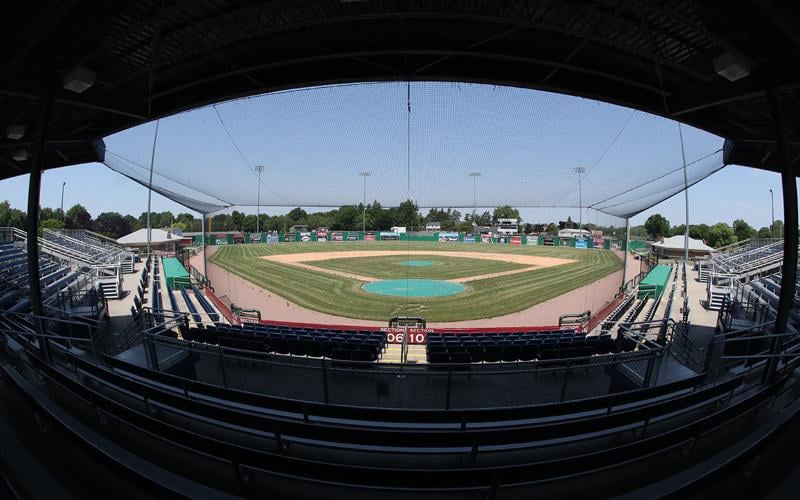
Writer and historian Bill Kauffman wants to keep baseball alive at Dwyer Field in Batavia.