

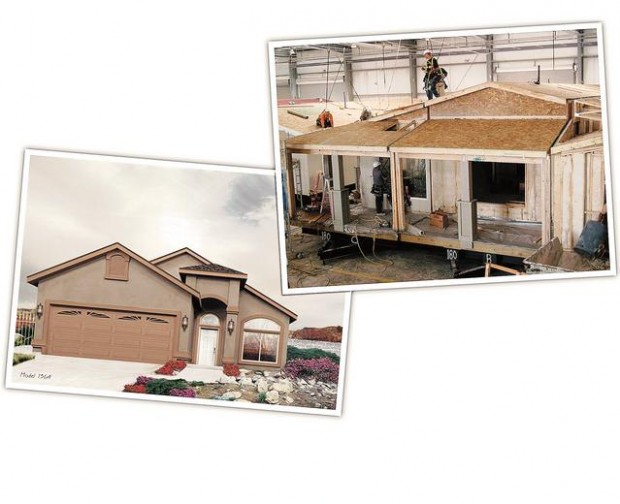
Here's a new sight in Tucson's home-building market in Tucson: digs on rigs.
OK, so maybe the sight of half a house on a tractor-trailer isn't exactly new, but Clayton Homes, a modular- and manufactured-home builder based in Maryville, Tenn., is making a foray into the Tucson market with its 77-unit development called Desert Vista Estates, near Interstate 10 and East Valencia Road.
"We really want to wait and see," said Scott Flanary, the project manager. "We think we're going to be extremely strong. We think we've got a good price range, and hopefully we'll be successful."
Although sometimes described as a high-quality type of affordable housing, Clayton's modular homes may not be the least expensive new construction in town. Although no public report has been filed and no prices have been finalized, Flanary said the company is kicking around a range of $197,000 to $247,000. The smallest home is about 1,370 square feet on a 7,000-square-foot lot.
People are also reading…
Renderings of the project were recently presented to billionaire investor Warren Buffett, chairman and CEO of Berkshire Hathaway Inc., Clayton's parent company, said Sofi Loomis, an agent with Realty Executives of Southern Arizona who is working on the project.
Sales and construction could start by the end of summer, Loomis said. The company is still filing paperwork. Lots already have been improved, and concrete has been poured.
Loomis said she thinks the project will appeal to home buyers "so they don't have to travel out to Benson and allow for housing in the city and not in the outskirts of the city."
So why buy a modular unit when some site-built homes are selling for less?
"Qualitywise, we think we kill them," Flanary said. "These are system-built homes. It's built in a climate-controlled environment. It's not framed on site. The quality is extremely stringent.
"We've got 6-inch (thick) walls, whereas others are 4-inch walls," Flanary continued. "Our finished garages are standard. Nine-foot ceilings — standard. You're going to get a lot more bang for your buck with us."
Flanary said the company also is opening subdivisions in Tennessee and Florida.
The homes that we'll see in Tucson will be about 70 percent assembled at a plant in Albuquerque and then trucked here. A 40-ton crane will lift sections of a home off the truck and onto a concrete foundation. Garages will then be added on, and the outside will be covered in stucco.
Modular homes are "as good as a stick-built homes," Flanary said. "These are not trailers. Matter of fact, that's a dirty word in our business."
Clayton, however, won't be the first to build a local subdivision of modular homes.
A few years ago, developer Bob Sharpe sold about 130 modular units built by Phoenix-based Cavco Homes in his award-winning Rancho Resort community.
Sharpe said the homes were about half-built in the factory and then completed on site with tile roofs, garages and stucco exteriors.
"The end result was it looked like conventional housing," he said.
Sharpe said the company switched to site-built homes because the modular homes were roughly 30 percent more expensive to build.
Originally on a land-lease agreement, buyers did have trouble finding conventional financing. Sharpe's company has since sold about 90 percent of the lots to homeowners. In Rancho Resort, Del Webb has built more then 200 homes, Hamco Homes plans to build about 200 more, and another 450 home sites are in escrow with a national builder, Sharpe said.
Modular homes can be delivered less expensively and more quickly than site-built homes, Sharpe said. However, the estimated price range for Clayton's new project "doesn't sound as affordable, and I'd like it to be," Sharpe said.
REAL ESTATE