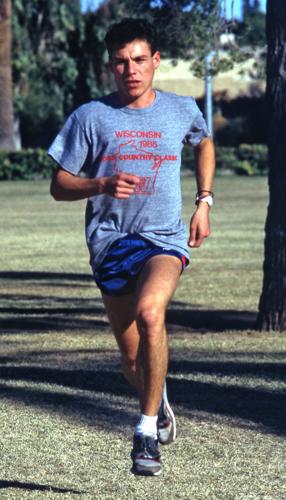

NOV. 24, 1986: ARIZONA PLAYS HOST TO THE FIRST OF THREE NCAA CROSS COUNTRY CHAMPIONSHIPS: 1986, 1991, 1996
In its transition from the WAC to the Pac-12, Arizona was a distance running power before anything else.
You can look it up. The Wildcats won four league championships in men’s cross country before Lute Olson reached the 1988 Final Four.
During an impressive stretch in which Arizona won the 1983, 1984, 1986 and 1987 Pac-10 championships, athletic director Cedric Dempsey and cross country coach Dave Murray began thinking in bigger terms.
The Wildcats and the NCAA agreed to stage the men’s and women’s cross country championships in Tucson in 1986, 1991 and 1996. It was a fitting celebration to Arizona’s arrival as a national power.
“As much as we wanted to showcase our program, we wanted to get the NCAA championships in a location with better weather in late November,” remembers Murray, who is retired and lives in Tucson. “Now the championships are held almost exclusively in Terre Haute, Indiana, but we had a very nice run in Tucson.”
People are also reading…
Two weeks after winning the ’86 Pac-10 title, Arizona’s men’s team was ranked No. 2 nationally on a sunny Monday morning when about 350 of the nation’s top college distance runners — men and women — arrived at Oro Valley’s El Conquistador Country Club.
The hilly terrain was supposed to be a home course advantage and then some.
“It took me about eight to 10 times to know how to run it,” said UA standout Matt Giusto, who would go on to make the USA 1996 Olympic team.
Said Murray: “This course is going to get some people.”
Ironically, it “got” Arizona more than anyone else.
UA senior Aaron Ramirez had the race of his life, winning the men’s championship by five seconds over favored Joe Falcon of Arkansas. Ramirez passed Falcon in the final 300 yards.
Giusto was third overall. Had the rest of Arizona’s lineup performed as expected, the Wildcats would’ve probably won the NCAA team championship, too.
But while running down one of the many hills at the golf course, Arizona’s All-Pac-10 runner Jeff Canada was jostled by an opposing runner in a mix of bodies. Canada suffered two cracked ribs and withdrew 2½ miles into the race.
To make it worse, the UA’s No. 4 runner, Chris Morgan, pulled a thigh muscle early in the race. He also withdrew.
“Without those two running near the lead group, we didn’t have a chance,” said Murray.
Arkansas won. Dartmouth, Boston and Oregon completed the Big Four. Arizona finished a disappointing sixth.
“The reason it’s hard to win a championship,” Murray says now, “is because you have to keep everybody healthy all year long. We kept ‘em healthy until the last race.”
By 1991, Arizona again hosted the NCAA championships, but moved the venue to Randolph Golf Complex.
Once again, the Wildcats were coming off another Pac-10 title. The Wildcats were led by freshman Martin Keino, son of Kenyan Olympic legend Kip Keino.
Keino and Arizona both finished fourth overall. Keino would win the 1994 NCAA title.
In 1996, the strength of Murray’s distance running program had evolved; freshman Amy Skieresz won the NCAA title at the Randolph golf facility. Skieresz won by a whopping 16 seconds over Providence’s Marie McMahon. The UA women’s team was No. 6 overall.
Arizona won its last Pac-12 men’s cross country championship in 1999.
The UA women’s cross country team won its only league title in 2013.
Where are they now: Giusto, who won the 1988 NCAA championship at 5,000 meters, was the USA national champion in the same event in 1993 and 1994. He now operates the family business, a bakery and chef’s supply firm, in San Francisco.
How they did it: After Skierez won the 1996 title, she finished second in 1997, 1998 and 1999, and won seven total NCAA championships.
She retired from running before attempting to make the USA Olympic team in 2000.