

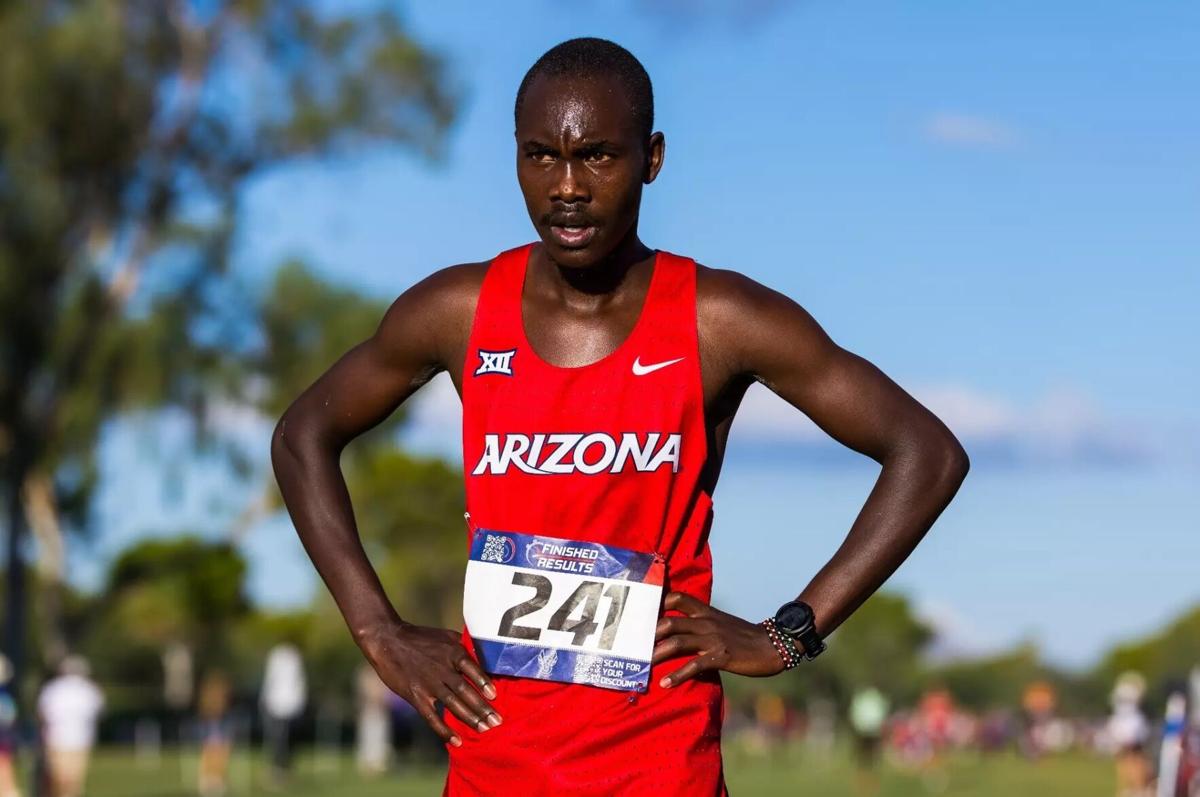
The last time Arizona men's cross country competed for a national championship as a team, life was much different for UA athletics.
The legendary Lute Olson was coaching Arizona’s men’s basketball team and the UA football team was amid a 10-year bowl drought.
Twenty years later, Arizona cross country is at the NCAA Championships at LaVerne Gibson Championship Course in Terre Haute, Indiana, for the first time since 2006. The UA men's team qualified for the NCAA Championships in head coach Andrew Dubs’ second season in Tucson, after placing fifth in the NCAA West Regional in Sacramento last week.
The NCAA Championships start Saturday at 8:20 a.m.
“We’re really, really excited,” Dubs said. “We’re thrilled to be here. It was our goal from the beginning of the season. The guys worked their butt off and we kept grinding away, chipping away. We had a race earlier this season and we upset some ranked teams and we put ourselves out there a little bit and set ourselves to qualify.
People are also reading…
“First time since 2006 and we’re really thrilled to be here. … We’ve had some great individuals over the years; some national champions, some All-Americans. To get a full team here, it’s honoring all of those alums and those who have come before us. Honoring them and running for them, it means a lot.”
Dubs joined ESPN Tucson’s “Spears & Ali” this week to talk about the path to the NCAA Championships, the leaders of the program and how Kenyan runners have impacted the sport.
How did you get the program into a position to compete for a team national championship?
A: “It’s definitely been a journey. It’s gone by faster and slower at the same time, if that makes sense. I remember telling our administration, when I got hired, we’re fixing the cross country program.
"I told that story to the guys last week. … I said ‘we,’ meaning them, have fixed this program. … Two years ago, we were towards the bottom of the Big 12 and now here we are 18 months later, going to the national championship.
"It’s a testament to the guys who bought in during the recruiting process. … It’s been incredible to happen this quickly.”
How much has sophomore Evans Tanui, who was your top finisher last race, helped with the foundation of UA cross country?
A: “He was the first domino of this whole thing. Incredible young man and one of the best smiles you’ll ever see. I’ll never forget the day we picked him up from the airport, the day he moved here.
He had like 30-something hours of travel (from Kenya) and a whole bunch of delays prior to that, so it took him several days to get here and once he got here, we got him off the plane and helped him move into his place and within an hour, he went on a 16-mile run.
"That work ethic and mindset got the ball rolling. What he brings every day, the guys gravitate towards him. He’s been a pleasure to have.”
Considering Tanui has three years of eligibility remaining with the five-for-five rule, how nice is it knowing you have a building block for the next few years?
A: “He’s only in his second year and these days, he’s got three years left. We’re going to build around Evans and continue to fill in those pieces.
"Yeah, we qualified this year as a team, but we have bigger goals in the future of trying to get into the top 10 and then eventually contend for a trophy in that top 4. We’ll build around him and continue to put the right pieces in place.”
Senior and Washington State transfer Josphat Meli had the second-best time for Arizona at the NCAA West Regional. What's the story on his path to Arizona?
A: “He kind of recruited himself. We were talking to a few other people and he reached out and convinced us of what he wanted. He was willing to put in the work. Adding him, it was instant leadership. He’s been incredible.
"He dove right in and took on a leadership role. He’s been a glue piece in putting this team together. … It feels like he’s been here five years. He has fit in seamlessly and took the team and glued them all together.”
You have four runners from Kenya, including Tanui and Meli. How much has Kenya influenced the sport and your recruiting strategy?
A: “If you go back and look at the history of program in the (1980s) and ‘90s and early 2000s, it was a lot of African runners. We kind of went back to that and what made us successful in the past. … We’re going back to our roots and the rest of the country has caught up to our roots. …. It’s really incredible to see cultures come together. Guys from the other side of the world and guys from a few blocks away from campus, it’s really awesome.”
Contact Justin Spears, the Star's Arizona football beat reporter, at jspears@tucson.com. On X(Twitter): @JustinESports

Justin Spears
Sports Reporter


