

Dire straits.
Two words that describe the situation for Minor League Baseball. The Bisons and roughly 160 other teams are on pause until April 2021. We have no idea what things will look like when they come back. And for many teams, if they come back.
Those were the two words used Tuesday night by Pat O’Conner, president and CEO of the minors, while discussing the cancellation of the 2020 season on a national conference call. It's a situation no one could have imagined when players reported to spring training and operations were full-speed ahead at Sahlen Field and other ballparks around the country.
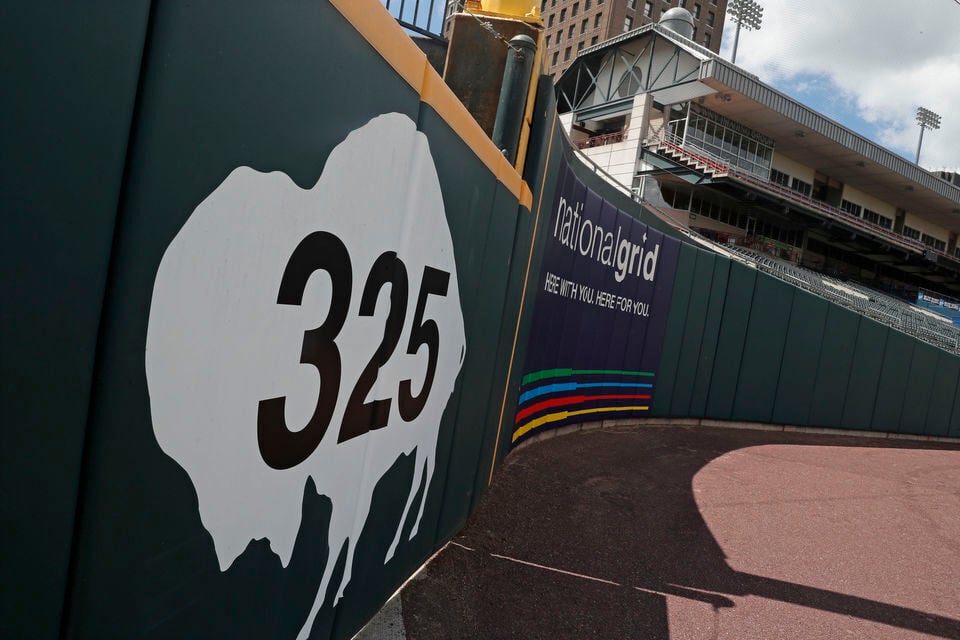
Around 7 p.m. Tuesday, the Bisons tweeted a lovely fisheye lens image of the downtown ballpark taken from the club level. In a play on the famous Tom Hanks line from "A League of Their Own", the tweet was accompanied by the simple notation, "Today, crying is allowed" followed by the crying face emoji.
People are also reading…
Today, crying is allowed. 😢 pic.twitter.com/7tDZtvVeVP
— Buffalo Bisons (@BuffaloBisons) June 30, 2020
In towns across the country, the silent spring and summer at the ballpark will stretch through the fall and winter with hopes of a triumphant Opening Day in 2021. In other places, it might never end.
There are 42 teams on the list for contraction for 2021 as part of negotiations for a new Professional Baseball Agreement between the majors and minors. Places like Batavia, Binghamton and Erie, Pa., are all on the list. Did fans in those cities see their last pitch and last home run in franchise history nearly 10 months ago without knowing it?
And your heart breaks for the good folks of Pawtucket, R.I., whose farewell season at McCoy Stadium before the franchise moves to Worcester, Mass., next year has been lost. McCoy is one of the great remaining relics of the minors, a 1940s park given some upgrades in the '90s but still behind most of its far shinier counterparts.
You park for free in the surrounding lots – but not too close to the park, lest you risk your car with foul ball artillery. The memorabilia is everywhere, including a huge display to the famous 33-inning game against Rochester in 1981 that stands as the minors' longest. It's folksy and familiar, not corporate at all. It's a simpler time, like you feel in a lot of small cities.
Fans in the stands buying tickets, merchandise and food are what make the money for these teams 70-plus times a year. There's no big TV money. Now, all their revenue has suddenly dried up. O'Conner admitted he's worried about teams having to sell their franchises or simply closing shop.
Some teams have recouped money from the federal Paycheck Protection Program. Many teams are banking on a potential loan bailout program from the feds to businesses that have obligations for lease, rent and other expenses for publicly owned sports facilities.
“There are very many teams that are not liquid, not solvent, not able to proceed under normal circumstances, and these are anything but normal circumstances," O'Conner said. "... Without some government intervention, without doing something to take on equity partners, you might be looking at half of the 160 who are going to have serious problems."
Startling.
Like most teams, the Bisons have furloughed a good chunk of their staff and only about 10 employees remain. You don't need people to sell tickets, suites and party areas for a season that is not happening. You don't need restaurant workers, merchandise stand attendants, groundskeepers, clubhouse attendants and their accompanying part-timers and interns. You don't even need a radio/TV announcer, as South Buffalo native Pat Malacaro's third season at the mic has been silenced and he's been furloughed.
At least the Bisons didn't have to pull the chute on many seasonal workers at the ballpark who were already hired. That's because the team never had its annual job fair to staff about 100 part-time slots, as it was canceled on March 14 and never rescheduled.
President Mike Buczkowski, new general manager Anthony Sprague and new assistant GM Brad Bisbing have combined to work for 69 years with the club, with Buczkowski's time dating to 1987. Even knowing Tuesday's fate was inevitable, there was still palpable disbelief it had come to this.
Buczkowski said he's spent lots of time during the pause watching old games rerun on MLB Network and said one that struck him was Kirk Gibson's home run for the Dodgers that turned around Game 1 of the 1988 World Series against Oakland.
"I listened to Vin Scully's call and it reminded me: 'In a year that has been so improbable, the impossible has happened,' " Buczkowski said. "I never thought ever that we would be making an announcement that there would be no Bisons season, that we would miss a full season."
Like all teams, the Bisons are suffering a major hit financially. But they're fortunate to have the corporate backing of Rich Products. Lots of minor-league clubs are family operations and will struggle. That doesn't just mean teams in tiny markets. Tough times are certain to head all the way up to Triple-A in some of the minors' long-time homes.
The Rochester Red Wings, for instance, have been a community-owned team for more than 60 years. They unveiled a refund policy Tuesday but said on their web site they were hopeful fans would allow their purchases to be rolled over into 2021.
"The loss of an entire season has put a strain on all Minor League Baseball teams, and we are among those who feel the financial effects," said longtime Red Wings president and CEO Naomi Silver, whose late father, Morrie, engineered the stock purchase and community ownership era for the franchise in 1957. "To the extent that fans and sponsors can afford to allow their 2020 payments to be held over to 2021, it would be extremely helpful to our ongoing operation. We were well prepared for a rainy day – or even a rainy season – but never did we imagine the absence of an entire season.”
Many teams are paying players through the end of the scheduled season in September, but it's a pittance, really, $400 a month in many cases. And if you're below Triple-A or not a high-round prospect, you're looking at a loss of an entire season. Think of players such as Lancaster's L.G. Castillo in the Brewers chain or Canisius High product Dan Dallas in the Padres system, both of whom have spent multiple seasons in Class A ball.
I go back to 1995 with Blue Jays president Mark Shapiro, when he was a 28-year-old farm director building the Bisons' first roster as a Cleveland Indians affiliate to within one win of an American Association championship. Development is the backbone of his baseball philosophy, so I figured the inevitability about the minors would hit him hard.
When I asked him about his feelings during a conference call last week, he said the entire situation was overwhelming.
"Man, that's probably been something I've been wrestling with the last 8 1/2 weeks. Way too much during my down time thinking about it," Shapiro said. "There are those moments when I reflect on the reality of a potentially lost season for the majority of our prospects and worry about our staff, and then I kind of pull back and realize and remind myself that we're not operating with isolated challenges.
"The challenges are not solely focused on player development, they're not solely focused on MLB and are not solely focused on the Toronto Blue Jays. We're operating in an environment where the challenges are universal, with tens of millions of people out of work and so many other things that are going on in the world. It's hard to deal with and feel bad about just what we're facing."
Shapiro offered high praise to the Jays' development staff for keeping players engaged during the pause through a variety of Zoom tutorials surrounding conditioning and baseball skills.
"But that certainly does not replace playing games," he admitted. "And for anybody who is a hardcore baseball fan, loves the game of baseball, loves to follow prospects and gets excited about seeing their performances, it's been one of the more challenging and disappointing processes to the global picture of what we're going through."
The Bisons have had disappointing moments over the years both on the field and off, particularly when the major-league dream died hard in 1991. But there has been nothing like the 2020 lost season.
"It's really hard," Buczkowski said. "I've thought about the times over the last 30 years when we've had difficult things happen. Five rainouts in a row, snowouts, canceling the fireworks on July 3 because it was too windy. The heartbreaks of losing those championship games ... Those are all the things now, what I wouldn't give to experience. Even the bad times, back in the days when things were normal."


