

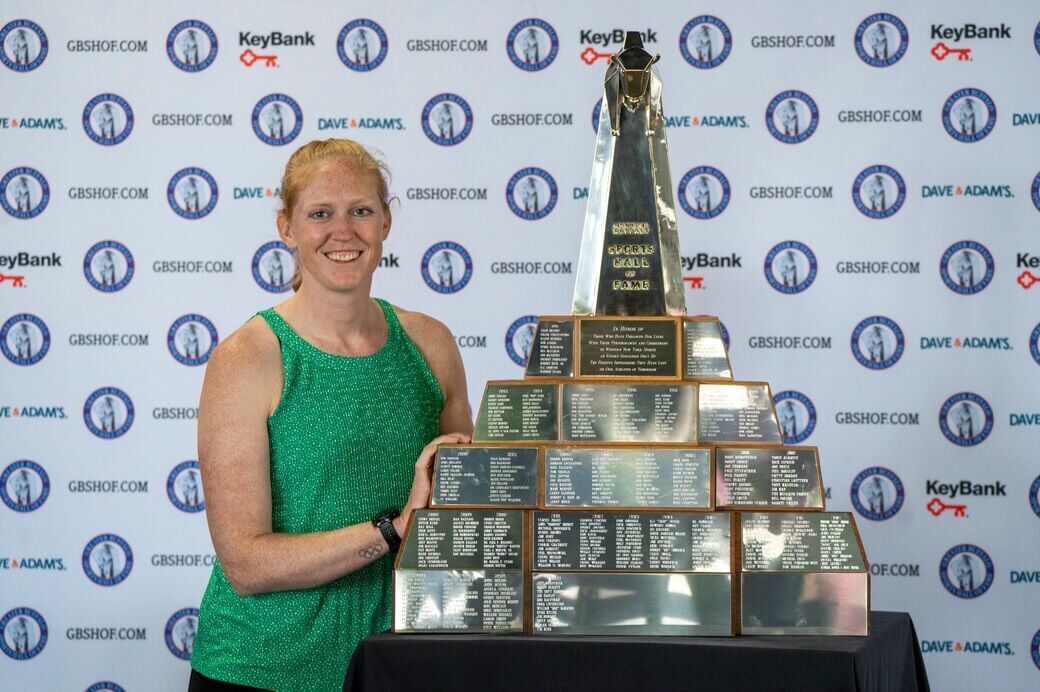
This is the next in a series of profiles of members of the Greater Buffalo Sports Hall of Fame Class of 2022, which will inducted Nov. 9. For more information, visit gbsohf.com.
Emily Regan found herself at a crossroads in the summer of 2021. She had walked away from years of rowing at the highest competitive levels in the world, and she planned to take time off to travel, then to figure out what her next step in life was going to be.
Life after competitive rowing became a short-lived endeavor. She coached at Ready Set Row, a camp in Maryland during which female coaches trained female rowers, and the engagement re-energized her, not just from an athletic standpoint but emotionally.
“It was such an amazing transition, from the point of falling short of going to Tokyo (for the Olympic Games in 2021) and being injured,” Regan said. “It was a point in my life where I could have been really sad, really depressed and I could have wallowed in it. Instead, I was at this camp that became an amazing experience in my life. I found – and this is something I always knew about myself – that I get a lot of joy and fulfillment in helping other people achieve their goals.”
People are also reading…
Shortly thereafter, in August 2021, she joined the coaching staff for the men's rowing team at Boston University.
Regan, 34, will be honored for her athletic career as one of 13 individuals, families or teams to be inducted Nov. 9 into the Greater Buffalo Sports Hall of Fame at the Buffalo Niagara Convention Center.
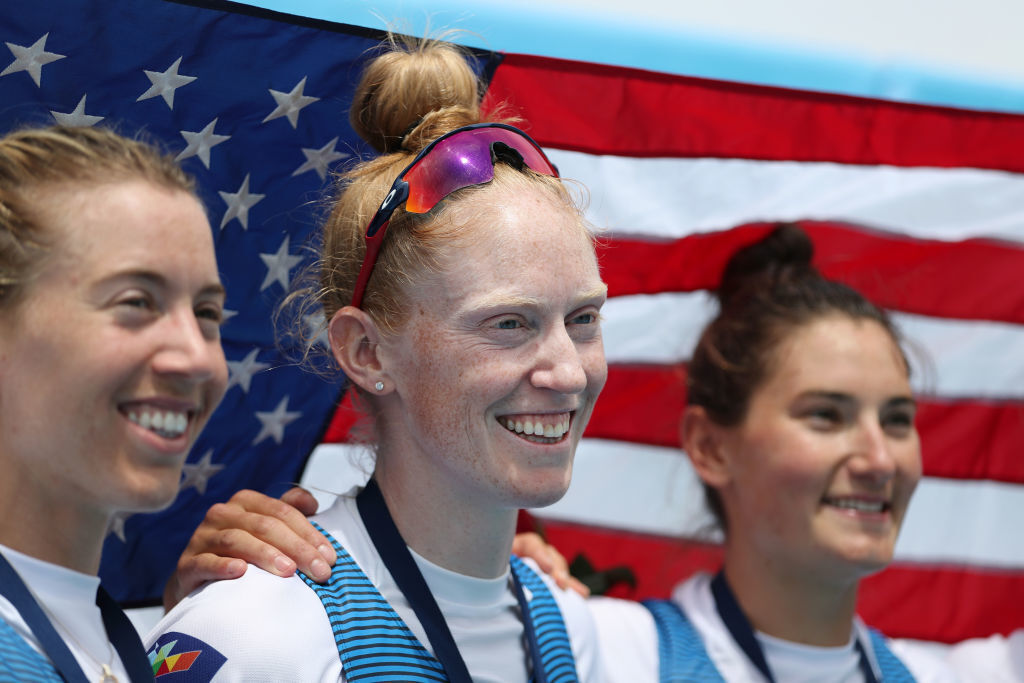
She helped the United States women’s rowing team win a gold medal in the 2016 Summer Olympics in Rio De Janeiro, part of a decorated tenure in competitive rowing. She helped Michigan State win Big Ten Conference titles in varsity eights and compete in the NCAA championships from 2008-10. She was an All-American in rowing at Michigan State, and was the Big Ten’s rowing athlete of the year in 2010.
“I didn’t think I’d ever expected myself to be inducted into any kind of hall of fame, especially when I was a young athlete,” Regan said. “Sometimes accolades bring that, but I look back at my childhood and when I was an athlete, and I didn’t even think I’d go to college to play a sport. To be here, it is so surreal.”
Regan grew up in a family of athletes; her brothers, Jim and Will, played basketball at Daemen College and at the University at Buffalo, respectively; her sister, Kelly, was the News girls basketball player of the year in 2005 at the Nichols School and went on to be a 1,000-point scorer at Manhattan College; and she played basketball and lacrosse and ran cross country at Nichols.
She never pursued rowing in Buffalo, other than one summer camp at the West Side Rowing Club, but Regan would learn how the sport could help her gain confidence and open doors to bigger and different opportunities.
The irony, though, of Regan’s success is that she had to be coaxed into rowing. At her freshman orientation at Michigan State in the summer of 2006, her mother, Barbara, met with Michigan State’s rowing coach. During the drive from East Lansing, Mich., back to Buffalo, her mother insisted that Regan join the Spartans rowing team, as a way to meet classmates in the community of a large state university. Regan signed up for the team with her college roommate, who also was prodded by the roommate's mother.
Getting into the boat was an intimidating process for Regan, too. Not only because she had never competitively rowed before, but because she had a fear of disappointing her teammates, even though the upperclassmen recognized Regan’s potential and insisted, “You’re going to be important to this team.”
The Buffalo native first shared her experience and the USRowing outbreak in a Facebook post July 7, offering a cautionary tale about how mild to moderate cases of the virus can affect even the best athletes in the world, physically and mentally.
“Sometimes I felt like I was rowing for other people, and my friends and the community I had in rowing kept me in it,” said Regan, a Buffalo native. “My freshman year (at Michigan State) I was ready to move on and do something else, because I had this fear of letting people down.
“With time, I found my own passion in it, and I learned a lot about myself, and gained confidence in myself as a human. I was the type of athlete who also felt like, if something was going wrong in the boat, it was my fault. But the more you train and the harder you work, you know the effort and the work prepared you to be successful.”
Regan stuck with rowing, and turned to her gut instincts to forge success.
“I knew that I trained really hard, and that was one of my strengths, the willingness to work so hard and go the extra mile,” Regan said.
She’s helped the United States national team win four gold medals (2011 coxless four, 2013, 2015 and 2018 women’s eights), a silver (2014 coxless four) and bronze (2019 women’s eights) in the World Championships.
She didn’t have an easy path to competing among the world’s elite, though.
“Emily has overcome numerous disappointments and injuries in her Olympic journey,” her father, Larry, wrote in a guest column for The News during the 2016 Olympics.
He recounted her not making the Olympic team in 2012, and the numerous injuries she sustained over the course of the next three years, including being diagnosed with exercise-induced asthma in 2014, before she made the U.S. Olympic team.
“Life has many setbacks,” her father wrote. “As Emily’s story illustrates, great things can be achieved with determination, hard work, perseverance and a willingness to fall short from time to time.”
Larry Regan, one of the biggest supporters of his children's athletic pursuits along with wife Barb, died in December at age 62.
When people ask Emily Regan what it’s like to win gold medal, she doesn’t just think about the gold medal itself, or the race that clinched it. She thinks of the path that got her there.
“You get flooded with the memories of all the hard times,” Regan said. “And the things you overcame to put yourself in a position to be there, at that moment. It’s all the training, the hard moments and the things you overcame. In training, you’re losing a lot more than you’re winning, and you’re competing against the best, and it builds a lot of character and strength.
"When you train for the Olympics, you have to be an eternal optimist, in a way. You’re facing so many setbacks and what feels like failure, in the moment, but you always have to see the opportunity and the positives, to be successful.”


