

As a breeze swept through Sahlen Field on a partly cloudy August evening, and Hyun-Jin Ryu readied to deliver the first major league pitch in Buffalo since 1915, Sportsnet broadcasters Buck Martinez and Dan Shulman lauded the Toronto Blue Jays’ staff for completing renovations on the 32-year-old ballpark.
Over two weeks, from the moment the Blue Jays announced their intent to call Buffalo home during the coronavirus-shortened season to their arrival, Sahlen Field underwent a dramatic face lift that included auxiliary dugouts, temporary batting cages on ballpark concourses, an additional clubhouse beyond the outfield fence, major-league quality lighting and alternations to the playing surface.
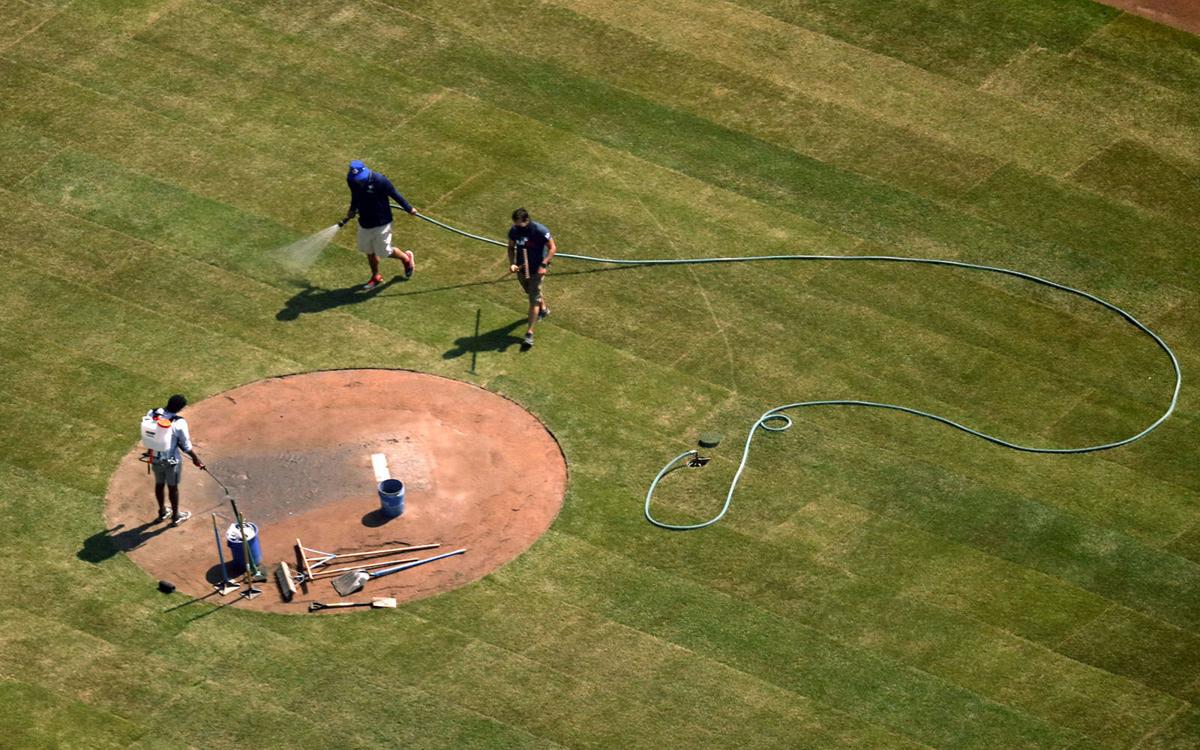
While there was no mention of the grounds crew who tend to the field every Bisons season, each played a role in bringing the Blue Jays to Buffalo. And only the successful completion of Game 1 on Aug. 11, could quell the angst that filled Danny Keene, who is in his second season as the Bisons’ head groundskeeper.
People are also reading…
“We were all really excited to have them here, to see the first game and how the field played, but it was also very stressful,” Keene, 32, said with a laugh. “I didn’t want to see any bad hops or errors that were our fault.”
Keene and his crew have received an overwhelmingly positive reaction to their work and maintenance on the freshly sodded grass, which remains in pristine shape during the final homestand. But the completion of the 26-game home season Sunday will come after some anxiety-filled moments, long days at the ballpark and a collaborative effort from three grounds crews.
“There’s a great sense of pride,” added Nate Rivera, the Bisons’ assistant groundskeeper. “You know you’re presenting something to people, even though if they don’t know the work we do and the amount of hours that go into getting the field ready for a game. Without us, there’s no baseball.”
For almost four months, the grounds crew anticipated a summer without baseball. On March 12, MLB announced it was suspending the start of the season by at least two weeks in response to the coronavirus pandemic and April 17, the Bison’s originally scheduled opening day, passed without a first pitch.
When the minor-league baseball season was canceled June 30, Keene, who was furloughed, received a phone call informing him the Blue Jays’ taxi squad planned to train in Buffalo. He put together a four-person crew to prepare the field as if the Bisons were playing games there this summer.
Weeds were growing along a sun-soaked infield that needed to be moistened and regraded. Edges along the field needed to be leveled and conditioner was laid down. Meanwhile, the Blue Jays were training in Toronto in preparation for a 60-game season, but they discovered July 18 that they would not call Rogers Centre home in 2020.
The Canadian government barred other MLB teams from crossing the board without undergoing a mandatory quarantine and Buffalo surfaced as the likely alternative to host games – until the Blue Jays began to survey options in Pittsburgh and Hartford, Conn.
“Every day was something new as far as the status of it,” said Danny Smolka, a 21-year-old Niagara University student who is in his fourth season on the Bisons’ grounds crew. “It was hard because it almost sounded like they wanted to come here, but they didn’t want to come here at the same time.”
“When I found out there was a chance the Blue Jays could come here, the stress level kind of skyrocketed because you’re at that next level,” added Keene, who previously spent three years on the Baltimore Orioles’ grounds crew. “You want to make sure everything is good for them."
As the MLB club weighed its options, Tom Farrell, the Blue Jays’ director of field operations at Rogers Centre, and Patrick Skunda, sports turf supervisor at the club’s facility in Dunedin, Fla., arrived in Buffalo to survey the ballpark and worked with Keene to construct a plan to revitalize the grass field.
After the Blue Jays announced their intent to play home games in Buffalo beginning Aug. 11, all involved quickly moved to replace areas of the 10-year-old field. A professional turf company needed only four days to replace the infield, strips of the sidelines and 25 feet of grass along the back arch of the infield.
The company also replaced sand beneath the new sod and regraded the infield to level it out. The home grounds crew's work included assembling the Blue Jays' new lockers and removing pads on the outfield walls. All the on-field repairs will remain at the ballpark in the future, providing the Bisons with a major-league surface as prospects work to develop into big leaguers. The crews from Buffalo, Toronto and Dunedin typically worked approximately 15-hour days to prepare Sahlen Field for the Blue Jays’ arrival.
“It’s definitely weird knowing what the stadium was like before all this happened,” said Smolka, whose family are longtime season-ticket holders and his brother, Jeff, also works on the crew. “I can’t believe they got it all done in that short amount of time. Teams are coming in and they always say what a great job we’ve done. They’re so impressed with everything that’s gone on here.”
However, while the extensive repairs were taking place, two MLB teams were ravaged by coronavirus outbreaks, leading to a total of 43 postponed games as of Friday. One of those clubs, the Miami Marlins, were the Blue Jays’ first opponent in Buffalo, causing some additional stress among those who would be tasked with tending to the field while players prepared for competition.
Members of the grounds crew also began to wonder if the season, and their work, was in jeopardy.
“The big thing for us was obviously, given the time we’re in, 2020 with Covid, the Marlins coming into town for the first series was like, ‘OK, what are we going to do for this?” said Rivera, 31. “How can we protect ourselves because the Marlins were hit pretty hard?’ That was a worrying moment for myself because although we don’t have contact with the players, we’re still in the same vicinity with them and the risk of contracting the virus and bringing it home to my family was worrisome to me.”
With safety protocols in place and the Marlins’ quarantines complete, the Blue Jays arrived in Buffalo the night of Aug. 10 and three players – Vladimir Guerrero Jr., Randal Grichuk and Anthony Alford – decided to take batting practice under the lights. All had spent time with the Bisons, though Grichuk played just two games with the team in 2018.
Their reaction to the field repairs provided the grounds crew with a sense sense of relief, and all their concerns were gone once the first game was complete, a 5-4 win over the Marlins. Keene and his six employees have worked alongside six people from the Blue Jays, including Farrell, and groundskeepers from Dunedin, all of whom have experience working with grass.
The collaborative effort has lessened the workload in some ways, but the field still required tedious maintenance in the past six weeks. The Bisons’ crew learned techniques they’ll use in future seasons – particularly methods to repair the mound and home plate – and all involved can say they provided a helping hand in a historic baseball summer in Buffalo.
The work did not go unnoticed. Amid celebrating a playoff berth Thursday night following a win over the New York Yankees, the Blue Jays took a few moments to shake hands with the grounds crews that provided them with a home when no one else would.
“Teams like the Red Sox and Yankees are playing on the surface that I grew up coming to games at,” said Smolka, who took a semester off from school to complete the Blue Jays’ season. “I never thought I’d see a day when major league teams are playing meaningful games in our home ballpark in Buffalo. I’m biting off every bit I can.”


