

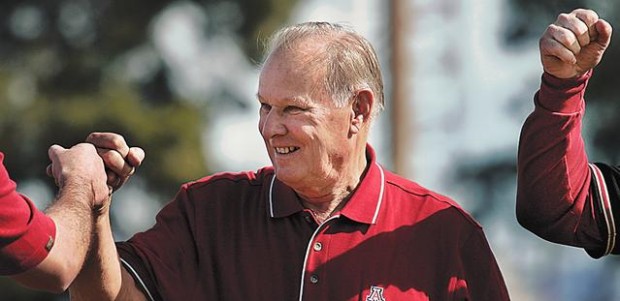
As gently as possible, which isn't possible at all, doctors attending to Dick Griesser told him he would be gone in eight weeks, maybe half that. Chemotherapy treatments weren't working, a special $125-a-day pill had not deterred the spread of cancer, and one of his lungs failed.
Yet Griesser insisted on attending a celebration for one of his old Flowing Wells High School coaching colleagues, Mark Latham, himself seriously ill and dying.
"Dick was barely able to walk," says Ted Sorich, the Caballeros' former assistant principal and NAU football star. "He was on oxygen."
But wasn't that just it? Dick Griesser didn't live for style points. He just let it roll.
"I don't know when Dick ever sat down and just did nothing," remembers Dean Metz, a rival baseball coach at Canyon del Oro High School and a friend of the first order for the last 50 years. "He taught biology, coached baseball, raised three kids, drove a bus, officiated football and wrestling, was an expert woodworker and carpenter. He'd wear me out just talking about his day. There wasn't a thing he couldn't do."
People are also reading…
Griesser always had something in motion, including himself.
The great Cactus Comet, Art Luppino, remembers watching Griesser during the outfielder's UA All-America days in the late '50s.
"When Dick ran, everything would be flying in different directions: dust, turf, small animals, a cap and often a shoe," says Luppino, Arizona's star tailback from 1953 to '56. "I thought it might be a good idea to produce a wind-up Dick Griesser baseball doll, something about 18 inches tall and market it for kids."
And then Luppino gets to the point. "I have never met a better man," he says. "Some as good, but none better."
Dick Griesser died Saturday. He was 77 going on 144. He lived two lifetimes, always up to something, most of it good.
The last time I talked to Griesser, in the fall of 2008, he had spent more than a year championing a cause to get one of the UA's first black athletes, football-baseball star Marty Hurd, inducted into the school's sports Hall of Fame.
Marty Hurd had been dead for more than 25 years. He had been forgotten. But Griesser persisted even though, at times, he was floored by the red tape and detours encountered putting Hurd's presentation in place.
"It's the right thing to do," Griesser said. 'I'll get it done if it takes me forever." And it almost did.
Griesser graduated from Phoenix North High School in 1951, accepted a baseball scholarship to Arizona and, although he didn't realize it, set in motion a life that made him an institution in this town.
His college days were interrupted by a term in the Korean War. He played first base for Team USA at the 1956 Melbourne Olympics. He played three years for Arizona at the College World Series. He played elite-level fast-pitch softball for 10 years, taught at Flowing Wells for 30 years, officiated for the AIA for 40 years and was married to Evelyn for 54.
He held on long enough, sustained by morphine, determined to see his son, Rich, open a business, the Next Level Softball Academy, on Saturday morning.
"And then he died," Rich says. "It's like he knew we were carrying on his legacy."
A week ago, John Gleeson, president of the Pima County Sports Hall of Fame, which had become one of Griesser's favorite let-me-volunteer-my-time activities, stopped at Griesser's home. It wasn't good.
"When I looked at Dick, I knew he was dying, but I could still remember that long home run he hit in the state championship softball game, for the Tucson Kings, a long time ago in Prescott," Gleeson remembers. "Must've gone 350 feet. Oh, boy, could he hit. But as good a ballplayer as he was, he was a better teacher and leader. You couldn't find a better friend."
Griesser will be immediately missed. He was on the "Moose Milk" committee for the Letterman's Breakfast, held the morning of every Arizona homecoming football game. It was a tradition started by Pop McKale, handed off to Mo Udall and acquired recently by Griesser and Metz, among others.
"It's a secret concoction," Metz says, chuckling. "We make 15 gallons and serve it to the lettermen before and during breakfast. It's a real conversation starter. It's part of the tradition. You don't want to let it go."
And isn't that what you would say about Dick Griesser? He was such a part of this city's sports tradition. You don't want to let him go.


