

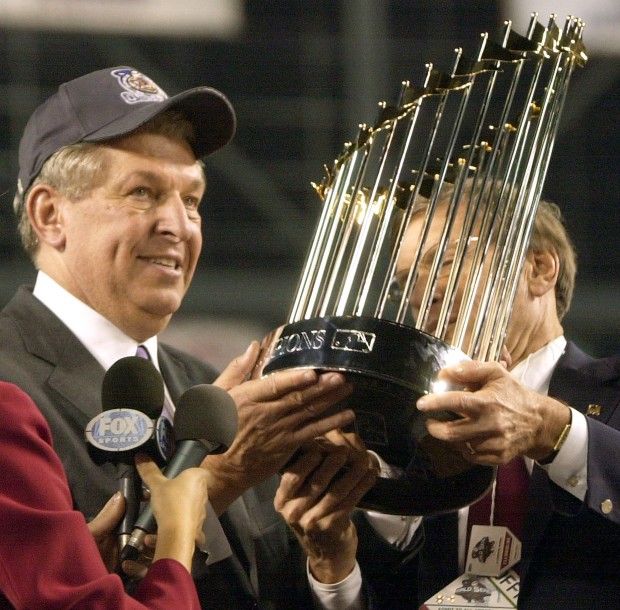
In celebration of Arizona's centennial, the Star is featuring our picks for the 100 best athletes, moments and teams. Throughout the summer, we have been showcasing our list. Here is the eighth of Greg Hansen's top 10.
Jerry Colangelo
Jerry Colangelo's website says he is available for trade shows, TV commercials, product-launch campaigns, celebrity golf tournaments, autograph signings, grand openings, speaking engagements, corporate sales meetings and, whew, healing the sick.
Well, sort of.
When a scandal rocked the Fiesta Bowl this spring, Gov. Jan Brewer asked Colangelo to be part of a panel to "help repair the tarnished image."
Weeks earlier, the Arizona Commerce Authority appointed Colangelo to its board, asking him to "help improve the image of the state and Phoenix's West Valley."
People are also reading…
Over the last seven years, Colangelo lost control of the Diamondbacks and the Suns, but he did not lose his influence. At 71, he remains the most powerful man in the history of Arizona sports - and, now, other things.
He is to Phoenix sports as Lute Olson was to Tucson sports, and then some.
Early in the baseball season, on nights the D-backs and Suns had simultaneous home games, I used to look down from the press box at Bank One Ballpark and spot Colangelo in his dugout-side box. He would sometimes be chatting with, say, Phil Mickelson, and then, by the fifth inning, be sitting courtside at America West Arena with Jake Plummer.
Who had a better job than that?
Who invented himself the way Jerry Colangelo did?
Rather than fade away when a hostile takeover with investors forced him out of his role as creator/baron of the Diamondbacks, he became managing director of USA Basketball, producing a gold medal at the 2008 Beijing Olympics.
Rather than succumb to bitterness when new Suns owner Robert Sarver cleansed the franchise of Colangelo's presence, he wrote his second book "Return of the Gold," which celebrates Act III of his extraordinary career, which Colangelo expects to cap with a gold medal at the 2012 London Olympics.
In 1993, when Colangelo was uber occupied - the Suns were playing in the NBA Finals against Michael Jordan's Bulls - he mobilized leadership of a behind-the-scenes effort to raise $125 million to acquire a major-league baseball expansion franchise.
Six months later, when the Arizona Diamondbacks were conceived, Colangelo told the Star: "In my discussions with baseball ownership originally, just to throw the idea out and see what they thought, they said, 'Jerry, if it's you, you'll get it. We want Phoenix. We want you.'
"Whether that was blowing smoke of whatever, I bought it. I've moved forward on that basis."
A four-word quote from enduring baseball analyst and former big-league catcher Joe Garagiola might be the most appropriate.
"Colangelo is the difference," Garagiola said then.
Soon thereafter came the $300 million downtown ballpark, followed by Randy Johnson, Curt Schilling, Luis Gonzalez and the epic 2001 World Series victory over the New York Yankees.
Colangelo was the difference.
How the basketball man became a baseball man is unparalleled in American professional sports.
Colangelo grew up in a broken home in a low-income area of Chicago and was an aspiring baseball pitcher. A sore arm forced him to solo in basketball; he became team captain at Illinois.
His initial foray into business was at a Chicago-area dry cleaning/tuxedo rental firm that went bust. His lifetime break came when he went to work for Chicago millionaire Dick Klein, who was attempting to raise $1.25 million to pursue an NBA expansion franchise that became the Chicago Bulls.
At 28, Colangelo became the youngest general manager in NBA history. His reputation inside the NBA grew so rapidly that the start-up Phoenix Suns contacted him about doing the same job for Arizona's expansion franchise. He was 30. His starting salary was $22,500.
Over the next 20 years he was the GM, the head coach, a scout, a promoter and an owner. What else is there?
He bundled an investment group to buy the Suns for $44 million in 1987. It was sold to Sarver for $401 million 18 years later.
But by then Colangelo's identity nationally was more as a baseball man. In effect, he bought the World Series title as much as the Yankees have done. Enormous deferred contracts to, among others, Johnson, Matt Williams, Jay Bell and Todd Stottlemyre created an unrest with investors.
For the second time in three years, Colangelo was, in effect, fired. Amazing.
"I had too much success too fast," he writes in "Return of the Gold." "We won three division titles and a World Series and you're not supposed to do that. I think it led to an attitude where it was real easy to throw me over the side."
"All I can tell you is I'd do it all over again and I'd do it the same way."


