

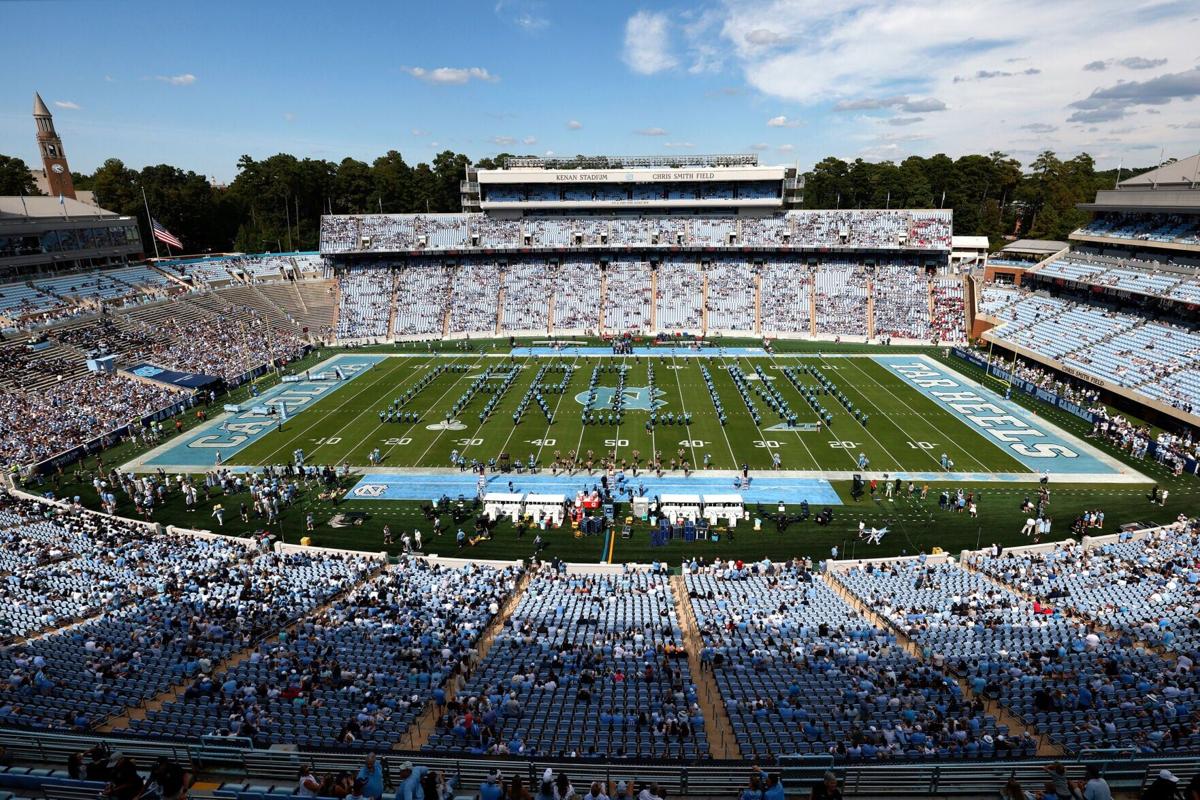
CHAPEL HILL, N.C. — North Carolina athletic director Steve Newmark presented a plan Tuesday to house revenue-generating parts of the UNC athletic department within an associated entity.
If approved, six pieces of the athletic department — multimedia rights, licensing, ticketing, NIL, special events and the operations of Finley Golf Course — would be moved into a new limited liability company, also known as an LLC.
Newmark said the associated entity would allow the Tar Heels to pursue revenue generation with more flexibility and more swiftly in a move that mimics several other collegiate athletic departments.
UNC faced a $15 million budget shortfall in 2024-25 despite recording record revenue of nearly $173 million, and is looking to be creative in addressing its rising costs.
“As college sports has evolved, we’re now competing in the marketplace with professional sports (and) other entertainment properties” said Newmark at a special meeting of the UNC Board of Trustees Governance Advisory Committee.
People are also reading…
The LLC model has become increasingly common for athletic departments across the country, and the approach can take different forms. Kentucky, for example, moved its entire athletic department into an affiliated entity called Champions Blue. Meanwhile, schools like Michigan State and Texas Tech have recently moved revenue-generating employees into an LLC.
Newmark said UNC’s associated entity would be “more conservative” than other schools.
“It still remains in the complete, total control of the chancellor and the university,” Newmark said.
The associated entity would be governed by a board, which Newmark said could consist of seven members: UNC’s athletic director, chief financial officer, chair of the Board of Trustees, chair of Rams Club and three independents appointed by the chancellor.
The board discussed the associated entity Tuesday without having a copy of the operating agreement, which Newmark said is in draft stage. Several board members pushed back on details of the associated entity, at least partially because they didn’t know many specifics.
“Are we good to table it until we get more information?” Chair Ramsey White asked the group just before the board closed its open session.
Why a college forms an LLC for athletics
Speaking generally, not specific to UNC, Nicholas Lord, the CEO of NOCAP Sports — which works with universities, brands and athletes to unlock revenue opportunities — told the News & Observer that athletic departments are bogged down by university disclosure requirements, and that the LLC structure allows them to move more quickly.
He pointed to sponsorships, ticketing and event management as straightforward areas to target with the LLC to maximize revenue, but those are just the tip of the iceberg. He is interested in what doors the model opens up five to 10 years down the line.
“It allows them to be much more flexible and innovative,” Lord said, “in regard to all different ways they generate revenue.”
Melinda Roth, a visiting associate professor at Washington and Lee, who has written extensively about the privatization of college sports, said name, image and likeness and revenue-sharing rule changes have pushed schools towards professionalization.
An LLC allows athletic departments to operate more like professional teams, she said, becoming more creative in revenue generation to increase their bottom line.
“Putting the business parts of the athletic department into a business and running it like a business is a way to manage it more professionally and potentially extract more revenue from the process,” Roth said. “Because let’s face it, college sports are becoming more and more like the prep leagues for professional sports.”
There will probably be fewer disclosure requirements, Roth added, under the LLC. For example, certain contracts or financial statements within the associated entity might not have to be revealed to certain requests, she said, though that’ll depend on UNC’s specific design.
Roth also said the LLCs can be structured to accept money from private equity companies. While universities could rule it out in their operating agreements or publicly denounce it, she said many have gone silent on the topic when launching their associated entity’s.
An alternative to private equity
Utah became the first school to accept private equity money when it finalized a deal with Otro Capital in June, according to The Athletic.
“When you invite private equity in, there are all sorts of issues,” Roth said. “Just think about it for a second: that’s a public university. How can there be such a thing as equity ownership of a public university? Well, that’s why you have to create a business entity that can then have that ability to have ownership of that specific entity.”
Newmark said the possibility of accepting private equity is not part of the intent of the LLC. Though he did not specify whether the school would rule it out in its operating agreement.
“The intent is just to focus on those six verticals,” he reaffirmed when asked about private equity.
Another consideration worth noting, Roth said, as universities professionalize their athletic departments, is whether athletes could be treated like employees, a move the NCAA has fought against for years.
In 2015, the National Labor Relations Board declined to assert jurisdiction when Northwestern football players’ attempted to form a union. In 2024, Dartmouth men’s basketball withdrew an NLRB petition following President Donald Trump’s election.
“If you have student-athletes as employees, you open up a Pandora’s box of issues,” Roth said, “not just that they could collectively bargain and strike and have all kinds of other issues, but they could demand overtime. You find me a UNC basketball player who’s not working more than 40 hours a week.”


