

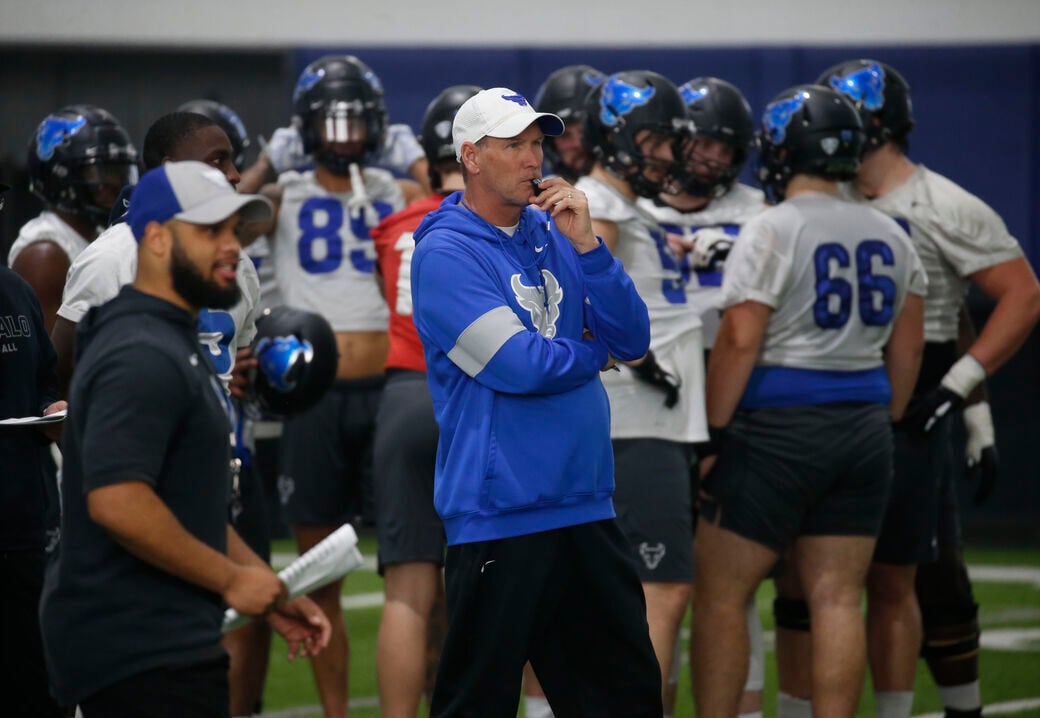
University at Buffalo football coach Lance Leipold needed three words to sum up the news that the Mid-American Conference had postponed all its fall sports.
“Shocking. Disappointment. Frustration,” Leipold said Saturday at UB’s Murchie Family Fieldhouse. “Those are probably some of the best words that can come out right now.”
But Leipold also said he understood why the MAC made its decision.
“Like all decisions, (athletes’) safety and their health are paramount in this, physically and mentally," he said. "It’s a blow. There’s a lot of guys that are trying to process everything. We’ll continue to support them, in every way possible, as they continue to reach their goals, on and off the field.”
The MAC is the first Football Bowl Subdivision conference to postpone its fall sports amid the coronavirus pandemic, and likely won't be the last. The conference said it will focus on playing its fall seasons in the spring, including football. At UB, the decision also impacts women's soccer, volleyball and men's and women's cross country.
People are also reading…
"It would be naive to say that you don't give thought and consideration to what the financial ramifications of any decision are, but this was a health and well-being decision, first and foremost," MAC commissioner Jon Steinbrecher said during a news conference Saturday on Zoom. "We don't know what this will mean financially."
Steinbrecher said the decision to postpone fall sports was unanimous among the university presidents in the league, and that conversations regarding the status of fall sports had taken place all week.
"I’d made known that we were into our conversations on what course of action we were going to take,” Steinbrecher said. "I had no certainty of how that would play out. I’d say that we went into our president's meeting Thursday, and I came into today’s meeting in a similar place. It could have gone several different ways. I don’t care to lay out the options, but you could figure out some permutations.
"This was a hard decision, but a thoughtful decision."
Steinbrecher said the vote of the 12 presidents was unanimous, and UB athletic director Mark Alnutt emphasized that the decision was not a cancellation of fall sports. However, he said the discussions regarding a fall season for the MAC were in-depth and involved, as well as the decision to be the first FBS conference to postpone fall sports.
“There was some concern about being the first because ultimately, you have to stand up for your decision, understand where it is and what others perceive or think is going to be out there," he said. "You can’t change things. For us, we made the decision and we’ll see what the rest of the conferences do, moving forward.”
The MAC's decision to postpone fall sports also puts one of the most promising football seasons in Leipold's tenure on the shelf, a little more than seven months after UB earned its first bowl win in the Bahamas Bowl.
Led by running back Jaret Patterson, who was fifth in the nation in rushing in 2019, and defensive linemen Taylor Riggins and Malcolm Koonce, who combined for 17.5 sacks last season, the Bulls were favorites to win the MAC championship.
Leipold said he found out Saturday about the decision to delay the fall sports season, and quickly rounded up his team for a Zoom meeting. He said another meeting with players and their parents was scheduled for Saturday afternoon.
“Unfortunately, it had leaked out before we could even call a meeting to let our players know,” Leipold said. “We had to do it as fast as we could and we will reconvene with them, shortly, this afternoon, along with their parents, and try to find answers to many questions and support all them, and be ready for what our season will be.”
The postponement of the fall seasons could impact the roster availability of MAC teams, as well, if players decide to transfer to programs that are fielding football this year.
Alnutt said the postponement of fall sports will have no bearing on the scholarships of athletes in fall sports, and he will look into the feasibility of athletes training on campus this fall.
"We're not going to have athletes on MAC campuses that can't do anything," Alnutt said. "We're looking at countable athletic related activity hours and some form of it, leading up to camp, to be able to continue with the sport of football. Monday was the report date for soccer and volleyball, so we're hoping to allow them to have some activity moving forward, not just this preseason but for the fall season."
Leipold also said UB’s athletic staff has been in touch with the campus counseling services, to work with players to cope with the loss of the season.
“Finding something out on Twitter is not the way you want to find out something is not happening,” Leipold said. “Where our players are, with the mental part, that’s probably where our next few days, we’ll probably focus on that.”
The MAC’s decision sent shock waves through college sports, but the postponement of the fall season wasn’t without precedent.
College football conferences across the country have reformatted their schedules over the last few weeks because of the Covid-19 pandemic and its regional impact. The Atlantic 10 and Metro Atlantic Athletic Conference, which include St. Bonaventure, Canisius and Niagara and do not sponsor football, in July announced the postponement of its fall sports.
The pandemic had already impacted UB, prior to the MAC’s announcement Saturday.
UB had already had two nonconference games canceled from its 2020 schedule: Sept. 12 against Football Championship Subdivision opponent Saint Francis at UB Stadium, and Sept. 19 at Ohio State. Saint Francis is a member of the Northeast Conference, which will not field a fall sports season, and Ohio State is a member of the Big Ten, which announced last month it will play a conference-only football schedule.
The Sept. 5 opener at Kansas State was also in peril as the Big 12 is allowing teams to play nine conference games and one non-conference game. K-State had UB and North Dakota as non-conference games on its schedule.
The MAC's scheduling would have also been impacted by the lack of guarantee games against nonconference opponents; the Power Five conferences (Atlantic Coast Conference, Big 12, Big Ten, Southeastern and Pac-12) shrunk their schedules to either phase out or limit nonconference opponents this season. Syracuse, for example, will play only one nonconference opponent (Liberty), as the ACC has a 10-game schedule that includes one nonconference game.
Ohio State was scheduled to pay UB $1.8 million, and Kansas State was scheduled to pay UB $900,000. While there is a force majeure clause – unforeseeable circumstances that prevent either party from fulfilling a contract – in the contracts between the programs, there is no language regarding cancellation due to a pandemic or an epidemic.
Alnutt said financial ramifications of the postponement of fall sports has yet to be determined, and echoed Steinbrecher’s statement that the health and safety of athletes was a priority in the decision.
UB's football revenues of $9,724,780 in 2019 made up 21.1% of UB's athletic revenues ($45,977,952), according to the school's NCAA Membership Financial Report, obtained by the News through a Freedom of Information Law request.
Yet while Alnutt was not sure what kind of financial impact the cancellation of fall sports would have on the athletic department, he was certain of one thing:
“There will be one, I will say that right now,” Alnutt said. “There will be one for UB Athletics, but in the same token, there’s still a lot out there to be determined, what exactly that impact will be."
Athletes have been training on college campuses this summer, but some colleges and universities across the country are returning students to campus, which could also foster a spread of a disease that is already highly transmissible, according to public health and medical experts.
Steinbrecher said the MAC consulted with health experts regarding the decision to field or postpone fall sports, and said those advisors were not secure with putting athletes in an environment that could facilitate the spread of Covid-19.
"There are simply too many unknowns to put our student-athletes into situations that are not clearly understood," Steinbrecher said. “It's not the easy decision, but it was the right decision."
As of Saturday morning, 96 FBS athletic programs and 29 FCS programs had either confirmed or had reported positive Covid-19 cases among athletes in their programs, according to a Buffalo News database.
Alnutt gave his first update on testing results in the athletic department since July 9, and said UB had six positive cases (four athletes and two staff members), including one active case, among 170 athletes and 84 staff members who were tested and 622 PCR tests.
“But with every decision, especially for our young people, you don’t understand why it’s happening, at the time,” said Alnutt, who added that 71 tests are still pending. “But I’m very hopeful, down the road, whether it’s a couple days, a week, a month, a year, whatever it may be, that they’re really going to look back and understand that this was a decision that impacts them.”
As important, Alnutt acknowledged the fact that the Covid-19 pandemic dictated the decisions the MAC made.
“The only bearing on this is where we’re at, nationally, from a virus standpoint,” said Alnutt, who is a member of the NCAA’s Division I Football Oversight Committee. “Not just in Erie County. But nationally. When we put together a return plan, nationally, that we’ve been working on since the end of March and implemented in late May, at the time we were in position to see how Covid was tracking, and making a downwards trend, where we could be in a position to play. We thought we'd have a few more months, that testing would be better than where it was now, and contact tracing would be more advanced.
“But, unfortunately, it’s not there yet.”


