Other than the time ESPN broadcaster Dave Pasch teased partner Bill Walton about being a “Big Ten guy,” referencing the future sports league of Walton’s alma mater, the subject doesn’t come up all that much.
The Pac-12 Conference, at least as it has been known for decades, is going away — and the words can be difficult even for professional broadcasters covering its men’s basketball games this season.
How many times, after all, can you say `sad’ or ‘frustrating’ or ‘heartbreaking,” and should you when there’s action going on in front of you that you are paid to describe?
“For the most part, I try to stay in the moment and just do the games,” says former UA standout Matt Muehlebach, a Tucson-based Pac-12 and Fox analyst. “I know the realization of what’s happening with the conference and when it all first came down it was heartbreaking, for the conference and for me.”
People are also reading…

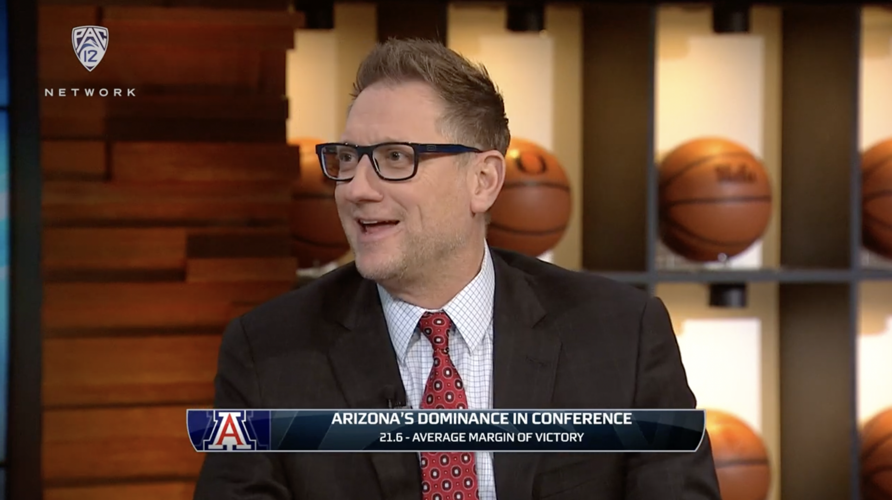
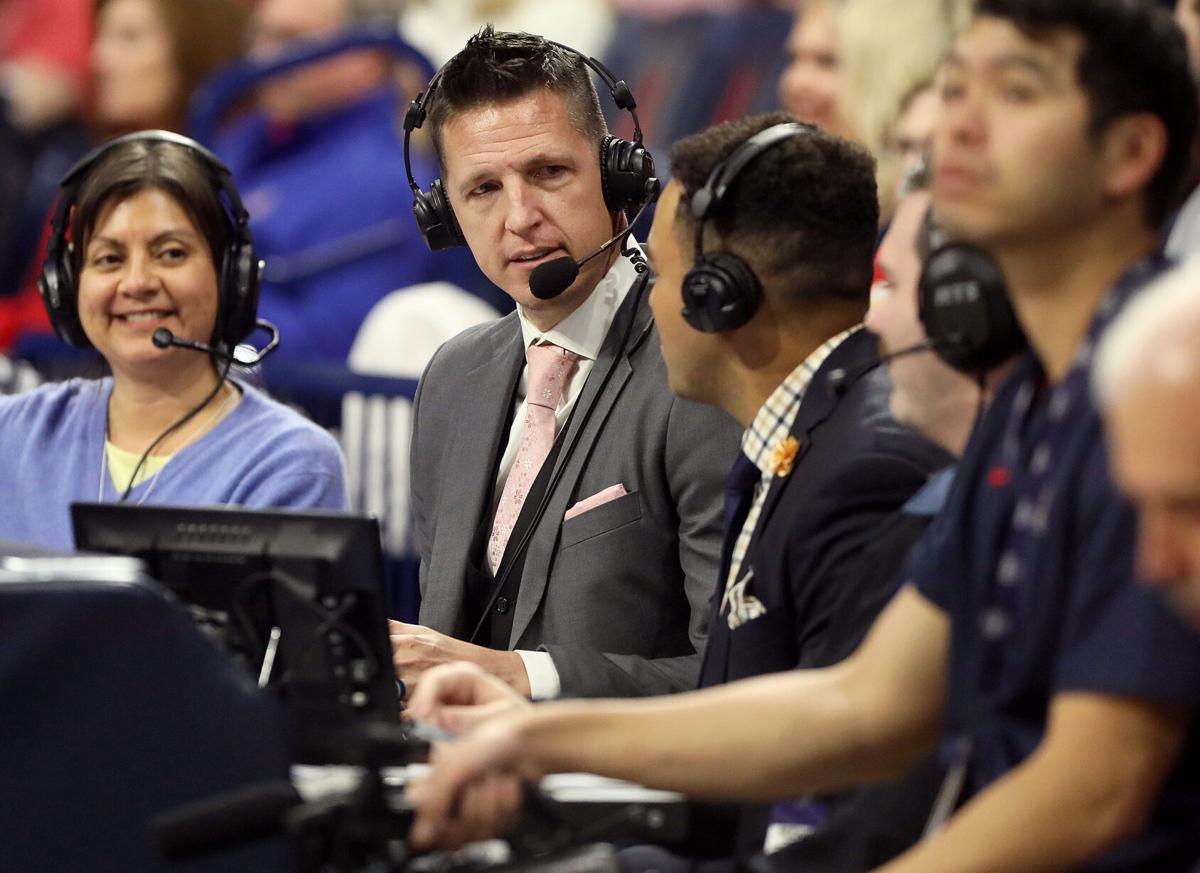
Former Arizona basketball player Matt Muehlebach (pictured during a studio segment in 2022), is an analyst for Pac-12 Networks and Fox. Muehlebach told the Star recently he knows “the realization of what’s happening with the conference” but that “for the most part, I try to stay in the moment and just do the games.”
It was hard for Muehlebach because he spent the latter half of his childhood growing up in the San Francisco Bay area, attending Cal and Stanford games and later choosing Arizona in part because he watched Lute Olson’s early Wildcat teams play the Bears and Cardinal there in the mid-1980s.

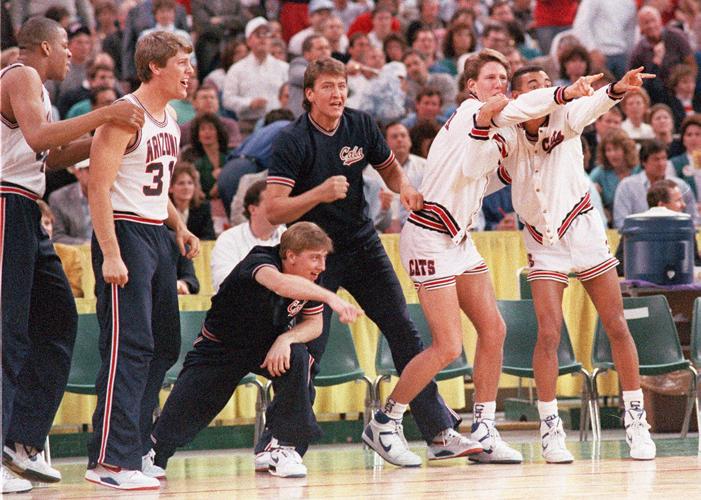
(From left) Sean Rooks Craig Bergman, Matt Muehlebach, Mark Georgeson, Jud Buechler and Harvey Mason celebrate a play during Arizona's game against North Carolina in the 1988 NCAA Tournament.
“They had (Craig) McMillan, and (Brock) Bronkhorst and (Steve) Kerr all running around, and I was like `Yeah, I love the way this team plays,’ ” Muehlebach said.
It was hard for Fox analyst Casey Jacobsen, who grew up in Southern California but starred for some of coach Mike Montgomery’s best Stanford teams and now lives in the Phoenix area.
“I’ve had months now to kind of digest it, and it still it still sits in my stomach like a pit,” Jacobsen said. “I was born and raised in the Pac 10/Pac-12 Conference, so I’m devastated that the conference that I grew up on and played in will not be. That’s sad to me.”
It also was hard for ESPN and Pac-12 play-by-play broadcaster Roxy Bernstein, because he grew up near Stanford, graduated from Cal and still lives in the Bay area today.
Bernstein says he’s been getting nostalgic while taking his last trips around the league — even though he may return to those same campuses next season to call ACC or Big 12 games — yet keeps most of that off the microphone. Also an occasional partner of Walton’s, Bernstein says he and Walton don’t talk about the Pac-12 situation during games unless it happens to come up.
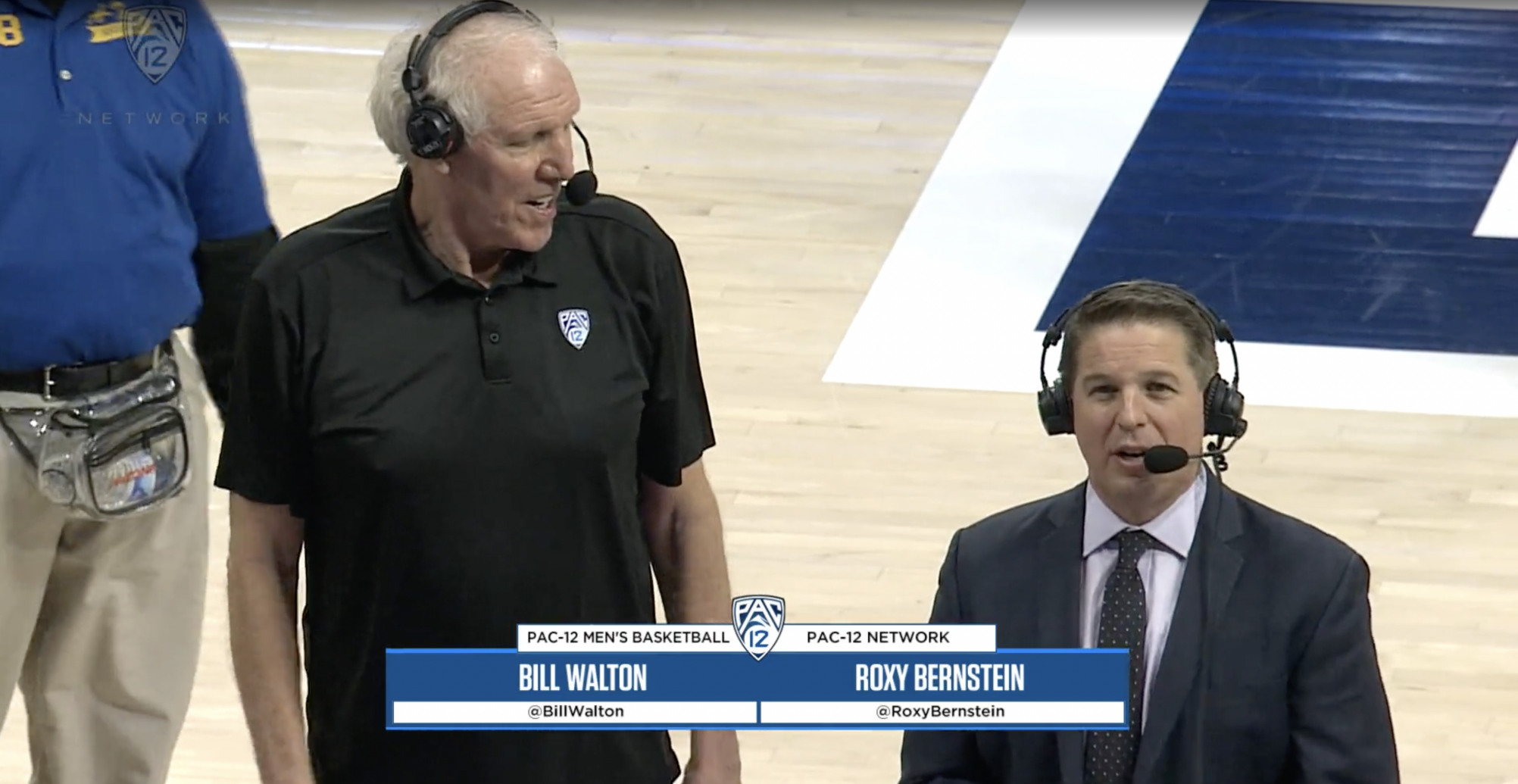
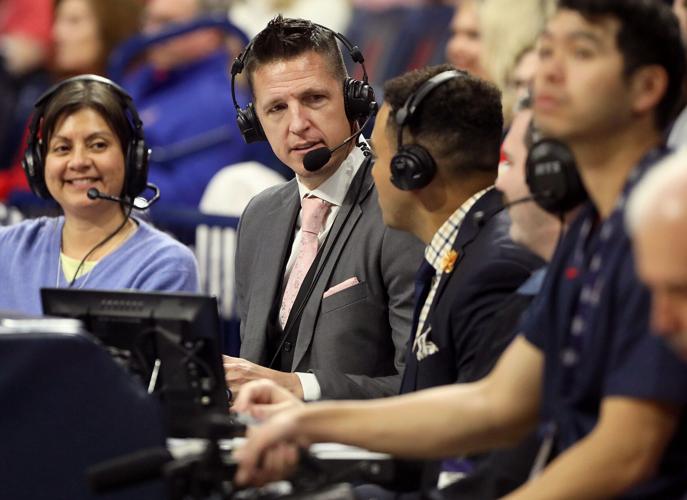
Roxy Bernstein and Bill Walton chat on the court as part of the broadcast for Arizona's eventual win over Utah at McKale Center on Feb. 8.
“And I have no idea about whether it will come up,” Bernstein said, noting Walton’s firm preference not to plan any banter before the games play out.
But the topic still burns inside Bernstein and, by all indications, also with Walton, the Hall of Fame former star at UCLA (Walton could not be reached for this story).
How could it not? A conference that began in 1916 with four members — Cal, Washington, Oregon and what is now Oregon State — wound up producing countless teams and athletes up that just don’t leave memory banks that easily.
“The first reaction I had was sad. It’s just sad,” Bernstein said. “You think of the most historic league in college basketball, or just college sports in general. It’s the league of Jackie Robinson. It’s the league of Kareem Abdul-Jabbar. It’s the league of Bill Walton. The league of Tiger Woods, John Elway, Jimmy Connors, John McEnroe, Tom Watson. You go on and on with these legendary figures, and essentially, it’s gonna be gone.
“And the aggravating, frustrating thing is it didn’t have to come to this. But unfortunately, it’s the reality.”
How it came to this, exactly, is still a matter of maneuvers among conferences, networks and school leaders that may never fully be disclosed. Even though the Pac-12’s own broadcasters work for media companies that were involved with the conferences and schools that realigned, Bernstein says he wasn’t privy to the detail.
“You hear rumors, you don’t know for sure what went on, but ... at the end of the day, schools were complicit,” Bernstein said.
Pasch said ESPN wanted the Pac-12 to have success and was invested in it, with Fox and ESPN having signed a $3 billion, 12-year media rights deal for the league that started in 2011-12. That deal is expiring this year, and maybe the Pac-12 with it.
“I’m sad about it,” Muehlebach says. “But also to some degree I’m like, what’s the quote from Moneyball? You know, adapt or die? I’m not going to dwell on it. I’m just trying to, more than anything, celebrate the conference as much as possible.”
Besides, maybe relalignment was inevitable. Jacobsen said the movement is another product of what college sports is today.

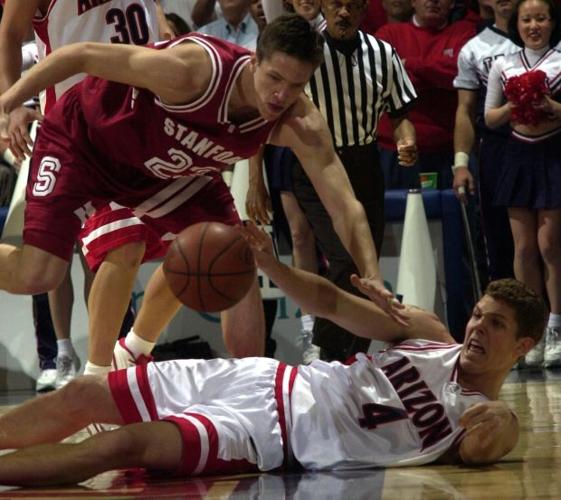
Arizona's Luke Walton shovels off a pass while on the floor as Stanford's Casey Jacobsen moves in during a matchup at McKale Center on April 14, 2000.
“We are now in a new world where we’re not pretending that college sports is amateur sports,” Jacobsen says. “We’re not pretending anymore. So in that sense, it’s good.
“But I’m sad that the Pac-12 had to implode because of this new world that we’re in. I was hoping that we could still figure out a way to make that work but money, television networks, they run it. I know that some fans don’t like that but also I’m happy that some of these players are now getting paid. I’ve been for that for a long time. The system has been archaic and needed fixing.
“Now is this current system that we have the perfect solution? I’m not so sure about that. But will we land somewhere in happy medium, five years, 10 years from now? I hope so.”
Maybe in five or 10 years what began happening in June 2022 will turn out to be a blip, an impulsive overreaction that was eventually remedied in some form. But for now, the history that is being written about the Pac-12’s demise began that month when UCLA and USC announced that they were headed to the Big Ten in 2024-25.
That seriously destabilized the league before it all blew up last summer: Colorado announced it was headed back to its former home in the Big 12, before Arizona, ASU and Utah said they were also Big 12-bound while Oregon and Washington opted to join the Los Angeles schools in the Big Ten.
Then, finally, Cal and Stanford, both less than an hour’s drive of the Pacific Ocean, signed on with the Atlantic Coast Conference.
Yep, it got that weird. Or that devastating, depending on how you view it.
“My alma mater is gonna be playing the ACC? That doesn’t make sense,” said Jacobsen, the former Stanford standout. “Arizona going to the Big 12 makes way more sense than most of the other teams. It makes way more sense than USC and UCLA playing in the Big Ten.”
Bernstein says the idea of his alma mater, Cal, joining Stanford in the ACC is “just ludicrous.” He said the Bay area schools needed a place to go, and that the ACC at least provided an academic fit with well-regarded schools such as Virginia, Duke and North Carolina, but also noted that that those schools’ athletes will have to spend a lot of time in an airplane.
“I just don’t see how it’s sustainable,” Bernstein said. “Somebody explain to me how that’s feasible when outside of their rival, the closest the school (SMU) in terms of mileage is 1,500 miles away? For football, maybe it’s five trips at most. But basketball, you’re going to the East Coast maybe nine times?
“It’s gonna take its toll on the student-athletes. Basketball, volleyball, baseball, softball, soccer. They’re all going to have to deal with these cross-country trips.”
The two remaining Pac-12 schools, Washington State and Oregon State, are offering a saner solution. WSU and OSU have two years under NCAA rules to maintain the league’s name and bring it back to at least seven teams, maybe by someday adding Mountain West, WCC or even current Pac-12 members back into the fold.
As of now, WSU and OSU are scheduled to compete as a “Pac-2” next season in football while other most other sports play affiliate WCC schedules.
“I think in a perfect world for them, they would love to see the Pac-12 reform in some way,” Bernstein said. “That’s why in football, they’re keeping the conference going there.”

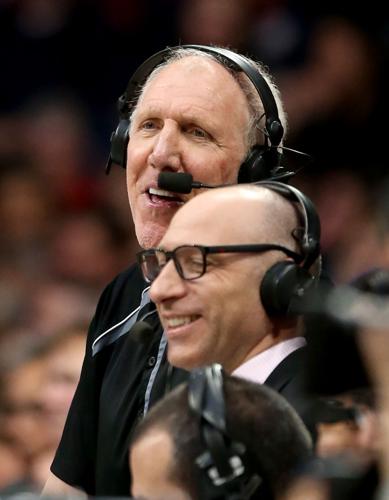
ESPN Analyst Bill Walton and play-by-play man Dave Pasch call the action Arizona's matchup wiht Washington at McKale Arena on Feb. 7, 2019.
Eventually, maybe some rivalries can be restored. Maybe Bay area athletes can travel to schools along the Pacific Coast once again instead of the Atlantic Coast. Maybe Oregon and Washington will play arch-rivals from their own states again.
Who knows? Nothing stays still for long in college sports anymore.
“We’ve handled it the best we can with the uncertainty of what’s next,” Pasch said. “Nobody really knows what next year is going to look like for all of us.
“None of this is good for college sports, but it’s where we’re headed and it’s part of the business. It’s unfortunate, but we’re just trying to get through the year and enjoy what we’ve got left in the Pac-12.”
Contact sports reporter Bruce Pascoe at bpascoe@tucson.com. On X(Twitter): @brucepascoe

Bruce Pascoe
Reporter