

The first time I suited up for a real basketball game — uniforms, coaches and referees — I was 10. I played for the Caps in the Logan (Utah) Bantam Basketball League. I must’ve weighed 77 pounds.
The local newspaper took a photograph of our team and published it on the front page of the sports section. I’ve kept it in a box for 50 years and can’t recall showing it to anybody.
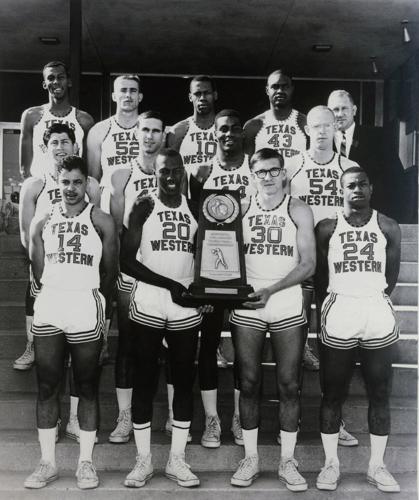
But when ESPN broadcast the historic 1966 NCAA championship game this week, Texas Western vs. Kentucky, I blew dust off the old shoebox and looked at the black and white image for what seemed like forever.
Standing in the back row, behind his all-white team, was our coach, Sam Haggerty, the first African-American I ever knew, and probably one of only two or three who lived in Logan in the early 1960s.
The old photograph shows my coach wearing a Utah State letterman’s jacket, which had such a powerful bearing to a 10-year-old that I can remember the smell of its white leather sleeves.
People are also reading…
I don’t recall a detail of any of our basketball games, but I do remember Haggerty saying that he scored a lot of points against Kentucky’s national championship team a few years earlier. (I later checked it out; Haggerty scored eight points against Adolph Rupp’s all-white Kentucky team in December 1957).
After completing his basketball eligibility, Haggerty spent a few years in the Army and returned to Logan to complete degree requirements. I lost track of him for a few years until I walked into the Nelson Fieldhouse and saw Haggerty, in his old letterman’s jacket, with the Aggies’ star player, 6-foot 8-inch Darnell Haney.
He laughed, shook my hand and introduced me to Haney. Over the next few days, I think I told everyone at Logan Junior High School that I met Darnell Haney.
“Sure you did,” they’d say.
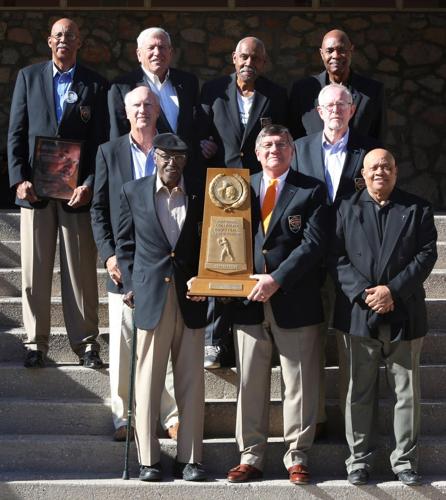
Whenever Texas Western’s 1966 national championship story is retold — and it will be retold all weekend during the celebration of its 50th anniversary — I think not of the Miners, but of Darnell Haney, Sam Haggerty and the struggle they had to find a place in American society.
This is the 60th anniversary of the year Haney led Phoenix Union High School to a perfect 23-0 record, routing Tucson High 79-35 in the state championship game. Haney was the state’s player of the year at a school that had won six state titles in seven years, and a prospect of the first level.
Neither Arizona nor ASU offered him a scholarship. At the time, Arizona had just one African-American basketball player in history, Hadie Redd.
So Haney wound up in Utah, in a white Mormon community, the third African-American player in USU history. He became close friends with my Bantam Basketball league coach.
A few years later, when I worked for the USU newspaper and was student manager of the Aggie basketball team, Haney returned to campus and attended a basketball practice. I reminded him of my connection to Haggerty, and he agreed to what turned out to be an hour-long interview.
Arizona’s 1956 player of the year grew up in poverty, one of 11 children. His father, a Phoenix garbage worker, was murdered in downtown Phoenix when Haney was 7. Darnell shined shoes at a downtown hotel, money that went to help feed his siblings.
I asked him if he kept in touch with Sam Haggerty.
“The last time I saw him was the day he graduated,” Haney said. “His mom drove in from California and I went with them to check into the Mitchell Motel. They wouldn’t give his mother a room. We had to sneak her into a dorm room at Bullen Hall.”
That was about the time Texas Western, now UTEP, beat Kentucky in the ’66 Final Four. Progress? Not everywhere.
In the early ’70s, after Haney and Haggerty earned degrees in sociology and began long and successful careers in Ohio and California, respectively, I was on duty when USU played UCLA in the Elite Eight. The Aggies’ two future NBA players, Nate Williams and Marvin Roberts, were the most famous people in my hometown.
Williams and Roberts got jobs working for Parson Construction that summer. I would beam every time the Aggie stars drove their construction vehicles to my dad’s gas station. Customers would ask for autographs from the two tall African-American basketball stars.
One night, as I worked the late shift, a foreman from Parson Construction stopped for gas. Our conversation turned to the basketball players who worked for him.
He used the “N-word.”
I had known the foreman for years; he sat in up-close seats directly across from the USU bench. I watched him stand and cheer when the Aggies soared to the Elite Eight.
I told him it was unthinkable he could cheer for them one night and refer to them with the “N-word” another.
The next thing I knew I was face down on the pavement.
The construction foreman rubbed my nose in a pool of spilled cleaning solvent, kicked me in the butt and drove off.
I thought about that when I looked at the photograph of my old Bantam Basketball team the other day. It was the best kick in the pants I ever got.
Contact Greg Hansen at 573-4362 or ghansen@tucson.com. On Twitter: @ghansen711.

Greg Hansen
Columnist


