Monti Ossenfort sat in front of a podium at the conclusion of the NFL draft and hesitated to make any proclamations. He does not want to provide an assessment of his own roster until he sees the players in a practice setting. He knows by now that spring assessments do not always correlate to fall results.
He is, though, firm in one area — that the Cardinals roster is better now than it was a year ago, when they went 3-14.
And why does he feel that way?
“Because we added good players in free agency, we added good players in the draft,” Ossenfort said.
That, of course, is the goal. It does not always — as Ossenfort knows — translate to reality. So for now, here is a grade for each of the Cardinals’ seven draft picks, as well as their overall haul.
Overall draft grade: C
People are also reading…
It’s not that the Cardinals failed to infuse their roster with talent in this draft.
Jeremiyah Love was widely seen as the best offensive weapon in the class. Chase Bisontis should immediately fortify the offensive line. Kaleb Proctor and Reggie Virgil are intriguing, high-ceiling additions.
But in a year when the Cardinals held the No. 3 overall pick, this class felt like a squandered opportunity. They made the safe pick with an electric first-round running back, rather than attempting to find a star at a more valuable position. And their third-round pick — quarterback Carson Beck — was a significant reach. Among the top three selections, only Bisontis represented notable value.
It’s also hard to square some of the Cardinals’ moves with the state of their roster. This is a rebuilding team that needed to strengthen its spine in anticipation of adding a quarterback in 2027. Instead, the selections of both Love and Beck were luxury moves from which the Cardinals are not yet ready to benefit.
Round 1, No. 3 overall: Jeremiyah Love, RB
Grade: C
In explaining the value of an elite running back, Cardinals head coach Mike LaFleur made a straightforward argument.
“When you bring in explosive playmakers at any position, you're giving yourself a better chance to have those explosives,” LaFleur said.
That’s certainly true, and Notre Dame's Love projects to immediately become one of the NFL’s most explosive running backs. The problem is that running backs — even elite ones — are easy to find. They regularly hit free agency, and they command palatable price tags. In the draft, they can often be found on Day 3.
By drafting Love, the Cardinals likely found one of those elite running backs, but they did so at an extraordinary price tag. Not only did they pass up on the opportunity to find a standout edge rusher or offensive tackle, but they spent $53.5 million to do so. That’s a new NFL record for guaranteed money on a running back.
Round 2, No. 34: Chase Bisontis, G
Grade: A
This is exactly the type of pick that the Cardinals need.
Bisontis should immediately strengthen their offensive line, enabling Isaiah Adams and Jon Gaines II to begin the season as depth pieces, rather than competing for a starting spot. Plus, left guard Isaac Seumalo is a 32-year-old playing on a short-term deal, so there is still room for Adams and Gaines in the long-term vision.
Plus, Bisontis, of Texas A&M, introduces standout athleticism to the offensive line. His only clear weakness is a lack of arm length, but the value was good at No. 34.
“Chase is what you want in a guard,” LaFleur said. “He can move, he can cover people up.”
Round 3, No. 65: Carson Beck, QB
Grade: D

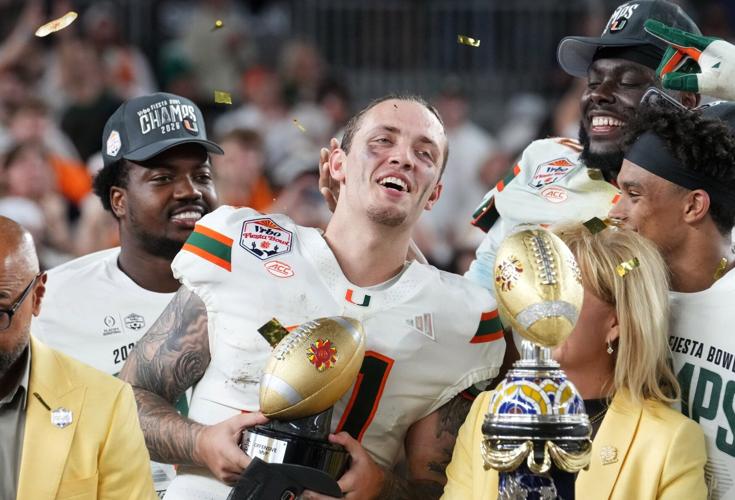
Miami quarterback Carson Beck is named offensive player of the game after their 31-27 win over the Ole Miss Rebels during their Vrbo Fiesta Bowl matchup at State Farm Stadium on Jan. 8.
It’s hard to understand the Beck selection. He is praised for his ability to process from inside the pocket, but he lacks the athleticism or arm strength to succeed off-schedule. Despite playing six seasons of college football, most recently with Miami, he never worked past his struggles when pressured — a key element of performing in the NFL.
Given the state of their quarterback room, the Cardinals were justified in taking a swing at a quarterback. But they could have done so later than the third round, and on a player with more upside than Beck.
“Carson played in a lot of big-game environments,” Ossenfort said, in explaining the pick. “Played in a lot of intense environments in the SEC.”
That’s true, but it does not overshadow the holes in his skill set.
Round 4, No. 104: Kaleb Proctor, DT
Grade: A-

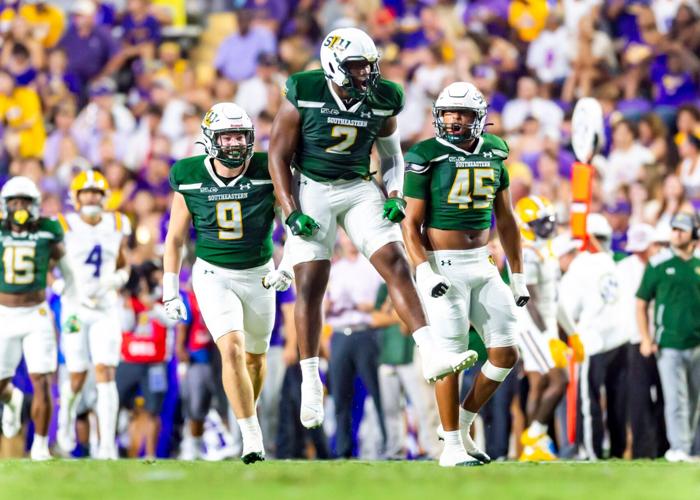
Southeastern Louisiana's Kaleb Proctor (2) celebrates vs. the LSU Tigers Sept 20, 2025, in Baton Rouge, Louisiana.
Proctor is a small-school defensive tackle who lacks the height that teams often seek out in the position. But he has a quick first step off the line of scrimmage and showed explosive traits as a pass-rusher. Despite coming out of Southeastern Louisiana, an FCS program, that is the type of risk that teams should take on Day 3 of the draft — especially when their defensive line lacks pass-rush juice, as the Cardinals’ does.
“If you have loose hips, if you can sink, bend your knees and your ankles — which Caleb can do — (a lack of height) can be an advantage to you,” assistant general manager Dave Sears said. “But you have to have your hand placement correct, enough lower body strength, all those kinds of things.”
Round 5, No. 143: Reggie Virgil, WR
Grade: B
Virgil arrives in the NFL with a somewhat strange profile. In college, he was noted for his ability to threaten teams downfield, which he also described as his own standout strength. Over the past two seasons, he has 16 catches on passes thrown at least 20 yards downfield.
But that skill set is typically associated with elite straight-line speed — which Virgil does not have. At the combine, the Texas Tech player ran a 4.57-second 40-yard dash, which is well below average for wide receivers.
“You don’t turn on the tape and say Reggie’s slow,” Ossenfort said. “In the end, that’s what matters.”
It’s a risky profile, but if Ossenfort is correct, Virgil would bring a necessary, field-stretching dimension to this offense.
Round 6, No. 183: Karson Sharar, LB
Grade: B+

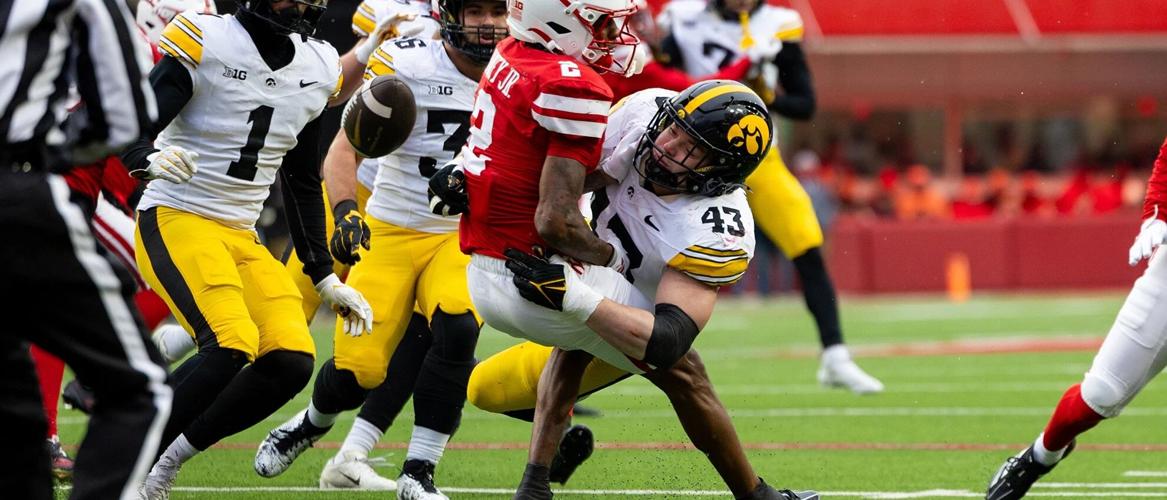
Karson Sharar (43) was an honorable mention All-Big Ten selection in 2025. He finished the season with 83 tackles, including 12 tackles for loss, four sacks, six pressures and one forced fumble.
Sharar lacks refinement as a linebacker, having only spent one collegiate season as a starter. He is also somewhat undersized, with below-average strength. But what he brings from Iowa is elite athleticism, with a relative athletic score of 9.71.
In this year’s draft, the Cardinals bet on those types of traits — especially up front. It could be the type of decision that infuses their roster with a needed speed element.
“Obviously, the more athletic, the better,” Ossenfort said. “… I wouldn’t say it’s something we necessarily target, but whenever we can add a good athlete, that’s always a positive.”
Round 7, No. 217 overall: Jayden Williams, OT
Grade: B
In the seventh round, finding a player who merely makes the roster qualifies as a success. Williams certainly has the traits for that to be a possibility, with his 6-foot-4, 307-pound frame. Now, it will be a matter of the Cardinals’ coaching staff molding his technique in a way that Ole Miss’ staff was unable to.