The Arizona Cardinals opted for a running back to shape the future of their franchise by selecting Notre Dame’s Jeremiyah Love at No. 3 overall in the 2026 NFL Draft on Thursday.
The move came after quarterback Fernando Mendoza and edge rusher David Bailey went off the board with the first two picks to the Las Vegas Raiders and New York Jets, respectively. At No. 3, the Cardinals’ options seemingly came down to Love and edge rusher/linebacker Arvell Reese.
In selecting Love, they chose a player viewed by many evaluators as the best overall prospect in this year’s weak draft class. This past season, Love rushed for 1,372 yards and 18 touchdowns on 199 carries, good for 6.9 yards per attempt. He added 27 catches for 280 yards and three touchdowns.

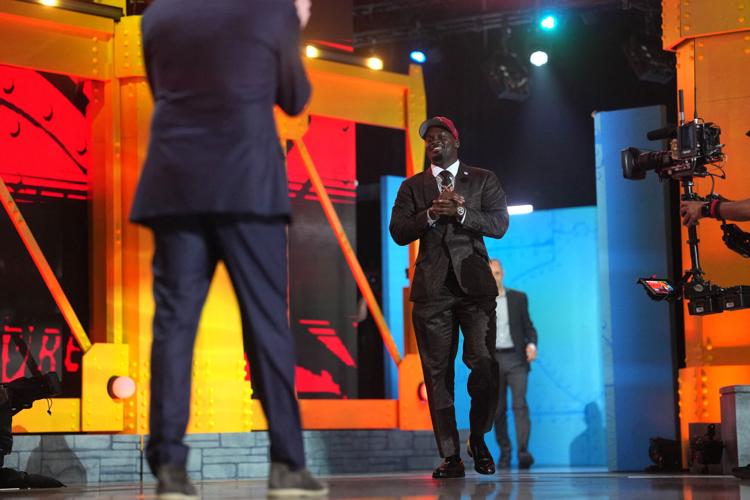
Notre Dame running back Jeremiyah Love is selected by the Arizona Cardinals as the No. 3 pick during the 2026 NFL Draft on April 23, 2026.
“When we're picking that high, the goal is to add an impact player,” general manager Monti Ossenfort said. “There were certainly other players that we talked about. We talked about the position, understand all that. In the end, we felt we added the guy that could impact our team the most.”
People are also reading…
Ossenfort also dismissed the notion that owner Michael Bidwill was involved in the Cardinals’ decision-making process.
“In the decision, no,” Ossenfort said. “Not at all. … Michael (Bidwill) has been great. He was awesome with letting Mike (LaFleur) and I go through our process. He was engaged as always, but really hands off and let us do our job.”
As a player, Love has the physical profile that teams covet at the position. He has a powerful frame (6 feet, 212 pounds) along with elite speed, having run a 4.36-second 40-yard dash. Plus, he’s seen as one of the most explosive running back prospects in recent years, along with the pass-catching ability that is crucial in the modern NFL.
“He didn't have that weakness in my opinion in any of those phases,” LaFleur said, referring to the run game, receiving game and pass protection.
Put it all together, and Love was viewed similarly to recent elite running back prospects such as Saquon Barkley and Bijan Robinson, both of whom have ascended to stardom.
Over the past decade, the league has had remarkable success with highly drafted running backs. The six running backs drafted inside the top 10 during that time frame are Ezekiel Elliott, Leonard Fournette, Christian McCaffrey, Barkley, Robinson and Ashton Jeanty. Of those players, four have earned All-Pro selections, while Jeanty is just one year into his career.
“I have the opportunity to really set a new standard for running backs,” Love said. “We've already had Saquon, we've had Bijan, we've had Ashton Jeanty. And now you have me.”

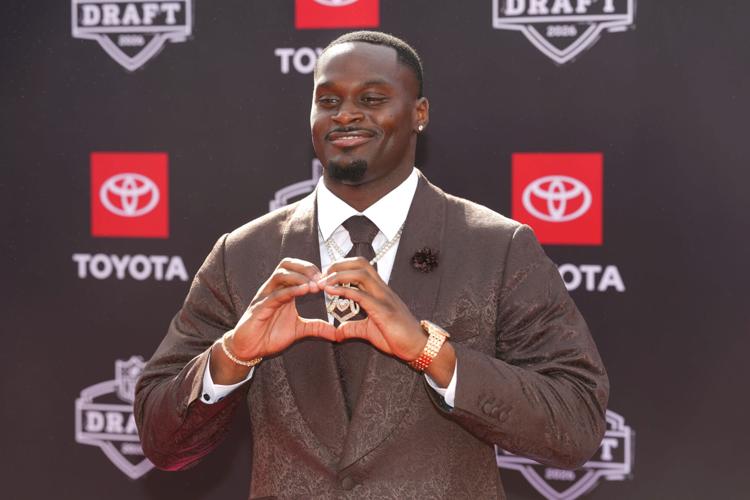
Notre Dame running back Jeremiyah Love poses on the red carpet before the 2026 NFL Draft on April 23, 2026.
The potential issue lies in the positional value of the pick, as Love immediately sets an NFL high for guaranteed money at running back. He will make $53.9 million during the four years of his rookie contract, according to Over The Cap. That blows past Barkley’s current deal, which includes $36 million of guaranteed money.
Love’s $13.5 million annual salary also makes him the seventh-highest paid player at the position on an annual basis. In other words, he will need to perform at an elite level to provide excess value.
By contrast, if the Cardinals had selected Reese, he would have become just the 34th-highest-paid edge rusher. That hints at one of the key risks in taking Love: It is much easier to find an elite running back than it is to find an elite pass rusher.
This offseason, Kenneth Walker — one of the league’s most explosive running backs — signed in Kansas City for just $14.4 million annually. Two years ago, Barkley hit the open market, landing in Philadelphia.
At edge rusher, on the other hand, the league’s top players seldom hit free agency, especially in their primes. Those players are typically acquired with early first-round picks. And on the rare occasions that they change teams, they command eye-popping price tags.
In the past year, both Micah Parsons and Maxx Crosby were traded for two first-round draft picks (before Crosby’s deal fell apart due to medical concerns).
That price tag would be unthinkable for a running back in the modern era. Even McCaffrey — the league’s most dynamic weapon at the position — was traded from Carolina to San Francisco without a single first-round pick being included in the deal.
When asked why the Cardinals were willing to overlook that scarcity, Ossenfort pointed to a simple philosophy.
“With every decision that we make in the draft, we take the best player that we think is available when we pick,” Ossenfort said. “And we did that tonight. That'll always be the case as long as I'm here.”
LaFleur, meanwhile, extolled the value of players who can create explosive plays out of nothing.
“I don't have to call the greatest plays sometimes when you just get the ball to Trey McBride; he breaks three tackles and he turns it into an explosive,” LaFleur said. “Same thing with our receivers. So when you can get that from the backs, it's just that next position that allows you to get those explosives.”
This, ultimately, is the gamble that the Cardinals made. They took a risk on a rare skill set, even at a position that has long been devalued by the league.
They did not waver, either. Ossenfort said the Cardinals settled on Love early in the week and that they were not close to trading away the pick, as had long been rumored.
And now, it is Love who may come to determine their future.
Grade: C
Love may be an elite talent, but this selection is a bet against history and positional value. Since 2017, teams that draft a running back inside the top 10 have gone just 108-170 during those players' rookie contracts. Assets as valuable as the No. 3 overall pick are in rare supply; elite running backs are in high supply, relative to other positions.