At work, Angelica Suffren prefers to avoid the spotlight.
As a WNBA referee, her job is to be invisible. That’s not the case off the court, when Suffren takes center stage as a competitive ballroom dancer.
On the dance floor, all eyes are on Suffren and her partner.

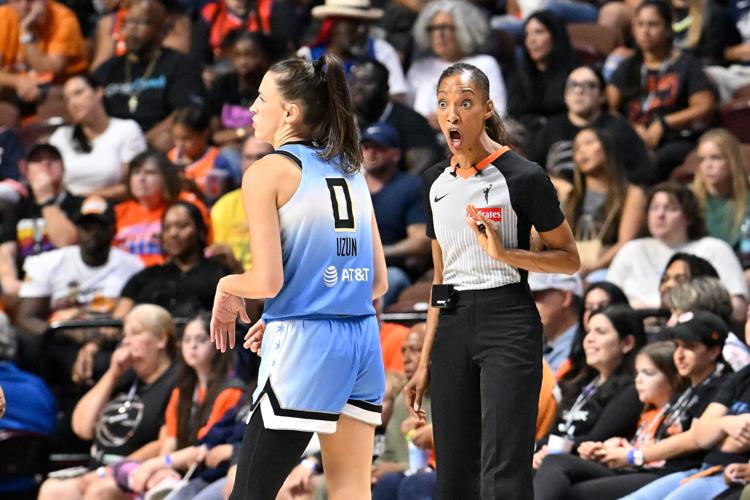
WNBA referee Angelica Suffren reacts to Chicago Sky guard Sevgi Uzun during the second half against the Connecticut Sun on Aug. 13 at Mohegan Sun Arena in Uncasville, Conn.
“It’s 100% a completely different world,” she said. “At the end of the day, I have to remind myself that people want to see something beautiful. They want to be moved. No one is rooting for you to fail, so that also makes me want to give. So giving more of myself on the dance floor will hopefully reach someone in a way that I didn’t know they needed.”
Every week, Suffren officiates one or two WNBA games in different cities. At the start or end of the week, she flies to New York to train with her ballroom dancing partner/coach, Aleksandar Vukosavljevic. If she’s lucky, she can spend a few days at home in Atlanta to recharge. She also competes in ballroom dancing at least once a month, sometimes sandwiched between basketball games.
People are also reading…
It’s a hectic schedule, Suffren admits. No day or week is the same.
“It takes effort and energy and lots of planning,” she said. “It almost makes it like a game to make the puzzle pieces fit together.”
Suffren has been a referee for more than 25 years. In addition to the WNBA, she’s officiated games in the NBA G League, Basketball Africa League, FIBA competitions and NCAA Division I women’s college basketball (including the 2024 NCAA Championship game between South Carolina and Iowa).
Suffren called fouls in her own games. Then she started officiating for others
Suffren, a former college basketball player, never predicted this career for herself. But others did. At Austin Peay State University in Clarksville, Tennessee, Suffren was a mouthy player who called fouls and travels when she saw them during her games.

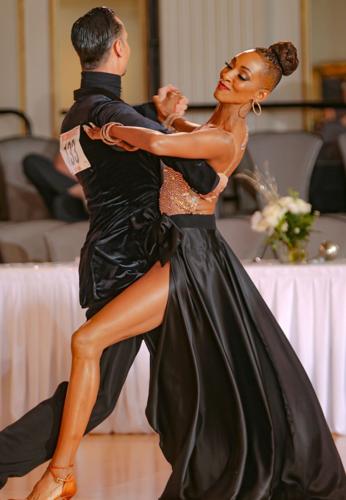
In between basketball games, WNBA referee Angelica Suffren is also a competitive ballroom dancer. "It's a completely different side of my brain," she said. "It is absolutely art, but it is unbelievably technical."
“My senior year, there were officials officiating my games who told me, ‘Oh, you’re going to be a referee,’” Suffren recalled. “I was like, ‘Who wants to be a referee? That’s not cool.’”
Then one day after her season had ended, Suffren was shooting around in the school’s intramural gym when the director offered her $10 to referee the men’s intramural championship game. She reluctantly accepted and never looked back.
“There was definitely a push to get college athletes into officiating at the time, particularly women,” Suffren said. “I just happened to come along at that time and I was sort of pushed along kind of fast.”
Ballroom dancing didn’t enter Suffren’s life until three years ago. On a date, someone asked Suffren about her hobbies outside of work and she realized she didn’t have an answer. For reasons she can’t explain, dance popped into her head. She Googled ballroom dance in Atlanta, found the first search result and went to try it out.
'I get to wear this in real life!' Ballroom glamour a contrast to ref's role
Suffren fell in love with dance immediately. She vibes with the music, artists like Nat King Cole and Ella Fitzgerald who were already in her regular rotation. She discovered that dance, like refereeing, requires extraordinary awareness and attention to detail. It’s also helped her learn more about herself.
“Everything has to be intentional (in dance),” Suffren said. “So there’s a certain level of awareness that I have to have about myself. You think you know yourself at this big age, and then you try something new and you realize there’s so many more things about yourself that you have yet to explore. And that, I think, is the biggest gift that dance has given me.”

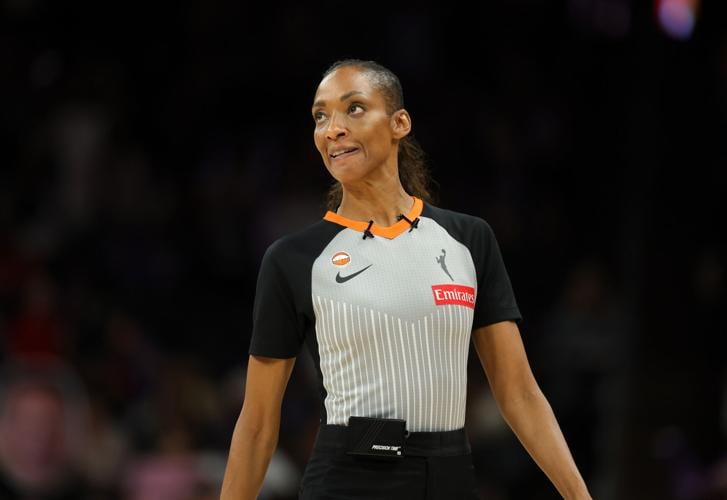
WNBA referee Angelica Suffren officiates a June 17 game between the Phoenix Mercury and Las Vegas Aces at Mortgage Matchup Center in Phoenix.
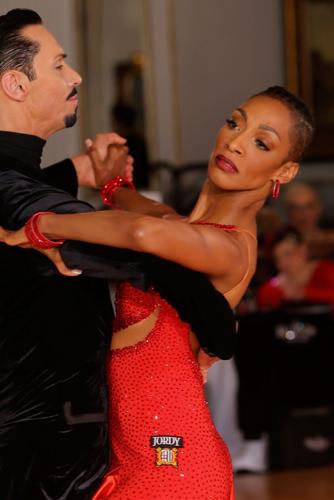
Suffren dances a style of ballroom called American Smooth, which encompasses the waltz, tango, foxtrot and Viennese waltz. She affectionately describes competitions like the Capitol ball scene from “The Hunger Games” movie, because the opulent environment is in such stark contrast to the world outside.
“You walk into the ballroom and there’s glitz and glamour and opulence and rhinestones,” Suffren said. “It’s so glamorous and completely opposite from my normal life. In one of my rooms upstairs I have all of my gowns, and sometimes I walk in and I’m like, ‘Man, I get to wear this in real life!’”
As a former college athlete, Suffren also enjoys the competitive side of ballroom – and she’s quite good at it. Last August, Suffren and Vukosavljevic won first place at the 2025 Capital Dancesport Championship in Washington, D.C. This spring, they won gold at the Emerald Ball in Los Angeles, one of three major American ballroom dancing events.
Still, Suffren stresses that she’s by no means a professional dancer.
“I’m learning every day,” she said. “It’s a completely different side of my brain. It is absolutely art, but it is unbelievably technical. I practice a lot, so the success I’ve enjoyed up until this point I totally attribute to my practice – of course my athletic ability, too, but I put a lot of time and effort into it.”
Suffren’s officiating schedule is even busier during the WNBA offseason, when she referees women’s college basketball games, but she still finds time to squeeze in solo rehearsals on the road. She has a go-to practice ballroom in every city, ranging from actual ballrooms to dance studios to a YMCA yoga room. She’ll even work on choreography while waiting for her clothes to dry in a laundromat.
The frequent practice allows Suffren to marry muscle memory and emotion on the dance floor, unlocking freedom while maintaining precision.

In between basketball games, WNBA referee Angelica Suffren is also a competitive ballroom dancer. "It's a completely different side of my brain," she said. "It is absolutely art, but it is unbelievably technical."
“Even though I get butterflies sometimes before games, I can always go back to my training. With dance it’s the same thing,” Suffren said. “I still have butterflies when I walk onto the dance floor, but if I know my routine, I know that I have a certain level of freedom in that discipline.”
If a referee does their job well, no one notices them. They usually only get attention if they make a mistake. In dance, however, mistakes are accepted as part of the process. Suffren views dance performance as a give-and-take with the audience, and she hopes that sharing more of herself will inspire basketball fans to act with compassion.
“If this makes people see officials as human, I’m all for it,” she said.