Before Tage Thompson’s jaw-dropping stickhandling and heavy right-handed shot were routinely featured on the nightly highlight-reel shows, a former teammate of the Buffalo Sabres center made a comment that raised eyebrows around the NHL.
Auston Matthews, the Toronto Maple Leafs’ franchise player and winner of the Hart Trophy in 2022, referred to Thompson as the league’s most underrated player during an interview at the league’s player media tour in October.
Thompson has become a superstar almost five years after he arrived in Buffalo as the lone prospect acquired in the trade that sent Ryan O’Reilly to the St. Louis Blues. Thompson, who, at 25, is amid his second season playing center in the NHL, sits third in the league with 36 goals. His 71 points through 54 games are more than the career high he set in 2022-23.
Auston Matthews KNEW Tage Thompson was about to go off. 😤Who do you think is the most underrated player in the NHL? @Steve_Dangle sat down with some stars from around the league to get their picks. pic.twitter.com/iakQJ80Rji
— Sportsnet (@Sportsnet) November 30, 2022
People are also reading…
Few players outside the Sabres’ dressing room know Thompson’s talent as well as Matthews. They’ve trained together in recent summers in Arizona, a state that both call home, and, as 17-year-olds, they were on the same team at the USA Hockey National Team Development Program in 2014-15.
Coached by the Sabres’ Don Granato, the 1997 birth year is considered among the best to come out of the NTDP. The roster included Florida Panthers winger Matthew Tkachuk, Arizona Coyotes winger Clayton Keller, Boston Bruins defenseman Charlie McAvoy, Anaheim Ducks winger Troy Terry, Minnesota Wild winger Jordan Greenway, Columbus Blue Jackets center Jack Roslovic, San Jose Sharks center Luke Kunin, Florida Panthers center Colin White and former Sabres defenseman Casey Fitzgerald, among others.
“It was such a fun experience to play with guys like that,” Thompson recalled following a recent practice in El Segundo, Calif. “Now, watching where everyone is at in their careers, it's kind of cool playing against a lot of the same guys. We had a really good team.”
Thirteen of the 20 skaters to appear in at least one game for that team are in the NHL. Most have prominent roles on their respective teams. Four are considered superstars. And that remarkably talented roster will likely be a talking point on the ESPN+ broadcast when Matthews and the Toronto Maple Leafs roll into Buffalo to play Thompson and the Sabres on Tuesday at 7:30 p.m.
'Great for the league'
Thompson didn’t have the same hype as Matthews when the two shared a locker room as teenagers. At the time, Thompson was 6-foot-1, five inches shorter than he stands now, weighed approximately 160 pounds and typically was used as the 12th or 13th forward. He persevered, as he has since Ryan O’Reilly was awarded the Conn Smythe Trophy as playoff MVP and hoisted the Stanley Cup with the Blues. Lessons learned that season served Thompson well while he worked to become the elite goal scorer he is today.
“I think you could just see it with his hands, how skilled and gifted he was,” the Ducks' Terry, who was in a bottom-six role with Thompson, told The Buffalo News recently ahead of his second All-Star Game in Sunrise, Fla. “And I think, at that time, learning to play with how big he was, his game was something he was still kind of working through and figuring out. You don't see guys that big that can stick handle like that and shoot like that.
“He truly is smart, skilled. He plays a small hockey player's games with his hands and how he moves and that type of thing, but he's 6-7, or whatever he is. I think he's great for the league. I couldn’t be happier for him, and it’s definitely noticed.”
Terry and Thompson were in the same situation. They were among the four players who made the Under-18 team in 2014-15 who weren’t at the program the previous season when the stars were Jack Eichel, Alex Tuch and Dylan Larkin.
Bonds were already forged. Roles weren’t defined, though.
Two of Thompson’s new teammates, Matthews and White, were advanced enough as 16-year-olds to skate with the Under-18 roster the previous season. Past accomplishments and opportunities didn't matter to Granato, who reminded his 1997-born players from the start of training camp that a “permanent hierarchy" didn’t exist.
Granato had to reassure players such as Thompson and Terry throughout the season that they were on the right path. To enhance development and provide opportunity, Granato used each line as a power-play unit during some exhibition games. The strategy couldn't be used when preparing for major tournaments, though, and there was ample competition for ice time.
One-on-one meetings were used to give them guidance on how to assert their skill on bigger, stronger opponents after doing so at lower levels.
It is challenging for players in a situation such as the one Thompson and Terry were in. The latter said he and others viewed it as "make-or-break hockey," because they were trying to impress NCAA coaches and NHL scouts. One bad shift or game can feel catastrophic to kids that age.
"When I really think about it, our team, I don't know the numbers on it, but it's got to be one of the better teams that have come through that program when you look at how many players actually made it to the NHL and are still big players," said Terry, who scored 37 goals for Anaheim last season. "Me and Tage kind of went through struggles there together."
Growth spurt
Thompson quickly learned that comparing his progress to that of others would only make it more challenging. Everyone was at a different stage in their development. Matthews was labeled a possible future No. 1 draft pick, a prediction that came true in 2016 when he was selected first overall by the Maple Leafs.
“We wanted to make sure that the whole team understood that nobody's ahead of anybody else just because somebody scored more goals than another guy,” Granato recalled following a recent Sabres practice in San Jose. “That’s where, as a coach, we wanted to reassure the players that nobody's future was any brighter than anybody else's or not. It was a message that, I think, was important to send to players that were just so talented.”
The dangles that Thompson uses to turn the league’s best defensemen into traffic cones were part of his game when he arrived at the development program in the fall of 2014. Short compared to what he is now, Thompson was still among the taller players on the roster, and often had the height advantage over his competition.
Granato saw signs of the player that Thompson would become. Lanky with a heavy shot and a long stick. Suddenly, Thompson hit a growth spurt. At first, he added only a few inches. The adjustment wasn’t terribly difficult. He’d work through any physical awkwardness in practice and start to feel good. But then he grew again, and again, until he was an imposing, 6-foot-6 forward.
Scouts began to see what Granato did. Even in a lesser role, Thompson made an impact with 12 goals and 26 points in 64 games. It was clear to everyone in the program, teammates included, that Thompson was going to need time to learn how to become an impact player at that size. It wasn’t until five years later, when Thompson started the season in Rochester, that he had the lower-body and core strength to use it to his advantage.

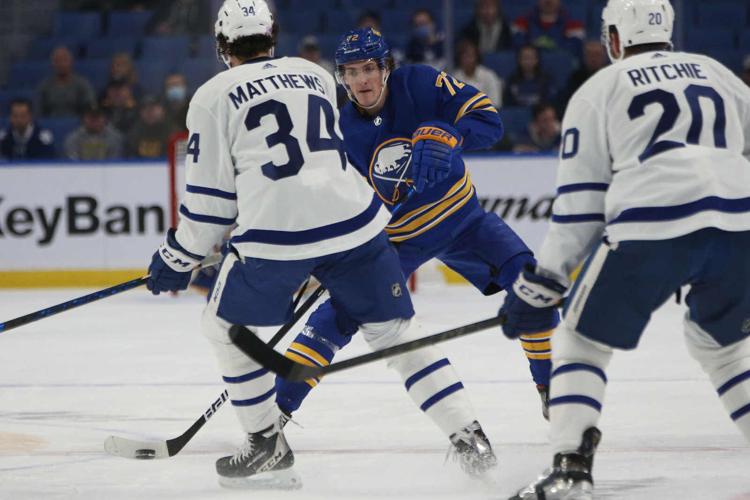
Buffalo Sabres right winger Tage Thompson (72) makes a move on Toronto Maple Leafs center Auston Matthews (34) at center ice during the first period.
“l think everyone progresses at a different pace, and that's something I learned going in there," Thompson said. "I was 17 and 6-1, 160, so some guys were fully developed, fully mature and they're at a different time and place in their career and their development. I knew I just had to be patient and continue to work and, obviously, it's kind of just a mental grind at that point.”
Differing paths
Those gifted players went their separate ways after that season. Thompson played one year at the University of Connecticut, where his performance led him to the Blues as the 26th pick in the 2016 draft.
Five of his teammates were also selected in the first round that summer: Matthews (first overall), Tkachuk (sixth), Keller (seventh), McAvoy (14th) and Kunin (15th). Two others were chosen in the first round in 2015, only a few months after they were teammates with Thompson: White (21st) and Roslovic (25th).
Among the group, only Tkachuk has more points than Thompson this season. Thompson is on pace to become the first Sabres player to reach the 100-point milestone since Pat LaFontaine and Alexander Mogilny in 1992-93.
"Everyone is getting impressed with his thing right now, but, I mean, I kind of had an idea when we were at the World Championships," Dallas Stars star winger Jason Robertson said, referring to the tournament in 2021. "Like, the talent and skill this guy has, how hard his shot was. It was very deceiving, the hands he has for a big guy. So, it wasn't surprising to me to see how he kind of took off last year and, I mean, he's just blown up this year."
Thompson's move to center in the fall of 2021 led to a breakthrough season that earned him a seven-year contract with the Sabres. He helped them win three of their five games against Toronto last season, including his goal and two points to lift Buffalo to an outdoor win at the Heritage Classic in Hamilton, Ontario.
Thompson and Matthews will cross paths Tuesday during an interesting time for both franchises. The Sabres are fighting to end an 11-year playoff drought that began when Thompson was 14 years old. They've won two straight and, as the youngest team in the NHL, control their own fate because of games in hand over competitors.
The Maple Leafs are all-in to try to win the Stanley Cup after sending a haul of draft picks and prospects to the Blues to acquire O’Reilly, who made his debut Saturday night.
The clash of the two great young centers will be shown exclusively on ESPN+ and Hulu. And while their time at NTDP was one short chapter in their hockey journeys, earning ice time on a team led by Matthews helped Thompson prepare for everything that he’s experienced since.
“I think having gone through that program, and the adversity and challenges those players face, I think it made it a lot easier for Tage to face challenges once he got to the NHL,” Granato said. “I think he was very well prepared to face challenges knowing that, you know, enduring it and fighting through it, there was going to be another side.
"I think the challenge of him trying to get where he's gotten with us in Buffalo since, was very similar to his challenge when he was at the national team program. So, he'd already done that successfully once, and I think that helped him know in the back of his mind that he was going to accomplish it here.”