

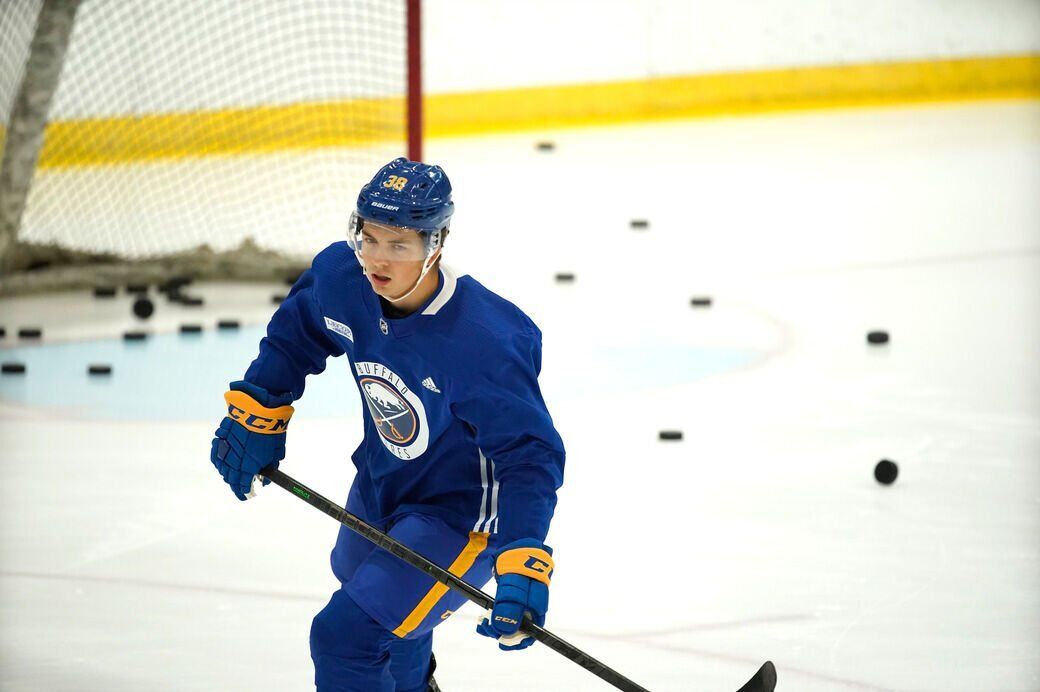
Long after the capacity crowd cleared out of the intimate, college-sized rink, Ryan Johnson stood near a wall outside the Golden Gophers’ dressing room that recognizes each University of Minnesota hockey alumnus to reach the NHL.
Johnson’s name isn’t listed yet. But his play as a senior defenseman on one of the top teams in NCAA hockey this season has him on track to someday join the numerous Golden Gophers who graduated to the best league in the world.
Now 21 years old, and almost four years removed from being selected 31st overall by the Buffalo Sabres at the 2019 draft, Johnson can’t fathom that his time in college is coming to an end.
“It’s definitely been a great experience,” Johnson told The Buffalo News following the Golden Gophers’ 8-0 win over Michigan State on Jan. 27. “It’s tough. Four years fly by. This is a really special place.”
People are also reading…
Johnson and his teammates are having the season he envisioned when he bypassed an opportunity to sign an entry-level contract with the Sabres to return to Minnesota for a fourth and final year. The Golden Gophers (21-8-1) are ranked second in the NCAA by USCHO.com ahead of their road game Friday night at Penn State. They’re averaging four goals per game, a mark that ranks fourth in the country.
From the left side of Minnesota’s defense, Johnson has five assists in his last four games. He’s totaled two goals and 15 points with a plus-15 rating through 30 games this season. His contributions aren’t limited to offense, either. Johnson leads the Golden Gophers in blocked shots, and he’s made significant progress in defending.
Johnson will try to help the Golden Gophers reach the Frozen Four for a second consecutive season after they lost in the semifinal round in April. Then, he’ll have a meeting with Sabres General Manager Kevyn Adams about his future. Johnson will have to decide if he wants to join the organization that drafted him or seek an opportunity elsewhere as an unrestricted free agent this summer.
“I really like the Sabres, and I really like Buffalo,” Johnson explained. “It's crazy that this year is going really fast. Just gonna have to wait and see, too. And obviously, just focus where I am right now. That opportunity will be great when it comes.
“I think Buffalo, they do have great opportunities, and it's an excellent place to play. So, I don't think that will be a problem. It just going to be my decision and talking to their general manager to get their view.”
The second part of Johnson’s answer relates to the Sabres’ current defense depth. With Rasmus Dahlin and Owen Power members of the club’s core, there won’t be a path to power-play opportunities for Johnson. He’d have to start his pro career in Rochester, then develop his game with the Amerks to eventually earn a spot in Buffalo.
The challenge isn’t a deterrent for Johnson. And though the Sabres have other talented, young defensemen in the NHL, their prospect pipeline is depleted at the position. They’ve drafted three over the past two years, not including Power, and none in the group is in the American Hockey League.
The Sabres have made significant strides in developing a relationship with Johnson. He was drafted by the previous regime, led by GM Jason Botterill, and worked closely with different development coaches during his first year in the organization.
Adams’ staff has made sure Johnson feels supported but not suffocated during his final season of college hockey. Nathan Paetsch and Tim Kennedy, both development coaches for Buffalo, have made trips to Minnesota to visit with Johnson and discuss the ways in which his development can reach another level. Johnson also enjoyed his visit to Buffalo in July for development camp, which gave him an opportunity to meet others in the organization and fellow prospects with whom he might someday share a locker room.
Patience is paying off for the Sabres. Johnson has improved his game in several notable areas, particularly in the offensive zone. While his shot totals have declined from last season given the plethora of talent on the roster, he’s exceptional on breakouts and continues to develop his playmaking ability.
“I definitely think I've been able to tune things in my game,” said Johnson. “Just finding out what kind of player I am. Obviously, I knew my breakouts were strong and as well as, like my skating. Just trying to develop all around, including how I think the game, too. Just learning how to approach different situations. Working on skills and building confidence as well.”
His performance in the 8-0 win in late January was the latest example of Johnson’s growth. Logan Cooley, whom the Arizona Coyotes drafted second overall in July, won the opening faceoff back to defenseman Brock Faber, who sent a quick pass over to Johnson.
Johnson threaded a perfect outlet pass down the middle of the ice to spring Cooley for a breakaway goal nine seconds into the game. Later, Johnson carried the puck down the right wing to enter the offensive zone and slowed down to assess his passing options rather than skating into bad ice. When the defensive coverage moved toward him, Johnson snapped the puck to the slot to set up a goal by St. Louis Blues first-round pick Jimmy Snuggerud.
“He’s obviously crazy talented,” said Golden Gophers center Aaron Huglen, a fourth-round pick of the Sabres in 2019. “He's so shifty. I remember playing him back in Sioux Falls in the USHL. Trying to go in on the forecheck on him, he just bounces right around ya.”
Johnson’s rush defense has improved, as has the way he kills plays around the Golden Gophers’ net. He’s always been an outstanding skater, but he’s worked with his father, Craig, a former NHLer and current assistant coach with the Anaheim Ducks, to continue to build on that strength.
The Sabres knew it was going to be a long wait when they drafted Johnson. He was only 17 years old and needed time to physically mature. Across three-plus years, he’s appeared in 133 games at Minnesota and won the program’s most dedicated player award as a freshman. In 2021, Johnson helped the United States win gold at the IIHF World Junior Championship.
“I think the talking points with our development staff to him is to round out his game,” said Adams. “He was drafted more as a really high-end skater and puck-mover type, but I think, just for him to mature in terms of closing quickly in the D zone, killing plays, and then being able to transition the other way. So, just becoming a little bit more of just that all-around, 200-foot defenseman, and I think he's definitely taking steps this year.”
The decision to sign with the Sabres won’t be Johnson’s alone. Interest must be mutual. And there’s an interesting layer to his situation that doesn’t exist with fellow prospect Erik Portillo, a junior goalie at the University of Michigan.
Since Johnson was a first-round draft choice, the Sabres receive a compensatory pick if he signs elsewhere, whereas they get nothing if they lose Portillo without trading his rights beforehand. The draft pick for Johnson would be the 31st selection in the second round, a valuable trade chip that could help Adams acquire a player for his NHL roster.
Adams met recently with Johnson’s agent, Pat Brisson, who also represents Power. The situation with Johnson was among the topics discussed, though formal talks won’t begin until after the Golden Gophers’ season ends.
“To be honest with you, it's a little bit of a unique situation with the way that the CBA is, and they get to this point, and obviously, we had talked to him last year about potentially turning pro or not,” said Adams. “I totally understand. They have a great team. It's a great spot. He wanted to be back there, finish where he started, which I respect. But these are the conversations that we'll have with him. It’s a unique one. Obviously, on our end, there's compensation because of where he was drafted where other players that isn't always the case.”


