Forty years ago this season, Nov. 30, 1986, Arizona and Stanford played a regular-season football game — the Coca-Cola Classic — in Tokyo's historic Memorial Stadium, home of the 1964 Summer Olympics.
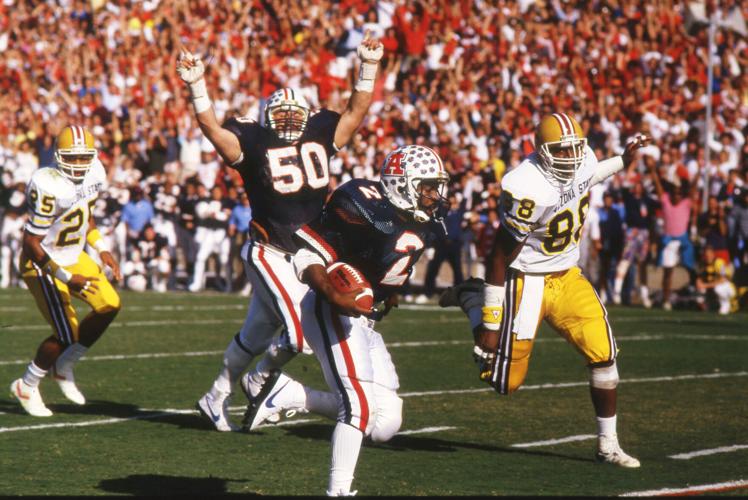
Remember? It was a week after Chuck Cecil's unforgettable 106-yard interception return at Arizona Stadium as the Wildcats stunned Rose Bowl-bound ASU, 34-17, surely one of the top two or three home games ever played in Tucson.
Now, four decades later, the Big 12 is running back the Pac-10's overseas experiment, three games from 1986-88, one of which was Arizona-Stanford.
Seeking a global brand and more TV presence, Big 12 commissioner Brett Yormark, a marketing-first administrator, seems determined to make a yearly conference game in Europe part of the league's football schedule. Inevitably, that would someday involve Arizona.
People are also reading…
Last year, Kansas State and Iowa State played a conference game in Dublin, Ireland. Next weekend, Arizona State is to play Kansas in a Big 12 game at London's famed Wembley Stadium.
The Sun Devils-Jayhawks game will be the centerpiece of Fox's Big Noon Kickoff programming. It gives the Big 12 exposure it usually can't wrestle away from the Big Ten and SEC.
The Pac-10's overseas football experiment, 1985-87, was a bust. Perhaps Yormark learned from those failures.
As you might guess, the Arizona-Stanford game of '86 has little in common with this week's ASU-Kansas game.
For example, Arizona was paid $190,000 by ESPN to play in Tokyo, a game that was broadcast at 9:15 p.m. in Tucson, which is still the latest kickoff in UA history.
ASU and Kansas will be paid $2.7 million this week, most of it by Fox, for a game that will kick off at 9 a.m., Tucson time.

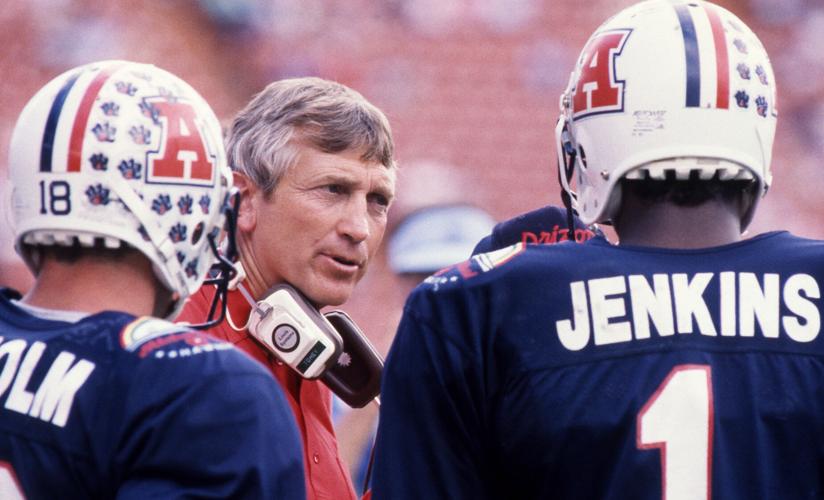
University of Arizona head football coach Larry Smith at the 1986 Aloha Bowl.
ASU was scheduled to leave Saturday's game at Texas A&M and fly directly to London, spending six days getting used to its unfamiliar surroundings.
In 1986, Arizona's 99-person traveling party flew to San Francisco on Wednesday of game week, where the Stanford football team and its staff boarded the same plane for a 15-hour flight to Tokyo.
The UA and Stanford had just two days to familiarize themselves with Tokyo, squeeze in two practice sessions, get used to the time change, and prepare for what was a very significant game. Arizona was 8-2 overall, ranked No. 12. Stanford was 7-3.
Arizona athletic director Cedric Dempsey and his chief assistant, Bob Bockrath, combined to make seven trips to Tokyo to make preparations for the game. ASU athletic director Graham Russini has not gone to London to help with plans for his team's week-long stay.
Arizona had to surrender a home game to play Stanford in Tokyo. It was the second of three Pac-10 games played in Tokyo, beginning with USC-Oregon in 1985 and ending in 1987 with WSU-Cal.
Dempsey once told me the UA's trip to Japan came at a loss of about $25,000.
What I most remember about that '86 game was that UA coach Larry Smith did not set a team curfew, allowing his team to enjoy their two full days in Tokyo before kickoff. Each player was given an NCAA stipend of $100 for their time in Tokyo.
Said Smith: "We're not bringing our guys around the world to lock them up in a hotel room.''
Whether it was related to the no-curfew or not, starting Arizona quarterback Alfred Jenkins was suspended for the Stanford game. He was replaced by seldom-used QB Andrew Crouch, who had never started a college football game. The UA played as if it was still celebrating its colossal win over ASU a week earlier.

UA running back David Adams scampers for a touchdown during the University of Arizona vs. Arizona State football in Tucson on Nov. 22, 1986.
Stanford won 29-24.
A few strange things took place. Neither team was allowed to practice in the stadium. They did so in a makeshift baseball facility. The field at Municipal Stadium was found to be incorrectly measured. UA officials walked the field and estimated that it was 89 yards long, not 100.
ASU's trip to London is much less of an unknown. The Sun Devils have done sleep-study research to help their athletes get acclimated to a foreign time zone.
Arizona and Stanford drew a crowd of 55,000 in a 90,000-seat stadium for the Coca-Cola Classic. ASU and Kansas hope to draw a capacity crowd of close to 85,000 for Saturday's Big Noon Kickoff on Fox.
When the UA returned to Tucson from Tokyo, Smith met with USC officials and was offered the Trojans head coaching job, which he ultimately accepted.
The UA's long-ago trip to Tokyo was a dud and then some.


 Santa Rita's losing streak avoids Tucson record | Greg Hansen