How times change: When Arizona's 2014 football team won the Pac-12 South Championship, the Wildcats' roster included just three transfers: receiver Cayleb Jones of Texas, receiver DaVonte’ Neal of Notre Dame and backup QB Connor Brewer of Texas. The other 82 scholarship players were Wildcats first, Wildcats only.
This year's UA roster includes 35 transfers. Yes, 35. They come from every conceivable corner of the college football map: Oregon, USC, Michigan,Texas, BYU and even ASU. At the other end, Arizona has activated transfers from not-so-high profile programs Murray State, Akron, Cal Poly and Marshall.
Welcome to college football, 2026. The most difficult thing for the average UA fan is probably being able to match names and numbers. That was rarely the case in the first 125 years of college football. Most players stayed four years, earned a degree and became Wildcats for Life.
People are also reading…
In years to come, what school will UA linebacker Max Harris use to identify himself? Harris has played at Incarnate Word, Louisiana-Monroe and Texas State.
More confusing, there are at least 31 sixth-year seniors in the Big 12 this year. I say '' at least'' because after examining all 16 rosters, it was difficult to decipher the rosters of Utah, Texas Tech, Kansas and Iowa State, none of which used the now-appropriate label of each player's year in college football, from "freshman'' to "sixth year.'' Those schools used "redshirt senior'' to identify their older players.
Arizona has three six-year players: offensive lineman Tristan Bounds, who began play at Michigan in 2021; defensive lineman Tre Smith, whose first college season, 2021, was at San Jose State; and tight end Cole Rusk, who has played at Illinois, Murray State and Eastern Michigan across the last five seasons.
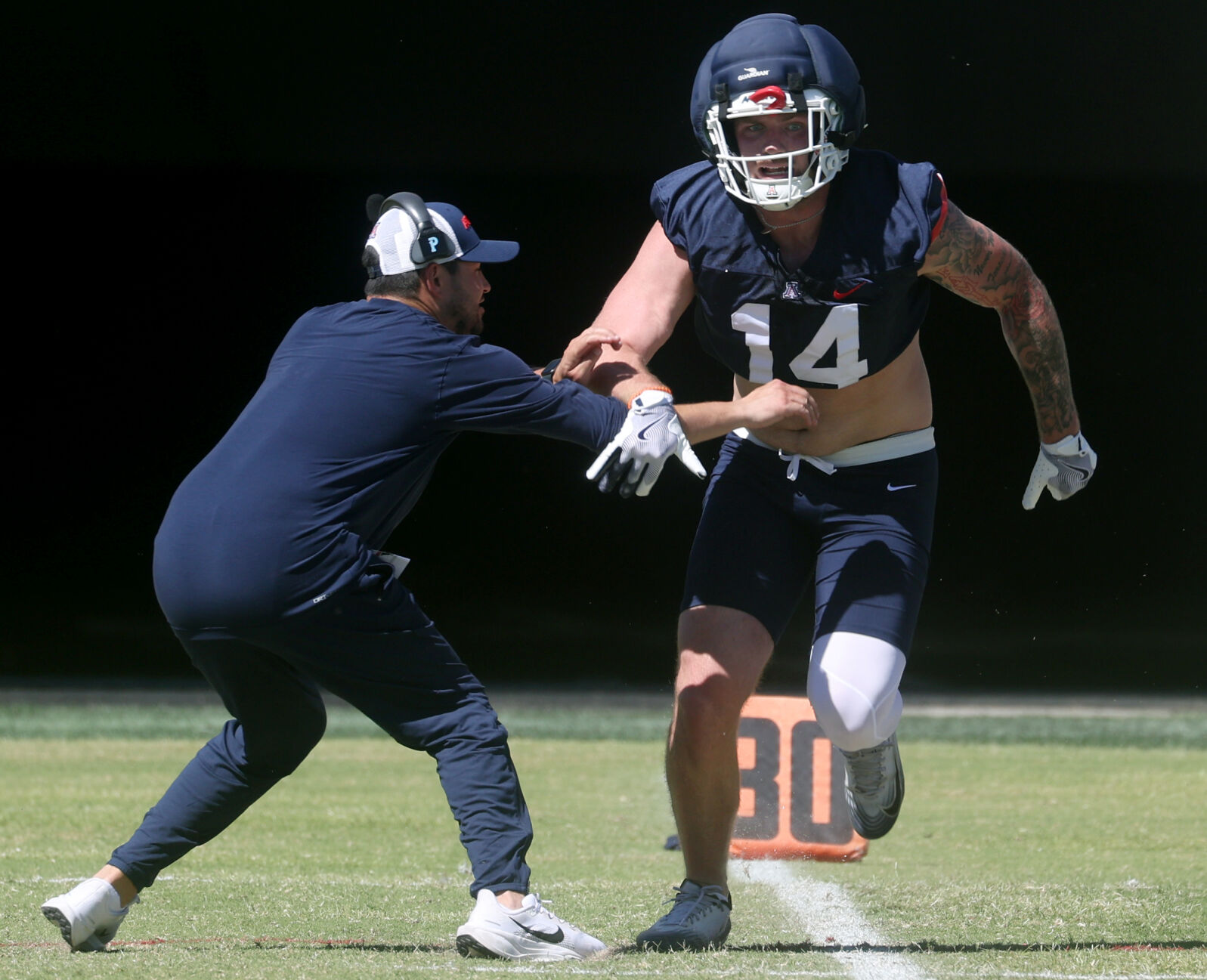
Tight end Cole Rusk, right, executes a drill during a spring football practice in Tucson on March 24, 2026.
There are exceptions.
Houston linebacker Brandon Mack II is in his eighth year of college football, a career that began in 2019 at Ole Miss. Baylor also has an eighth-year player, offensive lineman Cooper Lovelace, who started his college career in 2019 at Butler Junior College and has since played at USC, Northwestern and Colorado. Is that what we want to see in college football? Hello, NCAA?
Oklahoma State has three seventh-year players: running back Ayo Adeyi, who began in 2020 at Harding College; receiver Grant Jordan, who started his college football career in 2020 at Yale; and Jeremiah Piper, who played for Western Michigan in 2020 before transferring to Youngstown State.
And then there's BYU. The Cougars have eight returning Latter-day Saints missionaries who are all 25 or older. Those eight Cougars all served two-year missions before starting their college eligibility. This isn't new; it's been legal for more than 50 years. It is a clear advantage for the Cougars who deploy 25- and 24-year-olds almost as often as they start 19- and 20-year-olds.
This year's BYU roster includes running back Preston Rex, who played for California state champion San Clemente High School in the 2016 season. Yes, 2016. Rex went on a mission to Chile and then started his college eligibility clock in 2020. His teammate, offensive lineman Bruce Mitchell, helped Utah's South Summit High School win state championships in 2017 and 2018. He then went on a mission to the Seattle area for two years. He's an "old man'' in college football lingo.
More? BYU kicker Matthias Dunn graduated from high school in 2018, served a mission to Argentina, and then began his BYU career. He's been around so long that he has a pilot's license.
Maybe the NCAA could do better by declaring that no college football player can appear in more than 52 games. That's an average of 14 per year, which should be plenty. It's 12 regular-season games and four postseason games. Tell that to ASU sixth-year senior Zyrus Fiaseu, who has already started 45 games combined at San Diego State and ASU. If the Sun Devils have an epic season, Fiaseu could play in 60 games.
Isn't it all a bit too much?