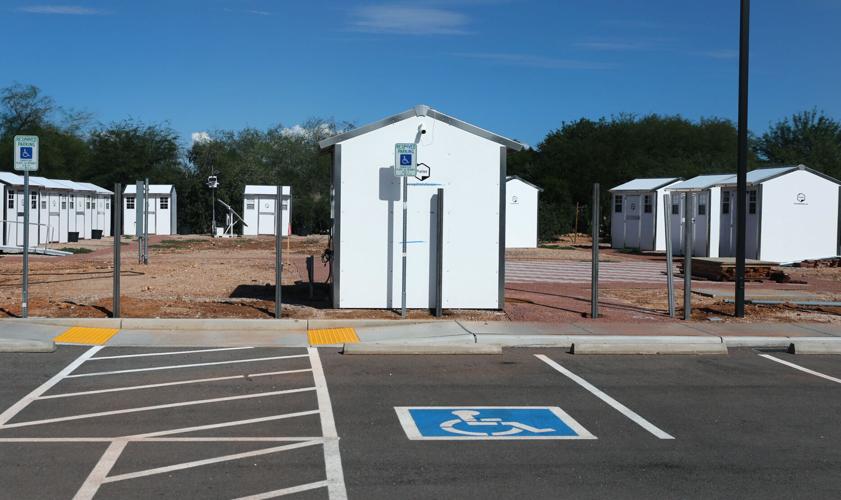
A microshelter community for unhoused people is still not open for residents after years of development and construction.
Now, the potential for its expansion before it's even open has been met with a combination of skepticism and enthusiasm in one midtown Tucson neighborhood as the city attempts to meet a growing need for temporary housing.
The background
Ten 64-square-foot micro-cabins currently sit empty on a dirt lot in the 2900 block of North Estrella Avenue, in the Keeling neighborhood near North Stone Avenue and East Fort Lowell Road. They are owned by The Homing Project, a nonprofit founded by former doctor Kristin Olson-Garewal.
In February, the city declared a housing emergency, which has loosened certain code restrictions to try to stimulate more shelter development. The Homing Project took advantage of the change and applied to add an additional ten cabins, which would allow up to 29 residents at a time.
People are also reading…
Of the four Keeling neighborhood residents interviewed by the Star, most opposition to the expansion comes from the fact that the site hasn’t yet opened its original ten shelters, despite being a work in progress for more than four years, according to previous news coverage. The houses can be assembled in an hour, and the permit for the original 10 shelters was issued in March 2025. The nonprofit originally aimed for an August opening, but has pushed it back again to mid-October.
William Lekas and Donna McDermott live two doors down and said they want to see the initial proposal succeed first before adding more capacity. They said they sometimes struggle to contact anyone at the nonprofit, and work has sometimes been at a standstill.
“Why think about putting 10 more homes in there? That's absurd. Finish what you need to do right now,” McDermott said.
One of the longest delays, Olson-Garewal said, came after the city told them each shelter needed fire suppression sprinkler systems. She argues they’re not necessary due to their size and the shelter’s plans to confiscate fire hazards like matches, lighters and cigarettes.

Some residents are pushing back on an expansion plan for a microshelter community for the unhoused that's yet to open.
The housing emergency declaration allows property owners to apply for special exemptions to certain zoning requirements. In the Homing Project’s case, they applied to exempt setback requirements, parking minimums, distance from another shelter, and the sprinkler systems, said Koren Manning, Director of the city’s Planning and Development Services.
Some residents have submitted public comments saying they’re anxious about looser fire safety, but Manning said other fire safety measures are in place.
“They will all have you know fire alarms and fire extinguishers, but just would not be sprinklered,” she said.
Lekas and McDermott also said they’ve heard different answers on who exactly will be living there. The site's target demographic has changed due to different grant funding requirements, Olson-Garewal said, but the site will now host female survivors of domestic violence in the most vulnerable age groups, from 18-24 and over 50.
Now, the shelter won’t open until it receives a certificate of occupancy for the expanded number of units, Manning said. However, the actual addition of the new units will not happen until the nonprofit raises enough money. The project, largely funded by individual donations according to Olson-Garwal, still needs another $100,000 to purchase the additional cabins.
Mixed Reactions
Debra Zeller lives across the street from Keeling Desert Park, which she says is a hotspot for the unhoused. She said her home has been burglarized and she has been approached by unhoused people with weapons. When she was still working, at times she felt so unsafe that she requested a different schedule to make sure she returned home before it was dark. Still, she is compassionate about the fact that many folks need help.
She’s in support of the expanded site, saying she would rather see a place for people to go than the park.
“These people are unsafe in a park . . . How in the hell are they going to get a job if they have no place to keep their stuff, and they don't feel safe at night, they can't even get a decent night's sleep?” she said.
Laurie Clark lives about 200 feet from the site, and says she’s most concerned for potential parking congestion on her street because of its proximity to the Poverello House, a daytime homeless shelter providing rest, food, and showers. She submitted a zoning appeal for the facility in 2023.
The house is zoned for an Adult Daycare facility, which usually offers daytime care to people with dementia or other serious illnesses. Clark’s appeal argued the city should not be allowed to waive a stipulation that adult daycares need oversight from the Department of Health Services, which was denied by the Board of Adjustment.
Manning said there isn’t an existing code that encompasses a daytime homeless shelter, and sometimes zoning decisions have to be made with the closest fit.
“We find the closest definition based on how the site operates, and we believe adult daycare is the closest because again, they're just providing services during the day,” she said.
As for parking, the Homing Project applied to reduce the required number of spots from 15 down to seven. Olson-Garewal said the spots are for staff, and that they won’t accept residents with cars.
Clark, a former architect, also said she is on board with the original ten shelters, but the expansion of The Homing Project reminds her of the experience with the Poverello House.
“I just think they are in a rush, and it's convenient to dump it in basically poorer neighborhoods…They're so desperate to try and solve this terrible problem that they're just kind of like going with any idea.
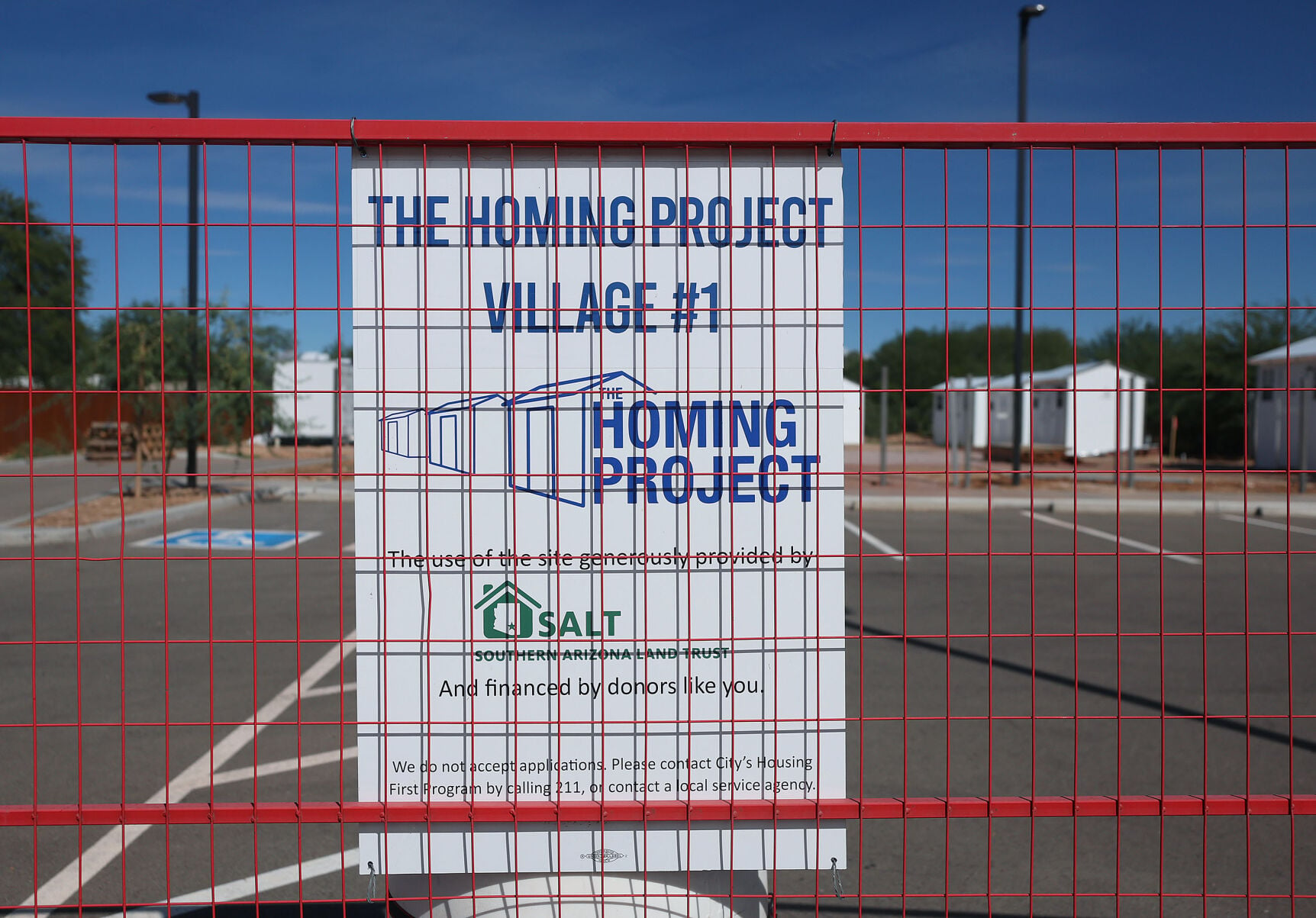
Some residents are pushing back on the proposed expansion of a microshelter community for the unhoused that has not yet openened in a midtown neighborhood.
What's next
The Homing Project is leasing the land rent-free from the Southern Arizona Land Trust, as part of a deal to help the eventual development of an apartment complex on the lot. The nonprofit’s lease expires in June of 2028.
“Our deal was also that we were going to put in permanent utilities improvements that we would leave behind, that would then make it possible for them to afford to build the apartment building,” Olson-Garewal said.
Olson said the project has faced many hurdles, but she still feels largely supported by the neighborhood.
“We understand that the neighbors have been very weary. I know when they see that nothing happens, they thought at one point they felt that we had abandoned the project. This is an experiment for them, and we are literally in everyone's backyard,” she said.
Manning said one goal of the one-year emergency declaration is to inform permanent code changes that can expand shelter care to more of the city.
“Right now our code is so restrictive for shelter care use that it's true. There's very few pockets across the city where shelter care can be allowed,” she said.
The city is currently receiving public comment on making shelter code changes permanent.
Other challenges
The Homing Project is the lone application for special exemptions, over seven months after the city passed its year-long housing emergency.
Low-barrier shelter is meant to be a temporary housing solution, which combines amenities and social services to eventually move people to more permanent housing or treatment for substance abuse or mental health conditions.
The city consistently cites a 2024 EcoNorthwest report that found the city needs about 4,700 units of specifically low-barrier-to-entry shelters to keep up with demand until 2045.
The city was hopeful the declaration would help to develop more sites like Star Village, a tent-living site on East Grant and North Stone, operated by the Primavera Foundation.
Manning said high costs are likely to blame for the slow uptake in special exemption requests, and zoning is just one piece of a complicated puzzle.
“It's a really tough time for funding for homeless services because so much of the funding is federal. It takes a lot to find sites that are suitable, get funding to build the units,” she said.
The Tucson City Council is expected to receive a progress update on the housing emergency at Tuesday’s council meeting.