

There's a world-class, thought-provoking, sensory-stimulating exhibit available to you through December, and the best part is that you don't have to travel across the globe to experience it.
It is an exhibit of the Dead Sea Scrolls, and it's just a short trip away in San Diego. The exhibit ends its six-month run at the Museum of Natural History in Balboa Park on Dec. 31.
Part breathtaking visual tour, part balanced geopolitical review, part mystery, and steeped in religious, scientific and historic nuance, it's an exhibit that appeals to all ages — a moving experience well worth the hour plane ride from Tucson.
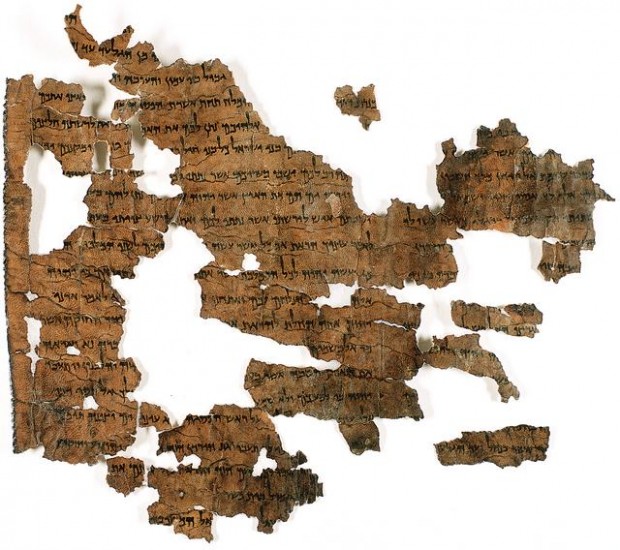
Featured are ancient biblical and non-biblical documents, including 12 of the 900 original Dead Sea Scrolls. Among them are the Ten Commandments and "4Q521, the Messianic Apocalypse," said Martin Abegg Jr., co-director of the Dead Sea Scrolls Institute in British Columbia, Canada.
People are also reading…
The scrolls "connect us to a period that laid the foundation of Western traditions, beliefs and practices," according to the exhibit's illustrated catalog.
Dr. Shalom Paul, chairman of the Dead Sea Scrolls Foundation, calls the exhibit a "must-see for all who are interested in the Hebrew Bible, early Judaism and early Christianity."
Caves harbored the manuscripts for centuries, until a Bedouin shepherd discovered their existence 60 years ago. For decades, world attention, academic, political and religious interests and complications kept them mired in controversy as scientists and scholars slowly gained access and began to piece fragments together and decipher their meaning.
This is not a traveling exhibit — it was specially arranged as a one-time event for San Diego. When the show ends, the artifacts will return to the appropriate museums and antiquities collectors.
"To produce the largest, most comprehensive Dead Sea Scrolls exhibit ever" took three years and a $6 million commitment, "a huge risk for a regional museum," says Michael W. Hager, the museum's president and CEO.
The setting
The first part of the exhibit is an eye-popping tour of Jerusalem and the Dead Sea area that sets the context for the scrolls. Sound seeps in — birds twittering, sheep gently lowing, trickling water. Dramatic lighting brings large aerial photographs of the Holy Land to life.
"Land gave birth to civilization . . . farmers and shepherds fed warriors, scribes, priests, kings and queens," say the side notes.
From 1947 to 1956, 11 caves near Khirbet Qumran in Jordan, formerly Greco-Roman Judaea, on the shores of the Dead Sea, yielded the treasure that came to be known as the Dead Sea Scrolls.
Sepia photographs show the goat-herders who uncovered the scrolls and the early scholars and scientists who began the work of sharing them with the world. A mocked-up desert camp features the old tent and archaeological tools of the early excavation team.
The science
Interactive displays on radiocarbon dating, papyrus and scribing bring children into the story line.
A video tells how skins become parchment.
"I learned lots of cool facts and there (sic) really old and I really liked it," 9-year-old Michael wrote in the museum's comment book.
Developments in science and technology have helped scientists posit where the Dead Sea Scrolls came from and who the scribes were, while conservators work to protect the scrolls.
On display for the first time outside Jordan is an engraved copper scroll, the only metal one in the entire find of 900, and the most mysterious of all. It describes hidden treasures and their locations, and part of it is missing.
At least two "Da Vinci Code"-type movies based on the copper scroll are in the works, according to Hager, the museum president.
The scrolls
A dimly lit "cave" leads to the scrolls and Qumran displays. Beside and above each softly lit original scroll fragment are enlargements, translations and comments.
Psalms, biblical text, judicial principles, community conduct codes and legal documents illuminate life in ancient times.
Twelve 2,000-year-old scrolls from Israel and three from Jordan join 1,000-year-old biblical manuscripts from the Russian National Library, 800-year-old Bibles from the British Library and 400-year-old Ethiopic manuscripts.
Huge panels of illustrated manuscripts, old and modern, invite visitors to explore how writing and ideas have shaped human history.
"People of all faiths — and no faith — look at the scrolls and appreciate how they have influenced morality and social values through the ages," says Hager.
Spielberg connection
Not to be missed is a video that features the digitized re-creation of the village closest to where the scrolls were found, Qumran. Here lived a small group of religious people who, some scholars say, may have been the scribes and protectors of the scrolls.
Hollywood director Steven Spielberg's Righteous Persons Foundation funded UCLA graduate student Robert Cargill's thesis work, enabling him to complete the video in time for the San Diego exhibit's opening.
The video portrays how a devout sect lived in the village, as well as the sect's elaborate water-gathering system and cleansing rituals.
Some 400,000 visitors are expected to view the scrolls in San Diego.
Hager says his goal is to "enable the public to see in these priceless documents, treasured over so many centuries, the ways that we — regardless of our culture or religious background — share a common heritage . . . and to better relate to people all over the world, as members of the human family."
If you go
The Dead Sea Scrolls – 1-619-232-3821. www.sdnhm.org, click on "Dead Sea Scrolls" for exhibit and ticket information.
The exhibit is open daily except for Thanksgiving and Christmas. Tickets for the general public run $28 (peak hours) to $24 (off-peak), with discounts for children, other youths, military and seniors.
Hours vary depending on the day of the week. On Mondays, the museum hosts scholars speaking on topics ranging from archaeology to philosophy.
Where to stay
Accessing Balboa Park, where the scrolls are on display, will be easy if you stay in one of the nearby bed-and-breakfast inns. Several are within walking distance or an under-$10 cab ride to the park, and just a short ride from the airport.
Many are Craftsman- or Victorian-style, and some are on the National Register of Historic Places. The inns listed here are in well-lit neighborhoods that feature free street parking with a variety of restaurant possibilities:
Balboa Park Inn, 1-800-938-8181 www.balboaparkinn.com 26 rooms, starting at $99.
Bankers Hill Manor, 1-877-871-7602 www.bankershillmanor.com 3 rooms, starting at $185.
A Victorian Heritage Park Bed & Breakfast, 1-800-995-2470 www.heritageparkinn.com 12 rooms, starting at $155.
Little Italy Inn, 1-800-518-9930 www.thelittleitalyhotel.com 23 rooms, starting at $79.


