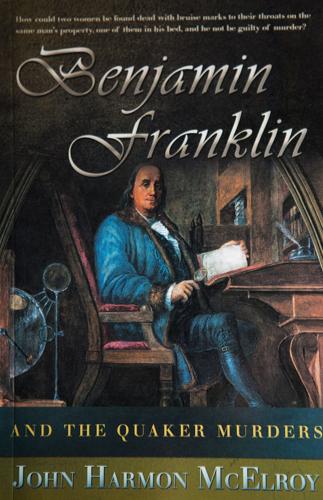
After years of yearning, retired University of Arizona professor John McElroy finally wrote a detective novel. “Benjamin Franklin and the Quaker Murders” is a mix of fiction and history from Penmore Press, drawing from McElroy’s vast knowledge of Franklin and the birth of our nation.
“You scratch any professor, and you’ll probably find a wouldbe novelist somewhere in there,” he said. “What I was shooting for is to make it entertaining but to make it informative as well.”
An avid fan of detective stories, he created and taught the course “Literature of the Early Republic” for 26 years at the UA, using Franklin’s autobiography as one of the course’s main resources. So it only makes sense that the protagonist of his historical-fiction murder-mystery would be a very realistic Benjamin Franklin.
To say McElroy admires Franklin is an understatement. He’s a hardcore fan. And he’s full of Franklin trivia: He was the only man who signed all four documents essential to America’s independence, he only slept four hours a night and he created windsurfing.
People are also reading…
“There’s nothing about Franklin’s career and history that I’ve ever run across that isn’t admirable,” McElroy said. As he talks about Franklin, his eyes widen, like he’s telling you the best part of his favorite story or letting you in on an age-old secret.
Set in 18th-century Philadelphia, the story begins with the discovery of a woman’s corpse wrapped in canvas shroud. Her hands and feet tied, she’s hidden behind a stone yard near the house of Quaker stonecutter Jacob Maul.
There’s overwhelming evidence pointing to Maul’s guilt, but lucky for the devout Quaker, he has history with Franklin, who makes it his quest to prove Maul’s innocence. But at 79 years old, after a 9-year-stint in France as America’s first French ambassador, Franklin doesn’t want to become known as your neighborhood detective. So he hires Revolutionary War veteran Captain James Jamison to be his legman.
McElroy got the idea for the plot a few years back when his wife, Onyria Herrera McElroy, was observing court trials, considering becoming a court translator. One day, she came back from the courthouse with a story about a man accused of strangling his wife, found dead next to him in bed. His defense lawyer made the case that it was a natural death. And that got McElroy’s creative wheels turning.
“Franklin could have been a detective, because he did so many other damn things,” McElroy said. “He could do anything.”
Maul and most of the book’s secondary figures are fictional, and there are allusions to historical figures of the time. But Franklin and the time period are accurate, right down to street names and Franklin’s gout and kidney stones.
One review on Amazon said, “Meticulously researched,” and that may be an understatement. Of the 27 reviews, all but three were five stars; the rest were four. Readers wrote the book “a rousing, well-written story” and “the kind of book that pulls you forward.”
“I’ve been very pleased that I managed to create the semblance of reality,” McElroy said. “Everything about Franklin’s interests, his genius, his accomplishments is absolutely true.”
McElroy grew up in a glass-manufacturing town on the banks of the Allegheny River in Pennsylvania—which became fodder for his novel. His family moved to New Jersey when his father got a teaching job at Princeton High School. They moved into a small apartment above a shop where McElroy got a part-time job.
It surprised him when his classmates told him he should run for class president, but he won. It also surprised him when they told him he should apply to Princeton University but he did, and not only got in but received a scholarship.
He met his wife in Cuba one summer while in Navy ROTC at Princeton. They moved to Tucson in 1970, and he took a job as an assistant professor at the UA. Three years in, he launched “Literature of the Early Republic.” When he retired in 1999, the UA retired the class as well.
McElroy and his wife have been married 60 years and have four children, eight grandchildren and two great-grandchildren.
And McElroy may or may not be a wind surfer, but he’s not unlike Benjamin Franklin in the ability to accomplish more than what seems possible for one person in a lifetime.
He has great admiration for the Quakers (as you may notice in his novel), as they were some of the first people in America to be against slavery. And McElroy’s great-great grandfather, an immigrant from Ireland, was an outspoken abolitionist in the years before the Civil War.
McElroy sent his children to one of the only desegregated schools in North Carolina in the early ‘60s. Onyria taught at a black college during segregation, and McElroy marched in the civil rights movement. And as a young professor, he volunteered, teaching in prisons.
In 1981 he accompanied a friend to Poland, then still a part of the Soviet Union, to teach English to the Poles, who were not allowed to go abroad. His eldest daughter Lauren McElroy remembers her father being blown away by the Solidarity movement he saw there.
“Eighty-five percent of workers in the entire country belonged to this union because they wanted freedom,” she said. “They were fed up with being under the yolk of the Soviet Union and the Communist Party.”
When McElroy returned to Tucson, he organized the Tucson Solidarity Movement in support of the people of Poland. Interviews with him from that time can be found in the archives of many local newspapers.
He was fascinated and impassioned by the Polish people’s fight for freedom. It reminds his daughter Lauren of Franklin’s ideals and ideas of freedom.
Besides Poland, McElroy taught in Colombia, Spain and Brazil, and has given talks in numerous countries. Travel is another trait he shares with Franklin, who crossed the Atlantic Ocean four times, which was no small feat in the 1700s.
While this is McElroy’s first novel, he’s written seven nonfiction books. He’s also edited and compiled a number of works.
When he was a graduate student, he edited eight different editions of the biography of Christopher Columbus into a single precise version. He enlisted his children to help him with this venture. Lauren remembers getting paid a nickle a page to read from one version while he followed along in another.
Both McElroy and his wife hold doctorate degrees, and Onyria has been just as influential in the world of academia. She wrote, with collaborator Lola L. Grabb, a highly used and widely respected bilingual Spanish-English medical dictionary in the U.S., said McElroy.
These are only a few of the important accomplishments in McElroy’s life, and although he’s 83, there’s sure to be more.
“Benjamin Franklin and the Quaker Murders” is the first novel in a trilogy. The second book is in the works and will be hitting Amazon before long.
You can be sure of two things in detective stories—the mystery will be solved and good will triumph over evil, McElroy said.
“Detective stories are stories about justice being done,” he said. “And this has a marvelous ending where justice is done.”
Find out more about McElroy at www.benfranklindetective.com.

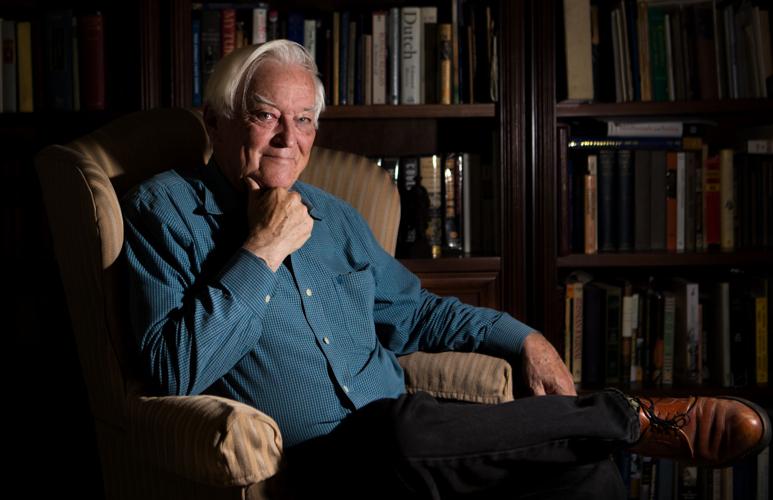
Author John Harmon McElroy sits for a photograph at his midtown home on Aug. 23, 2017, in Tucson, Ariz. McElroy, a professor emeritus of the University of Arizona, published his detective novel “Benjamin Franklin and the Quaker Murders” in June.
Danyelle Khmara is a freelance writer covering culture and social justice. Follow her on Twitter: @DanyelleKhmara