WASHINGTON — President Donald Trump's administration resumed processing immigrant visa applications from Hungary and Poland last week while maintaining a temporary pause on immigrant visa appointments elsewhere, four people familiar with the matter said.
The directive to prioritize immigrant visas at the U.S. missions in Poland and Hungary came from the White House, two of the sources said. While it was not immediately clear why the U.S. singled out the two countries for special attention, Trump and his senior aides cultivated far-right allies in both countries.

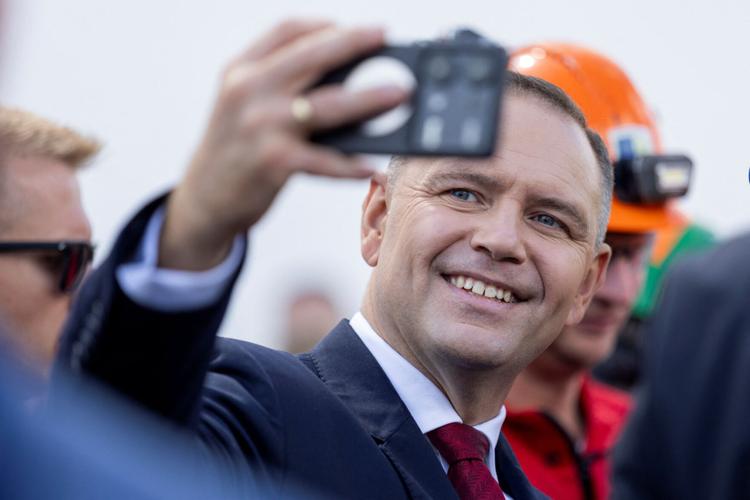
Polish President Karol Nawrocki poses for a selfie with members of the audience Aug. 12 after the christening and naming ceremony of a Polish Navy frigate at PGZ Stocznia Wojenna in Gdynia, Poland.
He publicly endorsed former Hungarian Prime Minister Viktor Orban, who was defeated at the polls in April, and Poland's nationalist President Karol Nawrocki, whose election put him at odds with the centrist government of Prime Minister Donald Tusk.
In May, Reuters reported that U.S. Deputy Secretary of State Christopher Landau instructed senior State Department officials to facilitate a U.S. visa for a fugitive former Polish Cabinet minister who took refuge from corruption charges in Hungary.
People are also reading…
The White House referred a request for comment to the State Department. A State Department spokesperson did not comment on why it resumed immigrant visa processing for Hungary and Poland.
The Hungarian Foreign Ministry and Prime Minister's Office, as well as the Polish Foreign Ministry, and prime minister’s and president’s offices did not immediately respond to requests for comment.

People buy food Dec. 3, 2022, at a market in Budapest, Hungary.
Trump targets both illegal and legal migration
Trump long campaigned on stopping illegal immigration, but his second term has been defined in equal measure by his expansive efforts to curb legal migration. The U.S. imposed travel bans on dozens of countries, introduced expensive new fees for certain work visas and mandated that all applicants undergo a vetting of their social media history.
In January, the State Department said it temporarily suspended the processing of immigrant visas — which allow people to move permanently to the U.S. — in 75 countries where applicants were "at a high risk for becoming a public charge."

After a federal judge ruled against the visa ban, the State Department paused immigrant visa interviews at all of its global missions while rolling out a new training program.
The State Department spokesperson, speaking on the condition of anonymity, said appointments were being adjusted to accommodate the new training. "Whenever there are updated instructions for visa applicants or changes to visa interview appointments, embassies and consulates communicate this information directly to visa applicants," the person wrote.
Global effects
U.S. consulates and embassies traditionally conduct hundreds of thousands of immigrant visa interviews every year, most of them with relatives of U.S. citizens or permanent residents. In 2024, the last year of Joe Biden's Democratic presidency, the U.S. issued about 600,000 immigrant visas.
The State Department’s January edict was its most far-reaching attempt to rein in legal migration. The visa suspension affected applicants from Latin American countries including Brazil, Colombia and Uruguay; Balkan nations such as Bosnia and Albania; and South Asian countries Pakistan and Bangladesh.
On Aug. 21, U.S. District Judge Jeannette A. Vargas struck down the policy as "patently unlawful."
In the days that followed, the State Department called missions around the world and told them to cancel immigrant visa appointments, according to two people with knowledge of the situation.

The State Department acknowledged the global pause in an Aug. 25 public statement, saying it would remain in place until staffers received new training in how to assess whether visa applicants could support themselves in the United States without relying on public benefits.
The U.S. government said in a court filing that interviews were temporarily rescheduled through Aug. 31.
However, the suspension could remain in place for months due to the structure of the new training program. Missions need to self-train based on materials sent from Washington; a consular officer then needs to visit each post to certify that the training was completed, a person familiar with the matter said.
On a Reddit thread, people from around the world, including Peru, the United Kingdom and India, posted about canceled visa appointments through September.
"We were at the finish line,” one person wrote, “and now this."