

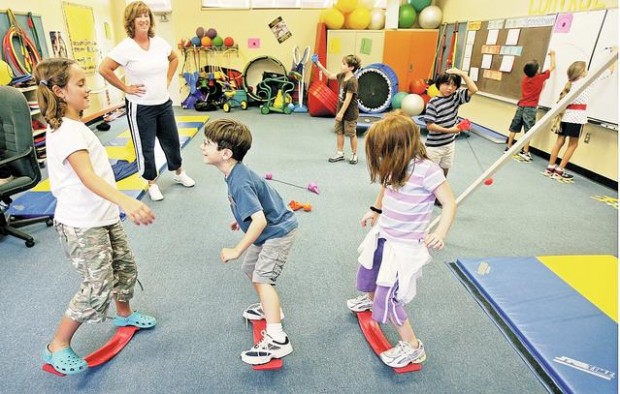
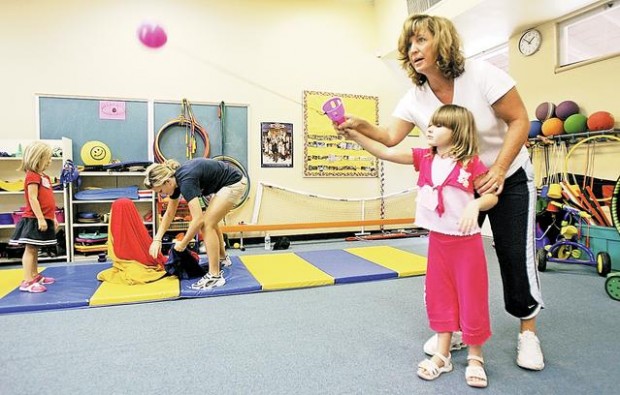
A Tanque Verde Unified School District physical-education teacher is using the money she won from an award to help students enhance their motor skills.
Cindy Hodgeson won an Ing Unsung Heroes award for $2,000, which will help her buy more equipment for the motor-lab programs she started at Tanque Verde and Agua Caliente elementary schools.
Ing is a national financial planning services company based in Atlanta.
Hodgeson created the labs to help students improve their classroom performance through sensory motor development.
Hodgeson oversees the motor-lab classes at the two elementary schools and she also teaches adaptive physical education classes to children with disabilities. Every child through fourth grade in the two schools attends the motor-lab class at least once a week, Hodgeson said.
People are also reading…
In addition to the motor labs, the money will pay for equipment that will be used in a Bal-A-Vis-X program that uses a combination of balancing and auditory and vision exercises to help students improve reading and writing skills.
Ing gave the award to 100 teachers nationwide who wanted to bring their innovative ideas into the classroom. Hodgeson will now compete for one of three top awards, which range from $5,000 to $25,000.
The school district implemented the motor lab two years ago at Tanque Verde Elementary School before expanding the program to Agua Caliente last year, she said.
The idea for the lab came more than three years ago when Hodgeson attended a workshop that emphasized the development of motor skills and its effects on learning, she said.
"I learned how reflex integration and sensory motor development impacts learning. I came back and presented it to both principals," she said.
Hodgeson learned that children who have fully developed their motor skills and reflexes learn better, she said.
Hodgeson received a $3,000 grant from the Tanque Verde Education Enrichment Fund to start the motor lab at Tanque Verde Elementary School and another $3,000 grant from the foundation to start the program at Agua Caliente, she said.
About 300 students from both elementary schools use the labs and rotate through different stations within the lab, she said.
The labs are equipped with a variety of equipment including small trampolines, balance beams, wooden spinners and a crawl tunnel.
Students also draw patterns on a white board, which helps work both sides of their brains. "All those are tools that will help them succeed in the classroom," she said.
The Bal-A-Vis-X program uses beanbags, exercise balls and other equipment to help students develop reflexes and improve their posture and attention span, she said.
"At the beginning of the year, we screen kids to check reflexes and we also do an eye-tracking test to see if they have good ocular muscle control," she said.
Most of the Bal-A-Vis-X activities are rooted in rhythm exercises that require coordination and focused attention through the use of beanbags and racquetballs while students stand on a balance beam, she said.
"They do it individually, then in pairs and then in as a whole group," she said. "It's all rhythmic."
Hodgeson has received tremendous support from the school district and parents, some of whom have volunteered in the lab.
"Watching these kids develop from the beginning to the end of the year, it's an amazing way to develop yourself with our technology," said parent Gloria Coldiron.
Coldiron has three children who have participated in the motor lab, including one who takes part in the Bal-A-Vis-X program.
She also volunteers in the lab at Agua Caliente.
Two of her sons attend Tanque Verde Elementary School, while her 4-year-old daughter attends Agua Caliente.
"To me, it's just as important as sitting down and reading with your children," she said.
Helena Bish said she understands the importance of physical and occupational therapy because her youngest daughter was born 10 weeks premature.
Bish's youngest daughter, who is now 5, is participating in the motor lab for the first time this year, Bish said.
Her oldest daughter, who is 7, has been involved in the lab for about two years, she said.
"There's fun, engaging activities while they're training their bodies to do something differently," she said.



 Former Sam Levitz building sells for $8.6 million
